


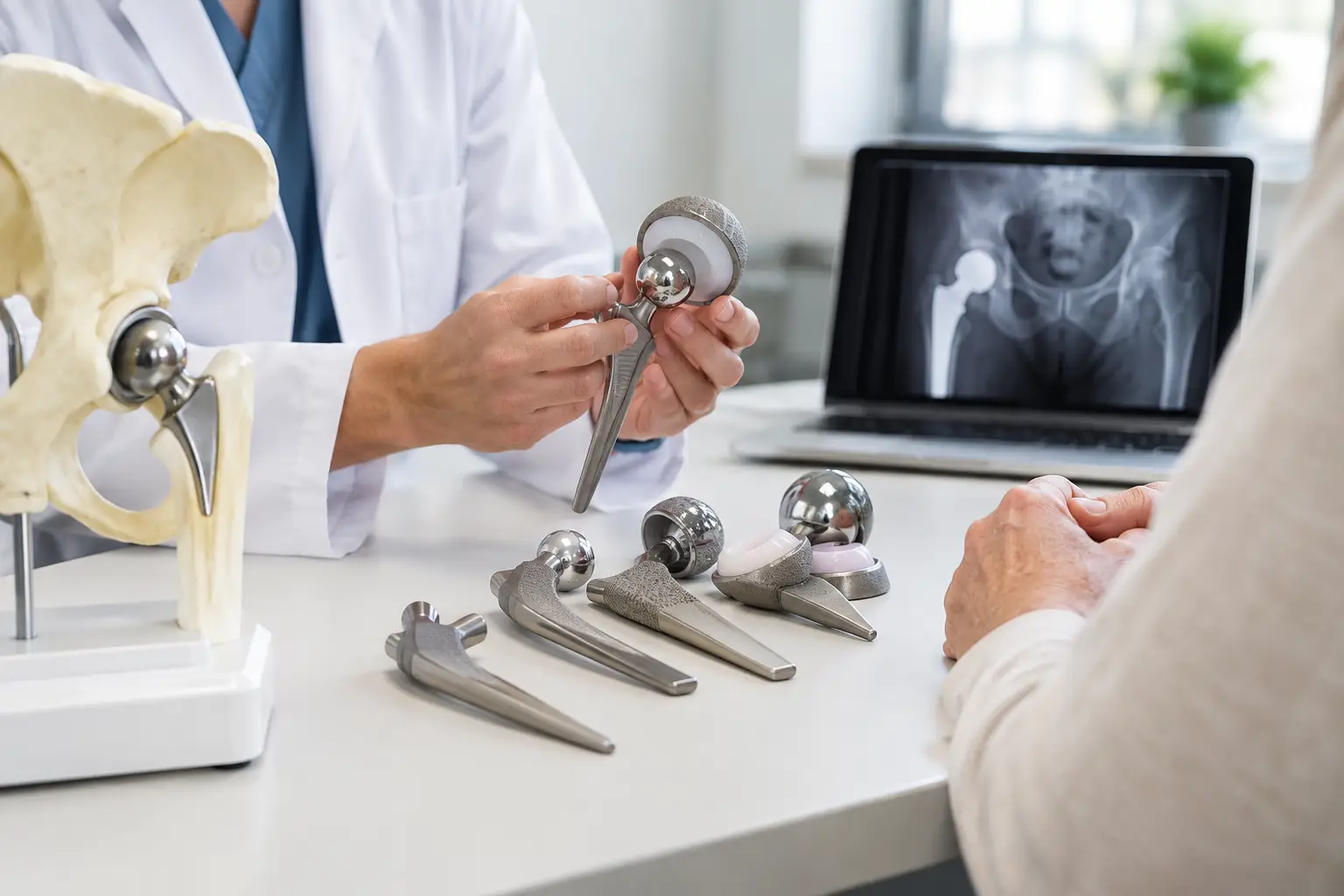
For someone living with persistent hip pain, the phrase hip implants can sound technical and remote. Yet the choices behind a hip replacement have a direct bearing on the things that matter day to day: getting out of a chair comfortably, walking without planning every step, sleeping more easily and returning to work, exercise or family life.
A total hip replacement is not a single, standard operation. It is a carefully planned reconstruction in which the surgeon replaces the worn or damaged ball-and-socket joint with components selected for your anatomy, bone quality, diagnosis and activity goals. The best implant is not simply the newest design or the one a friend has had. It is the one that can be positioned accurately and is most appropriate for you.
What hip implants replace
The hip is a ball-and-socket joint. The rounded top of the thigh bone, known as the femoral head, moves within the socket of the pelvis, called the acetabulum. Arthritis, injury or certain childhood hip conditions can damage the smooth cartilage that allows these surfaces to move freely. When non-operative treatment is no longer controlling pain or preserving function, replacement may be considered.
In a total hip replacement, the damaged femoral head is removed and replaced with a stem that sits within the thigh bone and a new ball. The damaged socket is resurfaced with a metal shell and a smooth liner. Together, these components are designed to recreate stable, low-friction movement.
There are several broad types of hip replacement, including total hip replacement, partial hip replacement and revision hip replacement. A partial replacement is most commonly used after particular hip fractures and replaces the ball but not the socket. Revision surgery involves replacing or reconstructing part or all of a previous hip replacement when it has worn, loosened, become unstable or developed another problem. It requires particularly detailed planning because bone stock and existing components must be assessed carefully.
How the right hip implant is selected
Choosing an implant begins well before the operation. A specialist consultation should establish what is causing your symptoms, how much they affect your life and whether joint replacement is the right next step. X-rays are central to planning, while CT scanning may be helpful where anatomy is unusual, prior surgery has been performed or a complex reconstruction is anticipated.
Your surgeon will consider the shape and size of your pelvis and thigh bone, the quality of your bone, leg length, hip stability and the pattern of joint damage. Your age and activity level are relevant, but they are not the whole story. A fit person in their seventies may have different needs from a younger person with poor bone quality or previous hip surgery.
The aim is to restore the hip centre, leg length and soft-tissue tension as accurately as possible. These details help support a natural-feeling stride, reduce the risk of instability and give the new joint the best conditions for long-term function. Implant selection and surgical technique cannot be separated: even an excellent implant depends on careful positioning.
Fixation: cemented or uncemented
Hip components can be fixed to bone with bone cement or designed to allow bone to grow onto a specially prepared surface. Neither approach is universally better.
Uncemented components are widely used, particularly where bone quality is good enough to support initial stability and later bone ingrowth. Cemented fixation can be an excellent and reliable choice where bone is softer or the anatomy makes it more suitable. In some cases, a surgeon may use a cemented component on one side of the joint and an uncemented component on the other.
The right approach depends on the individual hip rather than a one-size-fits-all rule. A clear discussion should explain the planned fixation method and why it suits your circumstances.
Bearing surfaces and materials
The bearing is the pair of surfaces that move against one another: the replacement ball and socket liner. Modern hip replacements commonly use a highly durable plastic liner, often paired with a metal or ceramic ball. Ceramic-on-polyethylene and metal-on-polyethylene bearings are both established options.
Ceramic components are very hard and have favourable wear properties, but they are not automatically the best choice for every patient. Metal components have a long clinical track record and may be appropriate in many reconstructions. The liner is usually made from highly cross-linked polyethylene, an advanced form of medical-grade plastic designed to reduce wear.
Rather than focusing on one material in isolation, it is more useful to ask how the complete construct has performed, why it is recommended for your bone and anatomy, and what follow-up is advised. Established implants with strong clinical evidence are generally preferred over unproven novelty.
Why size and positioning matter
The size of the femoral head and the orientation of the socket can affect movement and stability. A larger head may offer greater resistance to dislocation in some situations, but it is only one part of the decision. The implant must fit the patient’s anatomy, and the surgeon must balance stability with safe range of movement, leg length and soft-tissue tension.
Modern pre-operative planning allows measurements to be made in advance rather than estimated during surgery alone. This can be especially valuable for patients with leg-length differences, deformity, previous fracture fixation, dysplasia or an existing hip replacement that needs revision.
Some patients may benefit from custom hip replacement components or patient-specific planning. This is not necessary for routine cases, but it can be valuable when standard implants cannot adequately address unusual anatomy or significant bone loss. In complex surgery, the ability to anticipate technical challenges is as important as the components themselves.
Questions worth asking about hip implants
A consultation is an opportunity to understand your options, not simply to agree a date for surgery. It is reasonable to ask what is causing the hip pain, whether non-surgical treatment remains worthwhile and what improvement can realistically be expected after replacement.
You may also wish to ask which implant system and bearing surface are proposed, whether cement will be used, and what factors have informed those decisions. For a revision procedure, ask what has gone wrong with the existing replacement and whether bone graft, specialist components or staged treatment may be needed.
Just as importantly, ask about recovery. Most people begin mobilising soon after surgery with support from physiotherapy, but the pace of recovery varies. Early progress can be encouraging, yet muscles and soft tissues need time to heal. Returning to driving, work, sport and higher-impact activities should be guided by your surgeon and physiotherapy team rather than a fixed timetable.
What to expect from a modern hip replacement
For appropriately selected patients, total hip replacement is one of the most successful operations in orthopaedic surgery. It can provide substantial pain relief and restore meaningful mobility. However, it remains major surgery, with risks that deserve an honest discussion. These include infection, blood clots, dislocation, fracture, leg-length difference, nerve or blood vessel injury, persistent pain and the possibility that further surgery may eventually be required.
Risk is reduced through careful assessment, precise planning, appropriate preventative medication, early mobilisation and attentive follow-up, but it cannot be eliminated completely. Your general health, weight, smoking status, diabetes control and previous operations can all affect preparation and recovery. Optimising these factors beforehand is part of achieving the safest possible outcome.
A good result is not measured only on an X-ray. It is measured by whether you can move with greater confidence and return to activities that give your life shape. The most helpful next step is a specialist assessment that considers the whole person behind the hip, so any decision about replacement is informed, individual and made with realistic confidence.