


A hip replacement is designed to do far more than replace an arthritic joint. It should give you a stable, comfortable hip that supports walking, sleeping, work, exercise and the ordinary movements that pain may have gradually taken away. When comparing cemented versus uncemented hip implants, the key question is not which option is universally best. It is which method of fixation is most suitable for your bone, anatomy, health and long-term goals.
Both approaches are well-established and can provide excellent, durable outcomes. The choice is made as part of careful surgical planning, rather than being a simple matter of patient age or personal preference.
Cemented versus uncemented hip implants: the key difference
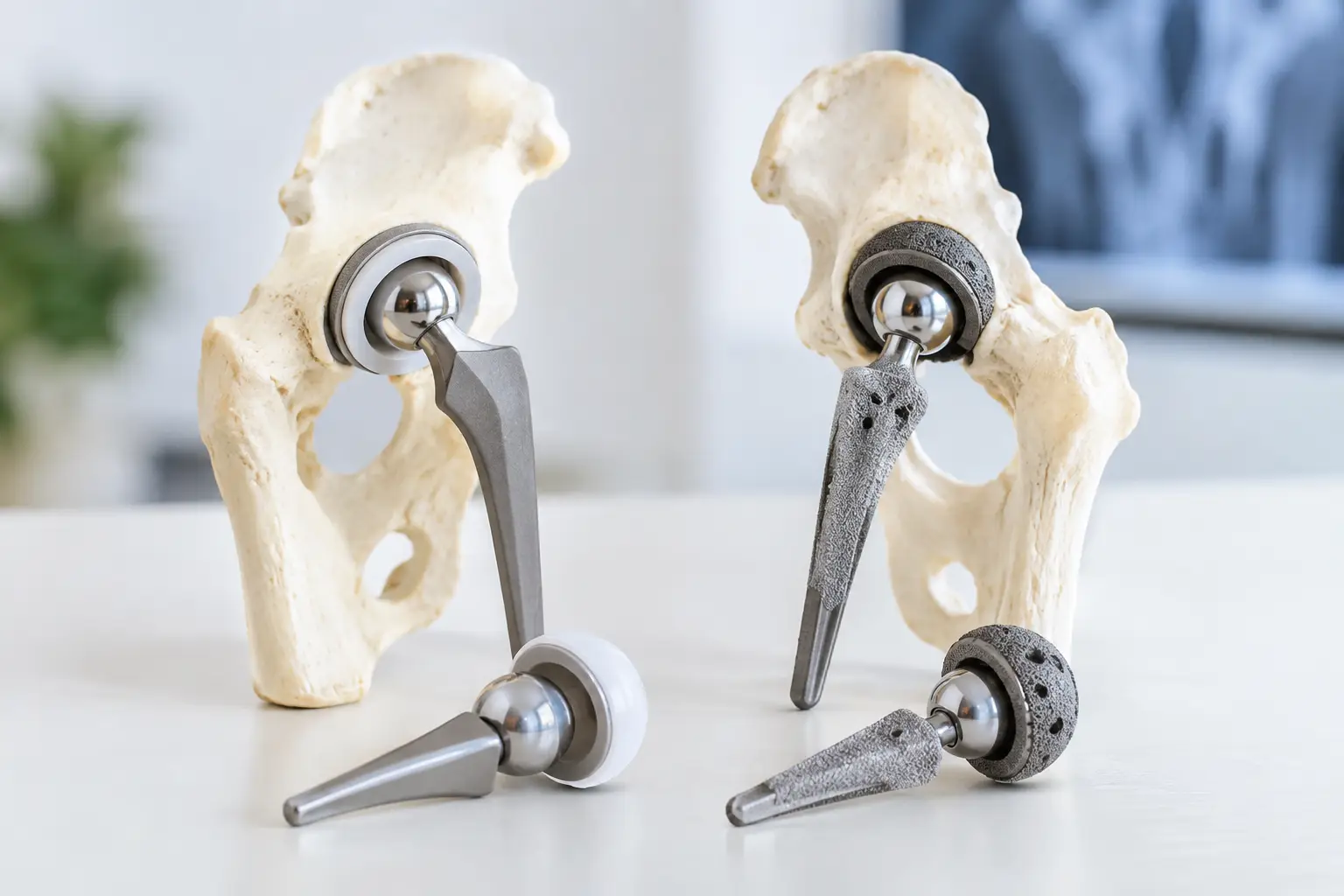
A total hip replacement has two main components: a cup that replaces the socket of the pelvis and a stem that sits within the top of the thigh bone. The bearing surfaces then move against each other to create the new joint. Cemented and uncemented describe how one or more of these components are fixed to the bone.
A cemented implant is secured using a specialised bone cement, usually called polymethylmethacrylate. This is not the same as household cement. It is a medical material that is prepared during surgery and sets within minutes, creating an immediate bond between the implant and bone.
An uncemented implant, also known as a press-fit implant, is designed to achieve a close mechanical fit in the prepared bone. Its surface is often textured or coated to encourage bone to grow on to it over time. This biological fixation develops gradually as the bone heals around the implant.
It is also possible to use a hybrid approach. For example, a surgeon may use a cemented stem with an uncemented cup, or vice versa. This can be a sensible option where the socket and thigh bone have different bone-quality or anatomical considerations.
When might a cemented hip implant be preferred?
Cemented fixation can be particularly reliable where the bone in the upper thigh is softer, thinner or less able to achieve a secure press-fit around an uncemented stem. This may be relevant for some older patients, people with osteoporosis, or those whose bone shape makes uncemented fixation less predictable.
Its principal advantage is immediate fixation. Once the cement has set, the stem is securely held in position, without relying on bone growth for initial stability. This can offer a very dependable solution in the right patient.
Cemented stems have a long and successful clinical history. Modern cementing techniques and implant designs have refined the approach considerably, and many patients enjoy excellent pain relief and function for many years.
There are, however, specific considerations. Preparing and inserting bone cement requires precise technique, and there can be temporary effects on blood pressure and oxygen levels during this stage of surgery. These risks are carefully assessed and managed by the surgical and anaesthetic team. In patients with particular heart or lung conditions, the overall medical picture is especially important when planning the operation.
When might an uncemented hip implant be preferred?
Uncemented implants are commonly used in patients with good bone quality and a femur that can provide a secure initial press-fit. The implant is held firmly at surgery, then the body strengthens that fixation through bone growth over the following weeks and months.
This option may be attractive for active adults and younger patients who are likely to place greater demands on their hip over a longer period. That said, age alone is not a reliable guide. A fit person in their seventies may have excellent bone for uncemented fixation, while someone younger may benefit from cement because of bone quality or anatomy.
Uncemented components avoid the use of bone cement and can preserve options if further surgery is needed in the future. They also come in a wide range of shapes, sizes and surface coatings, allowing the implant to be matched carefully to the individual anatomy.
The trade-off is that uncemented stems can carry a slightly higher risk of a crack or fracture in the thigh bone during insertion, particularly where bone is fragile. There may also be temporary thigh pain while the bone adapts, although this is not inevitable and often settles. Good pre-operative imaging, implant selection and surgical technique all help reduce these risks.
Does one type last longer than the other?
Patients understandably want to know which implant will last the longest. The honest answer is that implant longevity depends on much more than whether cement is used. Component positioning, bone quality, implant design, bearing material, activity levels, body weight and the accuracy of the operation all play a part.
Both cemented and uncemented hip replacements have strong evidence supporting their long-term performance when used for appropriate patients. National joint replacement data and clinical studies show that modern implants can provide very durable results, but no implant is guaranteed to last for life.
The cup and stem do not always need to use the same fixation method. A surgeon may choose the combination that gives the best stability in each part of the hip. This is why a discussion focused only on ‘cemented or uncemented’ can miss the more important issue: how the whole reconstruction will work together for you.
Will recovery be different?
Most patients follow a similar recovery pathway regardless of fixation method. Early mobilisation is usually encouraged, often on the day of surgery or the following morning, with guidance from physiotherapy. You will normally use walking aids initially and build confidence, strength and balance over the following weeks.
An uncemented implant needs time for bone integration, but that does not necessarily mean a slower recovery. Your weight-bearing instructions will be based on the stability achieved during surgery, the condition of your bone and any additional procedures required. Many patients can bear weight as tolerated with either type of fixation.
Recovery is influenced more strongly by your fitness before surgery, muscle strength, pain control, surgical approach, rehabilitation and the complexity of the operation. It is also normal for recovery not to be perfectly linear. Some days feel notably better than others, particularly in the first few weeks.
How the decision is made
The most reliable choice comes from detailed assessment rather than a one-size-fits-all rule. X-rays and, where required, further imaging help assess arthritis, bone shape, deformity, previous implants and bone stock. Your wider health, medications, fracture risk and expectations also matter.
During consultation, the discussion should cover the reasons for the proposed implant and fixation method in plain terms. If you have had previous hip surgery, significant deformity, a fracture around the hip, or a failed replacement, planning may be more complex. Revision surgery in particular often requires a tailored strategy to achieve secure fixation while preserving as much healthy bone as possible.
It is reasonable to ask which components are planned, whether cement may be needed as a back-up during surgery, and what factors have informed that recommendation. A good plan remains adaptable: the final decision may sometimes be confirmed in theatre once the surgeon can assess the bone directly.
Questions worth raising at your consultation
Ask how your bone quality and hip anatomy affect the recommendation, whether a hybrid replacement is being considered, and what the expected rehabilitation plan will be. You may also wish to ask about the anticipated longevity of the proposed bearing surfaces and the specific risks that apply to your medical history.
The aim is not to overwhelm you with implant terminology. It is to ensure you understand why a particular approach has been selected and what it means for your recovery and confidence moving forward.
Choosing a hip replacement is a significant decision, but you do not need to make it alone. The right fixation is the one that gives your new hip the strongest foundation for less pain, greater mobility and a safe return to the activities that matter to you.