


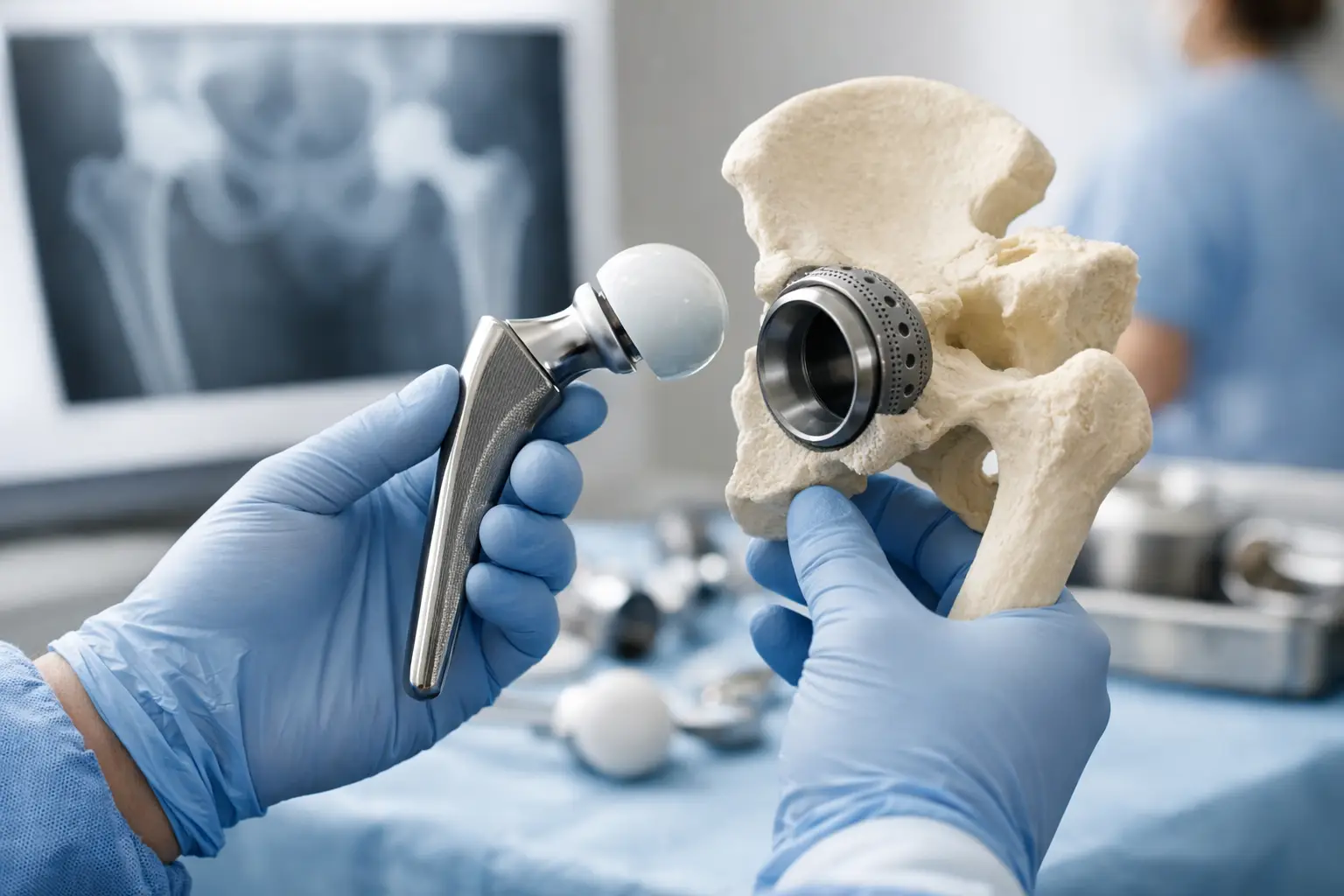
A hip replacement should never feel like a one-size-fits-all decision. Custom hip replacement surgery uses detailed imaging and personalised planning to help a specialist prepare for the individual shape, alignment and demands of your hip. For the right patient, this extra level of preparation can be particularly valuable – but it is not automatically the best option for everyone.
The aim remains straightforward: to relieve persistent pain, restore comfortable movement and help you return to the parts of life that matter to you, whether that is walking the dog, working, travelling, playing with grandchildren or returning to exercise.
What does custom hip replacement surgery involve?
The term can mean different things, which is why a clear discussion with a hip specialist is essential. Most commonly, it describes surgery planned using highly detailed imaging, often CT scans, to build a three-dimensional picture of the pelvis and femur. This allows the surgeon to assess bone shape, leg length, hip offset and the position of the joint in much greater detail before the operation.
That information may be used to create patient-specific planning guides or to select and position standard implant components more precisely. In some complex cases, a truly custom-made implant may be designed to match an unusual area of bone loss or an anatomy that cannot be managed reliably with off-the-shelf components.
A total hip replacement itself involves replacing the worn ball at the top of the thigh bone and the socket within the pelvis. The replacement components are designed to move smoothly together, reducing the bone-on-bone pain caused by arthritis or a damaged joint. Custom planning does not change the purpose of the operation. It aims to refine how that operation is prepared and delivered.
Why personalised planning can matter
No two hips are identical. There are normal differences in bone shape and leg length, and some patients have more significant variation because of childhood hip conditions, previous fractures, developmental dysplasia, surgery or longstanding arthritis.
Careful pre-operative planning helps the surgeon consider the position and size of the components before entering theatre. It can support decisions around restoring leg length, recreating the natural relationship between the pelvis and thigh bone, and achieving a stable hip through a useful range of movement. These details influence how the hip feels and functions after surgery.
For patients who have had prior hip surgery, the anatomy may be altered by scar tissue, old metalwork or bone loss. A revision hip replacement can therefore demand much more extensive planning than a first-time procedure. In these circumstances, custom solutions may be an important part of creating a safe and durable reconstruction.
Precision is valuable, but it should not be confused with a guarantee. A good outcome also depends on the condition of your muscles and bone, the quality of rehabilitation, your general health and how closely you follow recovery advice. Even the most carefully planned operation has recognised risks, which should be discussed openly.
Who may benefit from a custom approach?
Many people having a straightforward primary hip replacement will achieve an excellent result with well-established standard implants, selected and positioned through meticulous conventional planning. A custom-made implant is not necessarily better simply because it is bespoke.
Custom hip replacement surgery is more likely to be considered where standard options may not provide the best fit or support. This can include complex hip dysplasia, a previous pelvic or femoral fracture, marked deformity, major bone loss, a failed hip replacement or an infection that has required earlier treatment. It may also be relevant where several previous operations have changed the structure of the hip.
The key question is not whether a treatment sounds more advanced. It is whether it addresses a specific problem identified on your examination and scans. An experienced hip-and-knee specialist should explain what is unusual about your case, what the proposed plan is designed to achieve and whether a standard implant remains the safer, more predictable option.
Assessment before surgery
A thorough consultation starts with your symptoms and goals. Your specialist will want to know where the pain is felt, how far you can walk, whether your sleep is affected, what treatments you have tried and which activities you most want to regain.
Examination assesses your movement, strength, walking pattern and the condition of the surrounding joints and spine. X-rays usually provide the first clear view of arthritis, joint damage or previous implants. Further imaging may be appropriate for complex anatomy or revision surgery. A CT scan can provide valuable detail for three-dimensional planning, although it also involves radiation exposure, so it should be requested only when it will meaningfully inform treatment.
Your wider health matters too. Diabetes, smoking, weight, heart or lung conditions, medication and previous blood clots can all affect surgical planning and recovery. Optimising these factors before an operation is not a delay for its own sake. It is part of reducing avoidable risk and giving your new hip the best possible conditions to perform well.
Understanding the trade-offs
Personalised planning can add time, imaging and cost before surgery. For a custom implant, there may also be a manufacturing period. This is usually acceptable when the benefit is clear, but may not be appropriate if urgent treatment is needed or if conventional implants can solve the problem just as effectively.
A custom component is also designed around a plan made before surgery. During complex reconstruction, the surgeon must still be able to respond safely to what is found in theatre. This is why expertise in both detailed planning and complex hip reconstruction is so important. Technology supports clinical judgement; it does not replace it.
There are also the usual risks associated with hip replacement: infection, blood clots, dislocation, leg-length difference, fracture, nerve or blood-vessel injury, stiffness, ongoing pain and, over time, wear or loosening of components. These complications are uncommon, but they deserve a clear, individual conversation rather than a generic reassurance.
Recovery after a personalised hip replacement
Recovery is broadly similar whether your hip replacement has involved standard or custom planning, although revision and reconstructive cases often require a more cautious programme. You will usually begin standing and walking with support soon after surgery, guided by the hospital physiotherapy team. The first weeks focus on safe movement, wound healing, pain control and gradually building confidence.
Most patients use walking aids initially and progress as strength and balance return. Swelling, tiredness and interrupted sleep are common in the early phase. Improvement is rarely perfectly linear: a more active day can lead to temporary soreness, and it is sensible to pace yourself rather than push through increasing pain.
Driving, work and sport should be discussed individually. Someone with a desk-based role may return sooner than a person whose work involves lifting, climbing or long periods on their feet. Low-impact exercise is usually encouraged as recovery progresses, while the right timing for golf, cycling, swimming or gym work depends on healing, balance and the nature of your operation.
Questions worth asking at your consultation
A major joint operation deserves time and honest answers. Before deciding on surgery, ask:
- What is causing my pain, and have non-operative treatments been fully considered?
- Is my hip anatomy or previous surgery complex enough to justify custom planning or a custom implant?
- What are the expected benefits in my particular case, and what limitations may remain?
- Which implant and surgical approach do you recommend, and why?
- What are my individual risks, including those linked to my health or previous operations?
- What support will I receive before surgery and during rehabilitation?
The answers should be understandable and specific to you. If the benefits of a custom approach are uncertain, it is reasonable to ask whether a conventional replacement would offer the same likely result with less complexity or cost.
Choosing a specialist for complex hip care
For any hip replacement, and especially for revision or complex reconstruction, concentrated experience matters. Look for a surgeon whose practice is focused on hip and knee conditions, who can explain both surgical and non-surgical options, and who is comfortable advising against an operation when it is not the right next step.
At Mr. Kam Cheema’s practice, assessment is centred on careful diagnosis, precision-led planning and a realistic discussion of what treatment can achieve. The objective is not simply to obtain a good-looking X-ray. It is to help you move with less pain and greater confidence in everyday life.
If hip pain is steadily narrowing your world, the most useful next step is a specialist assessment that considers your anatomy, your health and your personal goals together. The right plan may involve a custom solution, a standard replacement or further non-operative care – but it should always be a plan you understand and can approach with confidence.