


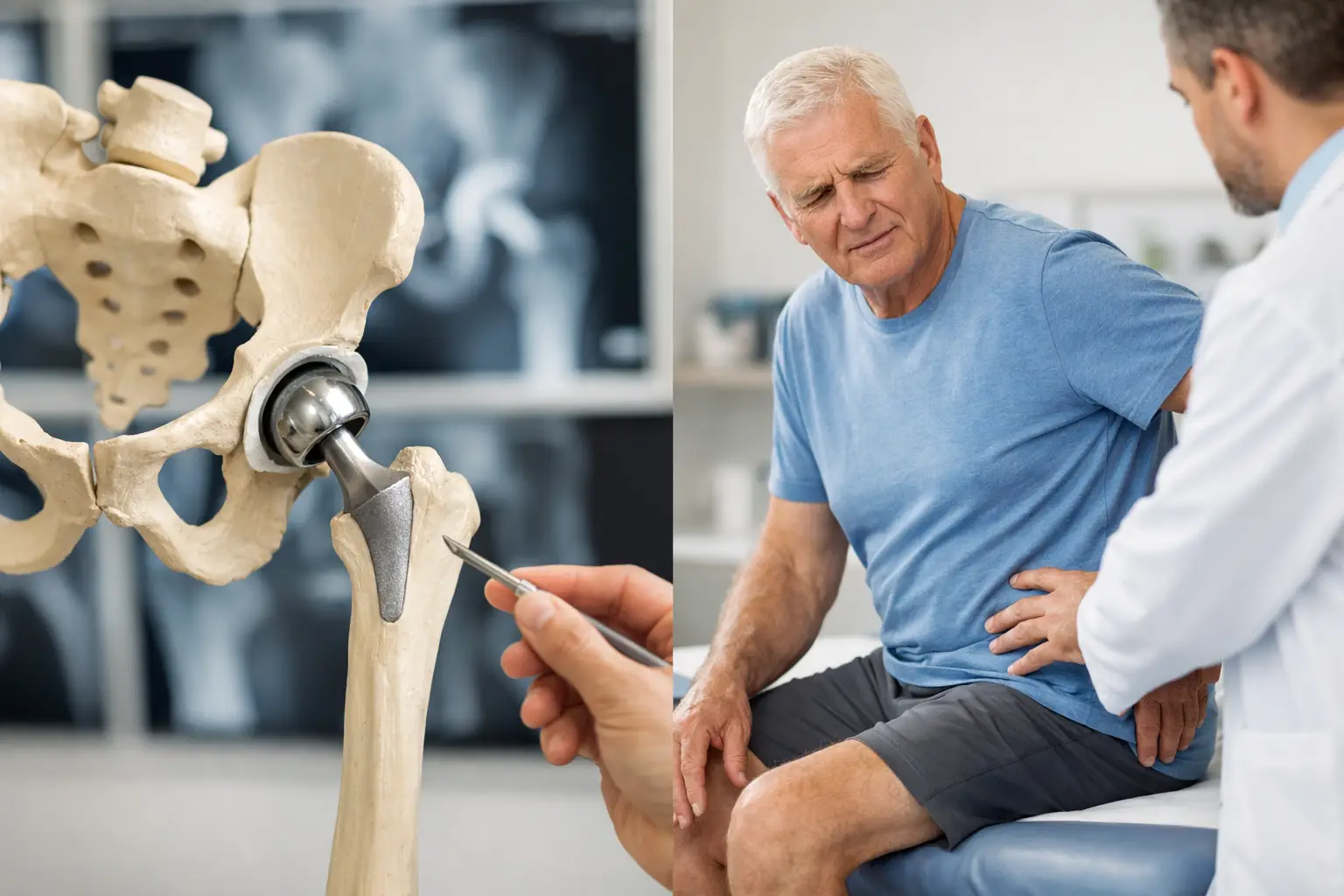
A hip replacement is designed to provide many years of comfortable, reliable movement. When pain returns, mobility declines, or the joint becomes unstable after a previous replacement, revision hip surgery may be considered. This is a more complex operation than a first hip replacement, but careful investigation and precision-led planning can offer a route back to greater comfort, confidence and independence.
Revision surgery is not automatically the answer to every painful hip replacement. The right treatment depends on the cause of the problem, the condition of the bone and soft tissues around the joint, your general health, and the effect symptoms are having on your daily life. A specialist assessment helps establish whether surgery is needed now, can be safely delayed, or whether a non-operative approach may be appropriate.
What is revision hip surgery?
Revision hip surgery is an operation to repair or replace part, or all, of an existing hip replacement. During a primary hip replacement, the worn ball-and-socket joint is replaced with carefully positioned components. Over time, those components can wear, loosen, become damaged or, less commonly, develop an infection.
A revision procedure may involve replacing only the hip socket liner or femoral head. In more involved cases, the socket component, stem in the thigh bone, or both may need to be removed and rebuilt. The operation can also require bone graft, specialised implants or custom-made components where bone loss is substantial.
The purpose remains straightforward: to address the source of pain or instability, create a secure joint, and help you return to the activities that matter to you. The surgical route, implants and recovery plan are individual to the problem being treated.
Why might a hip replacement need revising?
Hip replacements are highly successful procedures, but no artificial joint lasts indefinitely. Revision can be needed years after the original operation, although some problems need earlier attention. Pain should not be dismissed as an unavoidable part of living with a joint replacement, particularly if it is increasing, affects sleep or changes the way you walk.
Loosening and wear
The components of a hip replacement rely on a stable connection with the bone. Over time, this fixation can loosen. Wear particles from the bearing surfaces may also trigger a reaction in surrounding tissue, which can lead to loss of bone around the implant. This may cause groin, thigh or buttock pain, a sense that the leg is unreliable, or a gradual reduction in walking distance.
Instability or dislocation
A hip may dislocate when the ball comes out of the socket. One dislocation can sometimes be managed without surgery, depending on why it happened. Repeated dislocations, however, may suggest that the components are not ideally positioned, that the soft tissues are not providing enough stability, or that there is another mechanical issue requiring revision.
Infection
Infection around a hip replacement requires prompt specialist assessment. Symptoms can include persistent pain, swelling, wound leakage, fever or feeling generally unwell, though infection can occasionally present more subtly. Treatment may involve antibiotics and surgery. In some circumstances, the safest approach is a staged revision, where the existing components are removed, infection is treated, and a new hip replacement is inserted at a later operation.
Fracture or implant damage
A fall can cause a fracture around a hip replacement, known as a periprosthetic fracture. In other cases, an implant component can break or shift. These problems require detailed imaging and experienced surgical judgement, as treatment must restore both bone stability and hip function.
How is the need for revision assessed?
A thorough assessment should start with your story. When did symptoms begin? Have they changed gradually or suddenly? Is the hip painful at rest, on stairs, when getting in and out of a car, or only after longer walks? Previous operation records, implant details and X-rays can all provide useful context.
The examination considers gait, leg length, range of movement, muscle strength and the condition of the surrounding tissues. Standard X-rays are usually the first investigation. Depending on the concern, further imaging such as CT or MRI scanning may be used to assess component position, bone stock and soft tissues in more detail. Blood tests and, where appropriate, aspiration of fluid from the joint can help investigate possible infection.
This stage is not simply about confirming that something is wrong. It is about identifying precisely what is wrong. A painful hip replacement does not always mean the implant has failed. Pain can sometimes arise from the spine, tendons, bursae or other conditions around the hip. Avoiding unnecessary surgery is as important as planning the right operation when revision is genuinely needed.
Planning a complex revision hip replacement
Revision surgery demands more preparation than a primary hip replacement because every case has its own technical challenges. The surgeon needs to understand which components are well fixed, how much healthy bone remains, whether there has been infection, and what can be retained safely.
Detailed pre-operative planning helps select the right implants and anticipate the equipment that may be required. Where bone loss is present, specialised revision components can help rebuild support in the socket or thigh bone. In selected complex cases, custom implants may be considered to match an individual’s anatomy and the specific pattern of bone loss.
There are trade-offs to discuss openly. A larger operation may provide the most reliable reconstruction, but it can also involve a longer recovery and greater surgical risk. Conversely, retaining a stable component can reduce surgical trauma when it is safe to do so. The best plan is not necessarily the most extensive one. It is the one that addresses the problem properly while respecting your health, bone quality and goals.
What does recovery involve?
Recovery after revision hip surgery varies more than it does after a first hip replacement. Some people are able to bear weight soon after surgery, while others need a period of protected weight-bearing with crutches or a frame to protect a reconstruction or bone graft. Your rehabilitation plan will reflect what was found and repaired during the operation.
Pain control, early movement and physiotherapy are central to recovery. Initially, the focus is on safe transfers, walking and reducing swelling. As strength and confidence improve, rehabilitation progresses towards balance, endurance and the everyday movements that support independent living.
Most patients should expect recovery to take months rather than weeks. The pace depends on the complexity of the revision, muscle condition before surgery, overall fitness and whether infection or a fracture has been treated. It is sensible to arrange practical support at home during the early phase, particularly for meals, transport and tasks that involve bending or lifting.
Follow-up appointments allow the surgical team to monitor wound healing, mobility and X-rays. Contact the team promptly if you develop increasing redness, wound discharge, worsening pain, calf swelling, chest pain, shortness of breath, fever or a sudden change in the position or function of the leg.
Questions worth asking before surgery
A revision operation is a significant decision, and clear answers matter. Ask what is causing the problem, which parts of the replacement need to be revised, and whether there are alternatives to surgery. It is also reasonable to ask about the likely benefits, specific risks in your case, the expected hospital stay, weight-bearing restrictions and the practical help you may need at home.
For people seeking specialist care in London or Kent, it can be reassuring to choose a surgeon whose practice is focused on hip and knee conditions and who regularly manages complex joint replacement cases. Expertise matters, but so does communication. You should understand why a particular approach is recommended and feel able to make a decision without pressure.
A well-functioning hip replacement should support life rather than limit it. If a previous replacement is causing persistent pain, instability or concern, a careful specialist review can provide clarity and a considered path towards moving more freely again.