

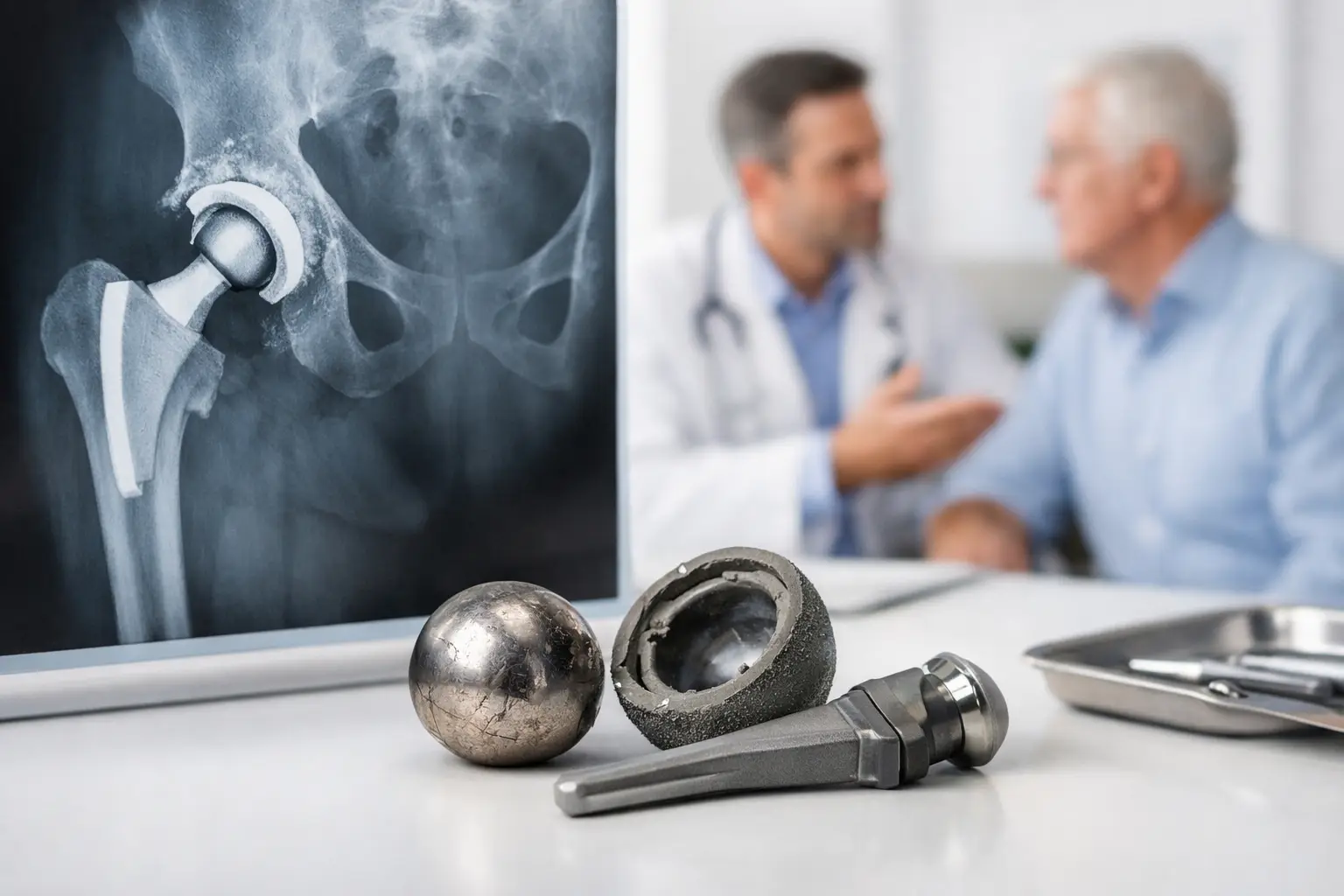
A hip replacement is designed to relieve pain and make everyday movement easier for many years. So, when pain returns or confidence in the joint begins to fade, it is understandable to ask: why do hip implants fail? The answer is rarely one simple issue. A careful assessment is needed to identify whether the problem lies with the implant, the bone around it, the surrounding muscles and tendons, or an infection that may not always be obvious.
Hip implants have an excellent track record, and most continue to function well for a long time. Failure does not necessarily mean that something was done wrong during the original operation. It can develop gradually through normal wear, changes in the bone, a fall or injury, or a problem that requires specialist treatment. The key is not to ignore persistent symptoms.
What does hip implant failure mean?
The term hip implant failure describes a replacement hip that is no longer providing a stable, comfortable or reliable joint. It may cause pain, stiffness, reduced walking distance, a feeling that the hip is unstable, or repeated dislocation. In some cases, changes are seen on X-rays before symptoms become severe. In others, a patient may experience increasing pain despite apparently normal early imaging.
A failed hip replacement does not always need immediate revision surgery. Some symptoms can arise from the lower back, bursitis, tendon irritation or muscle weakness rather than the implant itself. This is why an accurate diagnosis matters. Treatment should be based on the cause, your overall health, the condition of the bone and soft tissues, and the activities you want to return to.
Why do hip implants fail over time?
Wear of the bearing surface
Every hip replacement has moving surfaces. Modern materials are designed to reduce friction considerably, but they are not entirely immune to wear. Over many years, tiny particles can be released from the bearing surface. In some patients, the body reacts to these particles, leading to inflammation and loss of bone around the implant.
The risk varies according to the type of implant, the materials used, the position of the components and the demands placed on the joint. Wear is more often a long-term issue, but it can be identified before it causes extensive damage through appropriate review and imaging.
Loosening of the implant
For a hip replacement to work well, its components must remain firmly fixed to the bone. Loosening can occur gradually as the bone remodels around the implant, or as a result of wear debris and inflammation. It may also occur after a fracture around the implant.
Pain from loosening is often felt in the groin, thigh or buttock. Some people notice pain when first standing or taking their first few steps, while others find that walking, climbing stairs or getting in and out of a car becomes increasingly difficult. Loosening can be painful, but not every loose implant causes severe symptoms at first.
Infection around the hip replacement
Infection is one of the most important causes of hip implant failure to identify quickly. It can develop soon after surgery, but it may also present months or even years later. Occasionally, bacteria can reach a joint replacement through the bloodstream from another infection elsewhere in the body.
There may be obvious signs such as increasing pain, wound leakage, redness, swelling, fever or feeling unwell. However, low-grade infections can be far less clear. A hip may simply become progressively painful or stiff. Blood tests, joint aspiration and specialised imaging may be needed to establish whether infection is present.
Treatment depends on when the infection developed, the organism involved and the stability of the implant. It may involve antibiotics alongside surgery to clean the joint, or a staged revision procedure where the components are removed and replaced once the infection has been controlled.
Instability and dislocation
A replacement hip can dislocate if the ball comes out of the socket. This may happen after a fall or a particular movement, but recurrent dislocation can indicate a deeper problem. The components may not be positioned optimally for the individual, the soft tissues may not be providing enough stability, or spinal stiffness and pelvic movement may be affecting how the hip moves during daily activity.
A single dislocation does not always mean the hip will require revision surgery. Repeated instability, however, needs thorough investigation. Revision planning may include changing component position, using implants designed to improve stability, or addressing damaged muscles and other soft tissues where possible.
Fracture around the implant
A fall can cause a fracture in the bone around a hip replacement. These periprosthetic fractures are more likely where bone quality is reduced, but they can happen to anyone after significant trauma. The treatment depends on the location of the fracture and whether the implant remains secure.
Some fractures can be stabilised with plates, screws or cables while retaining the existing implant. Others require revision surgery to replace a loosened component and restore stable fixation. Prompt assessment is particularly important if you have new pain or cannot put weight through the leg after a fall.
Bone or soft-tissue problems
Hip replacement surgery relies on more than the metal, ceramic or polyethylene components. Strong bone, functioning muscles and healthy tendons all contribute to a stable and comfortable result. Bone loss can occur around an implant over time, sometimes without obvious symptoms. Damage or weakness in the muscles around the hip can lead to a limp, pain at the side of the hip and instability.
Patients with certain metal-on-metal hip replacements may also need assessment for adverse reactions to metal debris. This does not mean every metal-on-metal implant will fail, but it is a recognised reason for specialist follow-up where symptoms, blood tests or imaging suggest a problem.
Symptoms that deserve specialist review
It is sensible to seek assessment if a previously successful hip replacement becomes painful or less dependable. Symptoms that should not be dismissed include increasing groin, thigh or buttock pain; a new limp; stiffness; clicking or clunking with pain; a sense that the hip may give way; or a reduction in walking distance.
Urgent advice is needed after a fall when you cannot weight-bear, if the leg appears shortened or rotated, or if the hip has suddenly changed shape. Fever, wound discharge, increasing redness or feeling generally unwell alongside hip pain also require prompt medical attention because infection must be excluded.
Pain does not automatically mean the implant has failed. Equally, continuing to push through worsening pain can allow bone loss or soft-tissue damage to become more difficult to treat. Early investigation gives more options.
How is a failing hip replacement assessed?
A good assessment begins with listening carefully to the history. When did the pain start? Is it related to walking, sitting, stairs or particular movements? Was there a fall, illness or infection elsewhere in the body? These details help distinguish implant-related pain from problems affecting the spine, muscles or other parts of the pelvis.
Examination assesses walking pattern, leg length, hip movement, muscle strength and signs of instability. Standard X-rays are usually the starting point and can show loosening, wear, changes in bone or fracture. Depending on the findings, further investigations may include blood tests, CT scanning, MRI using metal artefact reduction techniques, bone scans or aspiration of fluid from around the joint.
For complex cases, comparison with previous X-rays and operation records can be particularly valuable. Revision hip surgery should never be planned on a single image or symptom alone. The objective is to understand precisely what has failed and why.
Can revision hip replacement help?
Revision hip replacement involves replacing some or all of the original components. It is more complex than a first hip replacement because there may be bone loss, scar tissue, instability or infection to manage. The procedure may require specialised implants, bone grafting or reconstruction techniques tailored to the individual anatomy.
The potential benefit is meaningful: less pain, a more stable joint and a return to everyday independence. However, revision surgery also carries greater risks than primary hip replacement, including infection, dislocation, fracture and slower recovery. Honest discussion about the likely benefit, the rehabilitation required and the alternatives is central to good decision-making.
A fellowship-trained hip specialist can help establish whether revision is appropriate now, whether monitoring is safe, or whether non-operative treatment may address another source of pain. For patients in London and Kent facing a complex or previously unsuccessful hip replacement, this clarity can be as valuable as the treatment itself.
If your replacement hip no longer feels like the reliable joint it once was, you do not need to assume pain is an unavoidable part of ageing. A timely, detailed review can identify the cause and provide a clear route towards safer movement, greater comfort and confidence in daily life.