

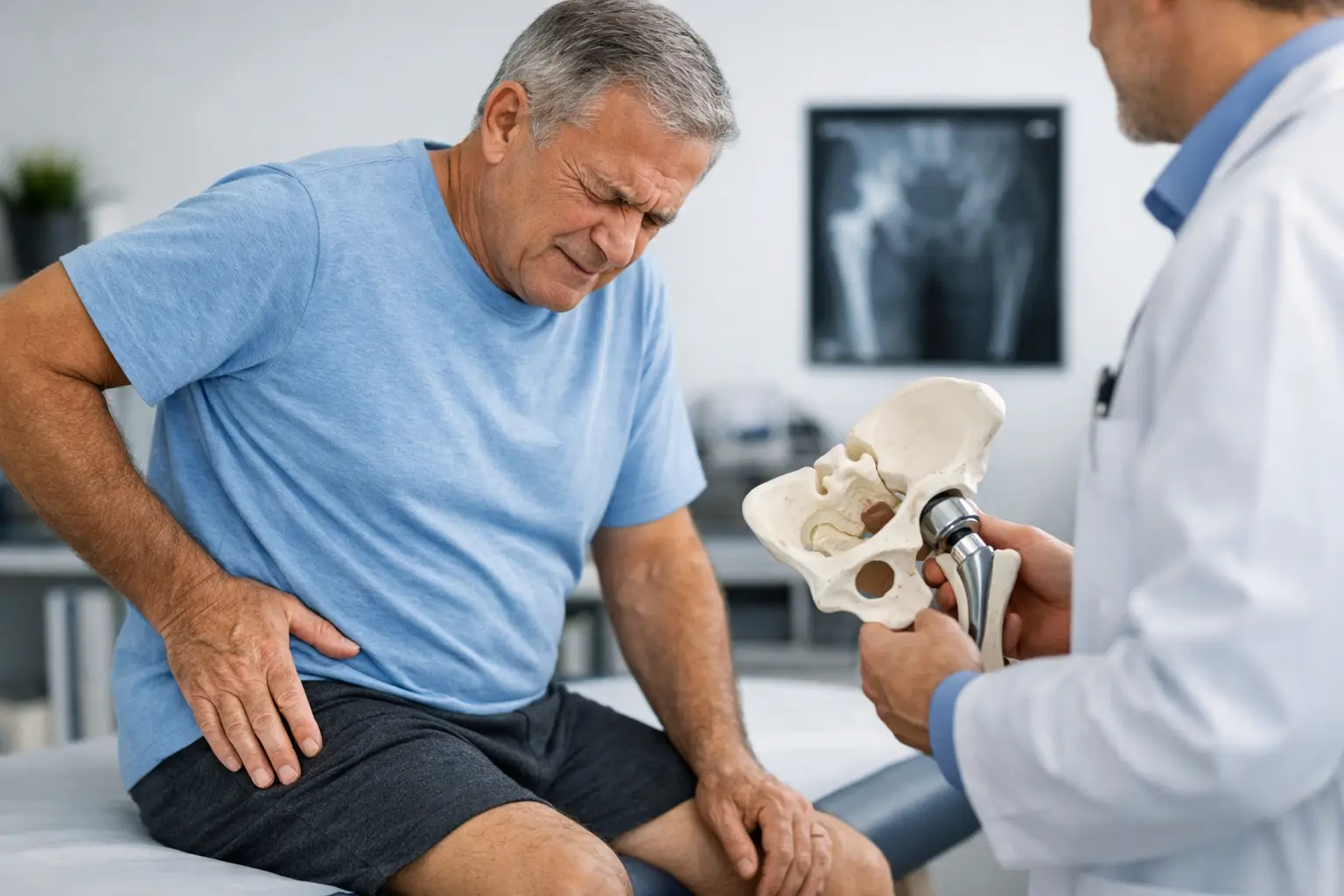
A hip replacement is designed to reduce pain and restore confidence in everyday movement for many years. If a previously comfortable hip becomes painful, unstable or increasingly limiting, it can feel worrying – particularly when you have worked hard through recovery. Not every new symptom means further surgery is needed, but recognising the signs hip replacement needs revision can help you seek the right assessment before a smaller problem becomes more complex.
Revision hip replacement is a planned operation to repair, replace or reconstruct part or all of an existing hip implant. It is different from a first hip replacement: the cause of symptoms must be identified carefully, and treatment is tailored to the condition of the implant, surrounding bone and soft tissues, and your own priorities.
When pain after hip replacement deserves attention
Some discomfort can follow increased activity, a minor strain or a fall. However, pain that persists, changes character or affects your walking should be assessed, especially if it develops after a period when the hip had been functioning well.
Pain may be felt in the groin, buttock, thigh or around the outer hip. A deep ache on weight-bearing, pain when rising from a chair, or discomfort that increases with walking can occasionally be associated with loosening of a component. Sharp pain, catching or a sense that the hip is moving abnormally may point to a different mechanical issue. The location alone does not provide a diagnosis: back problems, tendon conditions and knee pain can also be felt around the hip.
Night pain or pain at rest deserves particular attention. It does not automatically mean there is a serious implant problem, but it should not simply be accepted as a normal part of having a replacement.
Signs your hip replacement needs revision
A specialist will consider the full pattern of symptoms rather than relying on one sign. The following changes are good reasons to arrange a review.
Increasing stiffness or loss of movement
Difficulty putting on socks and shoes, getting in and out of a car, climbing stairs or reaching your usual walking distance may suggest that something has changed. Stiffness can arise from scar tissue, inflammation, muscle weakness or problems involving the implant. If mobility is steadily reducing rather than improving, a clinical assessment can clarify why.
Instability, slipping or dislocation
A hip that feels as though it may give way, shift or pop out of place needs prompt attention. A dislocation – when the ball comes out of the socket – can cause severe pain and an inability to bear weight, and requires urgent medical care. Even if the hip has been put back into place, recurrent instability should be investigated to understand whether component position, soft-tissue function, spinal movement or another factor is contributing.
Clicking, grinding or a new mechanical sensation
Occasional painless clicking is not always concerning. Yet a new clunk, grinding sensation, squeaking associated with pain, or repeated catching should be discussed. These symptoms can occur for several reasons, including impingement or wear, and need to be interpreted alongside examination and imaging.
Swelling, warmth, redness or wound changes
A hot, swollen or red hip, fluid leaking from a wound, or a new lump around the joint may indicate inflammation or infection. Infection around a hip replacement can occur soon after surgery or, less commonly, years later. It may also present more subtly, with increasing pain, fatigue or a general sense of being unwell. Fever, chills, rapidly worsening pain or wound discharge warrant same-day urgent medical advice.
A change in leg length or walking pattern
A noticeable limp, a feeling that one leg has become longer or shorter, or a new need for a stick may reflect weakness, pain avoidance or a mechanical change around the joint. These symptoms are not proof that revision surgery is required, but they are meaningful changes worth assessing rather than adapting to indefinitely.
Pain after a fall or injury
A fall can cause a fracture around the implant, dislocation or damage to the tissues that support the hip. Seek urgent assessment if you cannot put weight through the leg, the leg looks shortened or rotated, or pain is severe. Even when you can walk afterwards, persistent pain following a fall should be checked.
Why hip replacements sometimes need revision
Most hip replacements provide durable pain relief and improved function. When revision is needed, it is usually because the implant or the tissues around it have changed over time, rather than because the original operation has failed in a simple sense.
One possible cause is aseptic loosening, where the bond between bone and an implant component gradually weakens without infection. Wear particles from some bearing surfaces can, in certain circumstances, trigger a reaction that damages surrounding bone or soft tissue. Other causes include instability, fracture around the implant, infection, component breakage and adverse reactions to metal debris in specific types of implant.
The best treatment depends on the cause. A painful hip may be managed without surgery if testing shows that the implant is stable and symptoms arise from muscles, tendons, the spine or another source. Conversely, delaying review when there is progressive bone loss or infection can make later reconstruction more demanding. Honest advice means considering both sides: revision surgery can be highly effective, but it is a more complex procedure than primary replacement and should be recommended only when the likely benefits justify the risks.
What a specialist assessment involves
The first step is a detailed conversation. Your surgeon will ask when symptoms began, whether they followed a fall or illness, what movements aggravate them and how they are affecting sleep, work, exercise and independence. Details of your original operation, implant records where available, previous X-rays and any history of infection are valuable.
Examination assesses walking, leg length, hip movement, muscle strength and areas of tenderness. X-rays are usually the starting point and may show loosening, wear, fracture, component position or changes in bone around the replacement. Depending on the findings, further imaging such as CT, MRI designed for metal implants, ultrasound or a bone scan may be appropriate.
Blood tests can help identify signs of infection or inflammation. If infection is a concern, fluid may be taken from the joint for laboratory testing. This structured approach matters because revision planning should answer a precise question: what is causing the problem, and what treatment gives the safest prospect of lasting improvement?
When revision surgery may be recommended
Revision may involve replacing one component, such as the socket liner or femoral stem, or rebuilding both sides of the joint. In more complex cases, specialised implants, bone grafting or additional reconstruction may be required. If infection is confirmed, treatment may involve surgery alongside carefully selected antibiotics, sometimes in stages.
Recovery varies according to the reason for revision and the extent of reconstruction. Some patients can weight-bear soon after surgery, while others need temporary precautions or protected weight-bearing. Rehabilitation focuses on safe movement, strength and gradually returning to the activities that matter to you. The goal is not simply a satisfactory X-ray: it is less pain, greater stability and a hip you can trust in daily life.
Do not wait for symptoms to become disabling
Contact your surgeon or GP for a routine review if pain, stiffness, limping or mechanical symptoms are persisting or worsening. Seek urgent medical help for a suspected dislocation, inability to bear weight after an injury, fever with a hot painful hip, wound leakage, or rapidly escalating pain.
A timely specialist opinion can provide reassurance when the implant is sound and a clear plan when it is not. For patients facing a complex decision, careful investigation and an open discussion about non-operative and surgical options can turn uncertainty into a practical route back to comfortable movement.