


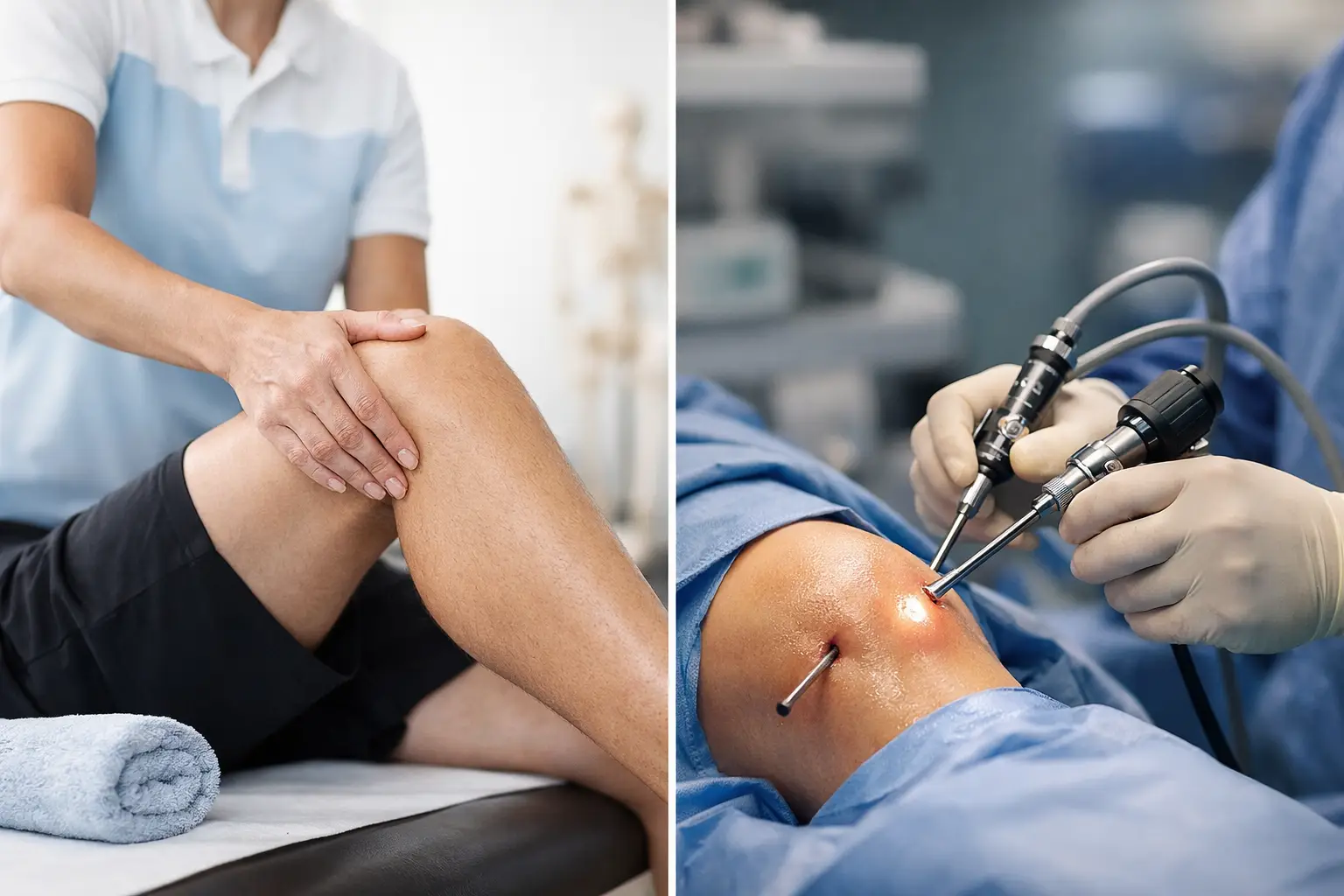
A meniscal tear on an MRI scan can sound like a straightforward reason for surgery. Yet many people with knee pain improve significantly without an operation, while others continue to catch, lock or lose confidence in the joint despite careful rehabilitation. Physiotherapy versus knee arthroscopy is therefore not a simple choice between the ‘conservative’ and ‘active’ option. The right treatment depends on the cause of symptoms, the condition of the knee as a whole and what you need to return to.
For someone who wants to walk comfortably, manage stairs, play with grandchildren or get back to sport, the priority is not simply making a scan look better. It is reducing pain and restoring dependable movement in a way that is safe and likely to last.
Physiotherapy versus knee arthroscopy: the central question
Physiotherapy aims to improve how the knee functions. A well-planned programme can build strength in the quadriceps, hamstrings, calf and hip muscles, improve balance and movement control, and gradually restore tolerance for walking, kneeling, stairs or sport. It may also address stiffness, swelling and the understandable tendency to protect a painful knee by moving differently.
Knee arthroscopy is a keyhole operation. A surgeon introduces a small camera and fine instruments through small incisions around the knee to inspect and, where appropriate, treat a problem inside the joint. Depending on the diagnosis, this may involve repairing a meniscal tear, trimming an unstable torn fragment, removing a loose body or treating selected cartilage-related problems.
Neither treatment is automatically superior. Arthroscopy is not a substitute for rehabilitation, and physiotherapy cannot repair every mechanical problem. In fact, physiotherapy is usually an essential part of recovery whether or not surgery is required.
When physiotherapy is often the best starting point
For many patients with gradual-onset knee pain, particularly from early arthritis or a degenerative meniscal tear, a focused course of physiotherapy is the sensible first step. Degenerative tears become more common with age and may be present alongside osteoarthritis. They can appear on a scan even when they are not the main source of pain.
In this setting, symptoms are often driven by a combination of joint wear, inflammation, reduced muscle strength and altered loading rather than one piece of torn tissue alone. Removing part of a worn meniscus does not reverse arthritis. Research and clinical experience have shown that arthroscopy for degenerative knee symptoms does not reliably offer better long-term results than structured non-operative care for many people.
A physiotherapy plan should be more than a sheet of generic exercises. It should begin with an assessment of pain, swelling, range of movement, strength, walking pattern, work demands and personal goals. Progression matters: exercises need to be challenging enough to create change, but paced appropriately so that a flare-up does not discourage you from continuing.
This approach can be particularly effective where pain occurs with stairs, prolonged walking, rising from a chair or returning to low-impact exercise. Weight management, if relevant, activity modification and pain-relieving treatments such as appropriate injections may also be considered as part of a wider non-operative plan. These measures are not about accepting a restricted life. They are about creating the best conditions for the knee to function well.
When knee arthroscopy may be appropriate
Arthroscopy may be recommended when there is a clear structural problem that is likely to respond to surgery. One important example is a traumatic meniscal tear in an otherwise healthy knee, particularly where the tear is unstable, repairable and causing persistent mechanical symptoms.
True locking deserves careful distinction from stiffness or pain-related hesitation. A locked knee is one that physically cannot fully straighten or bend because something is obstructing movement, such as a displaced meniscal fragment or loose body. This warrants timely specialist assessment.
Surgery may also have a role after a twisting injury where pain, recurrent swelling and catching persist despite appropriate rehabilitation, or where examination and imaging show a meniscal tear with a good prospect of repair. Preserving and repairing the meniscus, where possible, is preferable to removing tissue because the meniscus helps distribute load across the joint and protects cartilage over time.
Other reasons for arthroscopy can include removal of loose fragments within the joint or assessment and treatment of certain acute injuries. The decision should be based on the whole clinical picture, not an MRI report in isolation. A scan is valuable, but it must be interpreted alongside your symptoms, examination findings, age, activity level and the presence or extent of arthritis.
What are the trade-offs?
Physiotherapy requires commitment. Improvement is usually gradual, and exercises need to be performed consistently for weeks or months. Progress is rarely perfectly linear: a busy weekend, a long journey or an increase in activity can temporarily irritate the knee. However, it avoids the immediate risks of an operation and can improve the overall strength and control of the leg, benefits that remain valuable whatever future treatment is needed.
Arthroscopy may offer a more direct solution when a specific mechanical cause has been identified. It is generally less invasive than joint replacement, but it is still surgery. Risks include infection, bleeding, blood clots, anaesthetic complications, persistent pain, stiffness and, on rare occasions, injury to structures around the knee. There is also recovery time to consider, although this varies considerably according to the procedure performed.
A simple arthroscopy with a minor meniscal trim may allow relatively early weight-bearing, while a meniscal repair often requires a more protected rehabilitation programme to give the repair the best chance to heal. Returning to running, pivoting sports or demanding physical work should be guided by recovery of strength and function, rather than the calendar alone.
It is also important to be realistic about arthritis. If the principal cause of pain is moderate or advanced osteoarthritis, arthroscopy is unlikely to provide a durable answer. In those circumstances, the conversation may be better focused on non-operative symptom management, injections where appropriate, or knee replacement when pain and loss of function have become unacceptable despite appropriate treatment.
Questions that lead to a better decision
A specialist assessment should clarify not only what is visible on imaging, but why your knee hurts and what is preventing you from living as you wish. Helpful questions include whether the symptoms are likely to arise from the meniscus, arthritis, cartilage, ligaments or kneecap; whether there is genuine mechanical locking; and what improvement is realistically expected with each option.
It is also reasonable to ask what would happen if you continued with physiotherapy, whether the meniscus can be repaired rather than partly removed, and how arthritis may affect the likely result. Clear answers help ensure that surgery is being chosen for a meaningful reason, rather than because it feels like the quickest route forward.
For patients with complex symptoms, previous knee surgery or a mismatch between scan findings and daily limitations, this individual assessment is especially important. Fellowship-trained hip and knee specialist Mr Kam Cheema considers both surgical and non-surgical pathways, with treatment planned around the diagnosis and the activities that matter to each patient.
Recovery is not an afterthought
Whether you start with physiotherapy or proceed to arthroscopy, rehabilitation remains central. Early after surgery, this may focus on controlling swelling, restoring full extension and re-establishing a normal walking pattern. Later, it progresses towards strength, balance, confidence and the specific movements required for your work, hobbies or sport.
The most successful decisions are rarely about choosing physiotherapy or surgery in principle. They are about identifying the source of the problem, giving non-operative care a proper opportunity where appropriate, and using arthroscopy selectively when it offers a genuine route to better movement and less pain. A careful assessment can replace uncertainty with a treatment plan that is both proportionate and focused on getting you back to the life you value.