


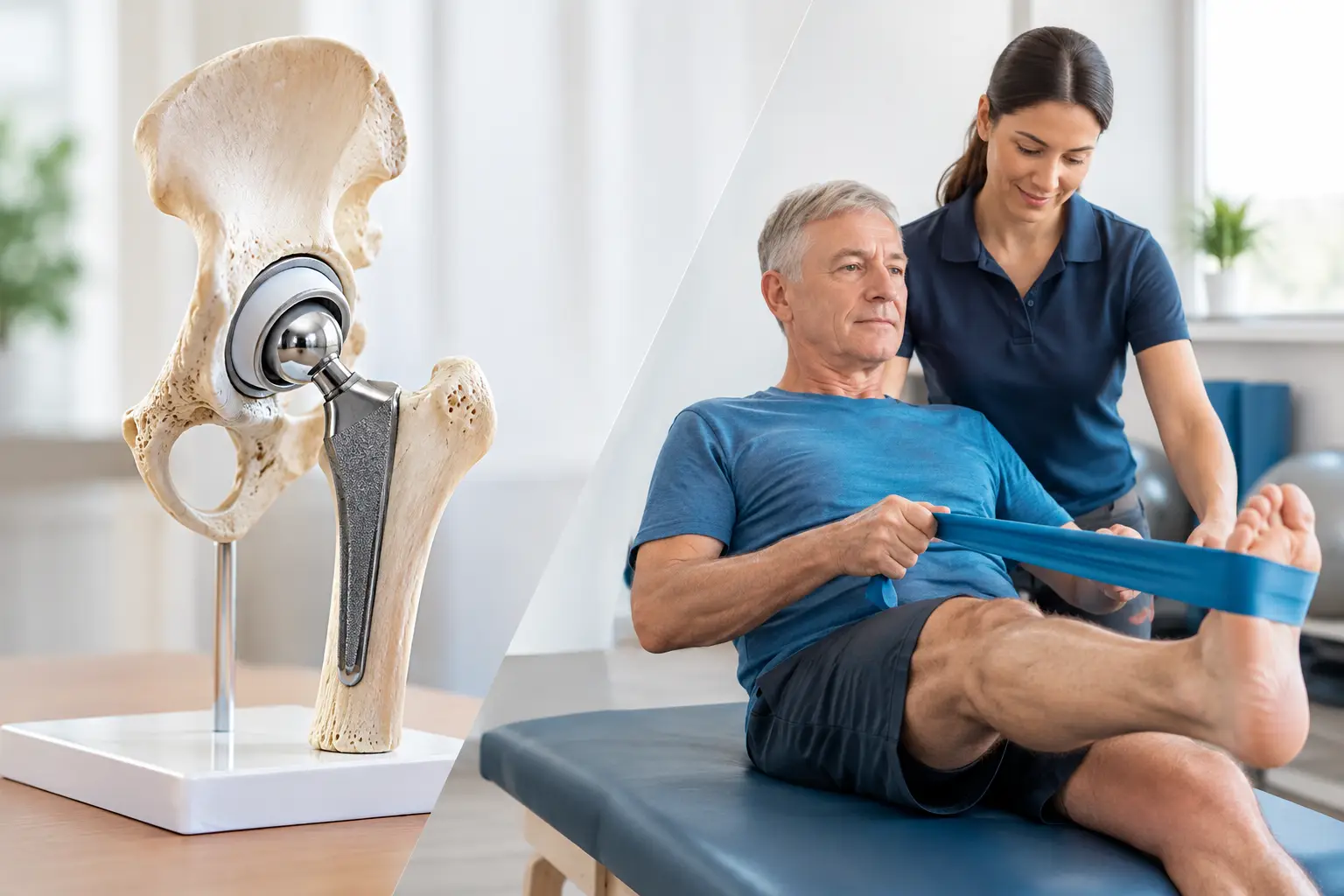
A hip that hurts on the stairs, disturbs sleep or makes a short walk feel like a calculation can gradually shrink a person’s world. The question of hip replacement versus physiotherapy is therefore not simply about choosing surgery or exercise. It is about identifying the source and severity of the problem, understanding what is realistically reversible, and selecting a route back to the activities that matter to you.
For many people, physiotherapy is a valuable first step and sometimes all that is needed. For others, particularly where arthritis has caused advanced joint damage, a hip replacement offers the more reliable prospect of lasting pain relief and restored mobility. The right answer depends on your hip, your symptoms and your goals.
Why the decision is rarely either-or
Physiotherapy and hip replacement do different jobs. Physiotherapy aims to improve the way you move, strengthen the muscles supporting the hip and reduce the strain placed on painful structures. A hip replacement removes damaged joint surfaces and replaces them with carefully positioned artificial components.
This distinction matters. Exercise can improve strength, confidence and function, but it cannot regrow cartilage that has been worn away by established osteoarthritis. Equally, surgery is not automatically the best response to every painful hip. Pain may arise from tendons, bursae, the lower back, a muscular injury or referred pain, all of which need proper assessment before a major operation is considered.
A specialist consultation should clarify the diagnosis rather than rely on an X-ray alone. The severity of symptoms, examination findings, imaging and the effect on daily life all contribute to a sound recommendation.
When physiotherapy may be the right place to start
A tailored physiotherapy programme can be particularly helpful when hip pain is mild to moderate, has developed after an injury or is linked to weakness, poor movement patterns or reduced flexibility. It is also commonly used while investigating the cause of symptoms, and as part of preparation for surgery where replacement is likely later.
Treatment usually focuses on improving hip and core strength, maintaining movement and helping you return safely to valued activities. A physiotherapist may also advise on pacing, walking aids, footwear and modifications that reduce aggravation. The programme should be adapted to your starting point. Exercises that provoke sharp or lingering pain are not a sign that you simply need to push harder.
For early arthritis, physiotherapy can reduce symptoms and help preserve independence. Some patients find that building strength around the hip allows them to walk further, manage stairs more comfortably and delay the need for surgery. Weight management, where appropriate, and sensible activity choices can further reduce load through the joint.
There are limits, however. If pain is severe at rest or at night, walking distance is steadily reducing, and ordinary measures no longer provide worthwhile relief, physiotherapy may help you cope but may not address the underlying mechanical problem.
What good physiotherapy should achieve
The aim is not perfection on a single good day. It is meaningful functional improvement over time: less pain when getting dressed, greater confidence leaving the house, or the ability to enjoy a walk without paying for it for the next two days. If a well-delivered programme has not produced these gains, it is reasonable to review the diagnosis and treatment plan.
When hip replacement becomes a sensible option
Total hip replacement is generally considered when the hip joint is significantly damaged and symptoms have a substantial impact on quality of life despite appropriate non-operative treatment. This may include advanced osteoarthritis, inflammatory arthritis, osteonecrosis or certain consequences of previous injury or surgery.
The decision should not be based on age alone. Some people in their sixties, seventies or beyond remain very active and benefit greatly from replacement when pain limits that activity. Younger patients may also be suitable where damage is severe, although the expected lifetime demands on the replacement deserve careful discussion.
The clearest indication is often the combination of severe pain, restricted movement and a loss of normal life. You may be avoiding work, relying on pain relief to sleep, stopping exercise you enjoy or needing help with shoes and socks. When the joint is the clear source of those limitations, replacement can be transformative.
Modern hip replacement is a planned reconstruction, not merely a pain procedure. Component choice, sizing and positioning are considered carefully to support stability, leg length, movement and the long-term performance of the joint. Fellowship-trained hip specialists use detailed assessment and precision-led planning to tailor the operation to the individual anatomy and clinical need.
No operation is without risk. Infection, blood clots, dislocation, fracture, nerve or blood vessel injury, stiffness and ongoing pain are uncommon but recognised complications. Artificial joints can also wear or loosen over time and may, in some cases, require revision surgery. Honest advice means balancing these risks against the limitations you are living with and the likely benefit of continuing non-operative care.
Hip replacement versus physiotherapy: comparing the outcomes
The comparison is not entirely fair because the treatments serve different stages and causes of hip disease. Physiotherapy is lower risk and does not require an operation or surgical recovery. It can enhance function and is beneficial before and after hip replacement. It is often the preferred approach where symptoms are manageable or the diagnosis is uncertain.
Hip replacement involves a larger commitment. There is a recovery period, structured rehabilitation and temporary restrictions while tissues heal. Most patients need support at home initially and progress at different speeds. Driving, returning to work and resuming hobbies depend on comfort, strength, the demands of the activity and the advice of the clinical team.
In return, a successful replacement can offer more substantial relief when pain is driven by end-stage joint damage. The objective is not to make the hip feel exactly like a natural joint, but to provide a stable, comfortable hip that supports walking, sleeping, work, travel and recreational activity with far less limitation.
A useful question is: what is the limiting factor? If weakness, stiffness and movement control are the main issue, physiotherapy may offer considerable benefit. If bone-on-bone arthritis is causing constant pain and restricting every part of life, an exercise programme alone is unlikely to change the joint surfaces.
The role of injections and other non-operative options
For some patients, treatment sits between physiotherapy and surgery. Image-guided or clinically targeted injections may be considered depending on the diagnosis. Steroid injections can sometimes settle inflammation and provide short-term relief, while other treatments may be appropriate in selected circumstances.
These options should be presented realistically. An injection may create a window in which you can engage more comfortably with physiotherapy, attend an important event or manage symptoms while considering your next step. It is not usually a permanent solution for advanced hip arthritis. Repeated treatment without a clear plan can postpone a decision without improving the overall trajectory.
The most appropriate option depends on the nature of the pain, imaging, medical history and previous response to treatment. A personalised plan is safer and more useful than assuming that every painful hip needs the same injection or operation.
Preparing for the decision
Before deciding, think beyond the pain score. Consider what you have stopped doing, how symptoms affect sleep and mood, whether you can work safely, and what outcome would make treatment worthwhile. It can help to keep a brief record of bad days, walking tolerance and the medication you need. This gives a clearer picture than trying to recall several months of symptoms in one appointment.
You should also discuss your general health, medicines, previous operations and support at home. These factors influence the safety of surgery and the shape of recovery, but they do not automatically rule it out. If replacement is recommended, prehabilitation through sensible exercise, nutrition and preparation for the home environment can make the recovery process more manageable.
For patients in London and Kent, access to specialist assessment can help bring clarity sooner, particularly when symptoms have persisted despite treatment or previous advice has felt uncertain. Mr Kam Cheema’s practice assesses both non-operative and surgical routes, including primary and complex hip replacement, so the discussion can remain focused on what best serves your long-term function.
The best treatment is the one that matches the condition in your hip and the life you want to return to. If pain has become the deciding factor in your day, a careful specialist assessment can turn uncertainty into a clear, considered plan.