


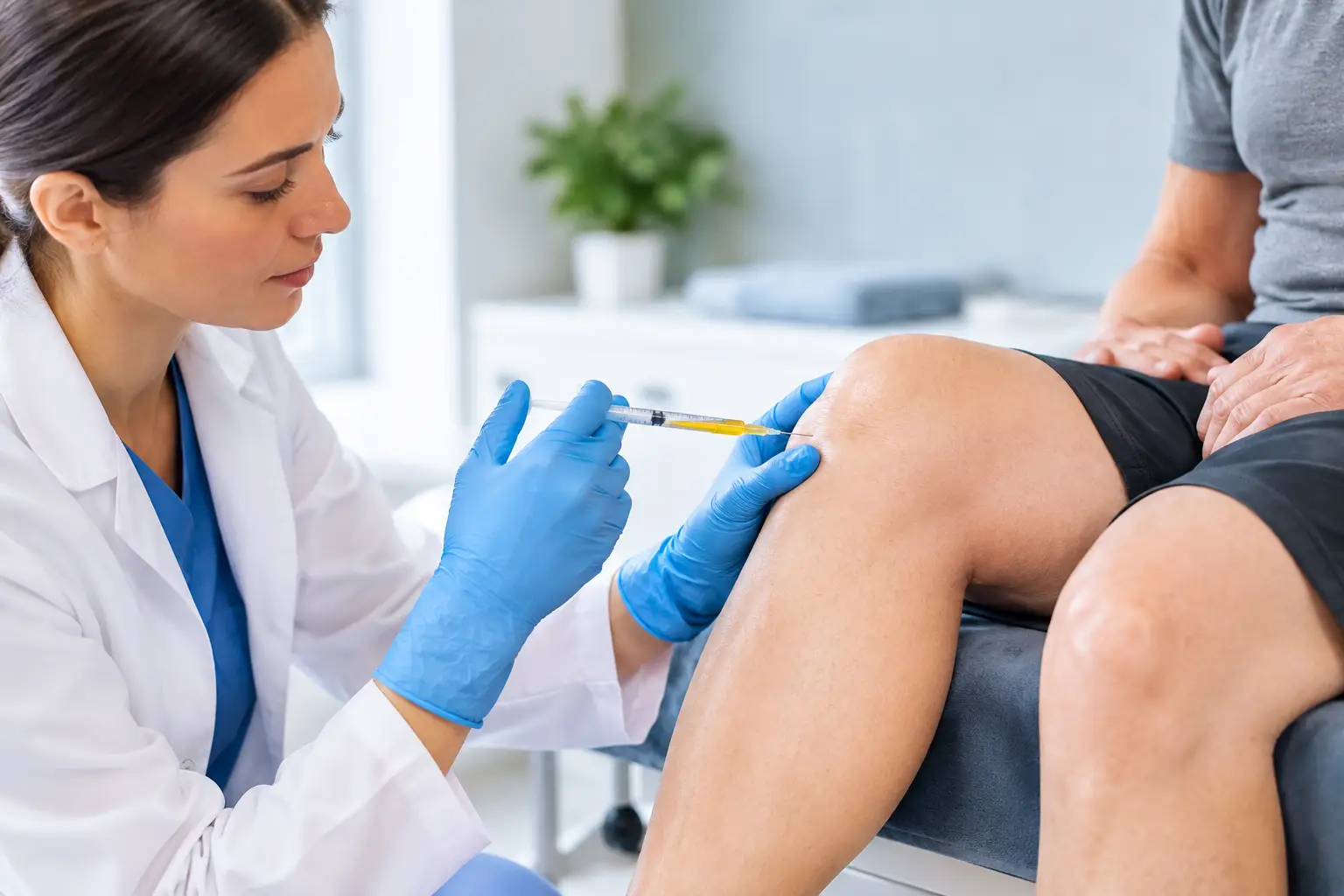
Persistent knee or hip pain can make ordinary decisions feel restrictive: whether to take the stairs, walk the dog, play with grandchildren or continue exercising. This PRP injection review explains where platelet-rich plasma may fit within a thoughtful orthopaedic treatment plan, what results are realistic, and when another option may offer a better route back to comfortable movement.
What is a PRP injection?
Platelet-rich plasma, usually shortened to PRP, is made from a small sample of your own blood. The sample is processed in a centrifuge to concentrate platelets and plasma, then injected into the area being treated. Platelets contain signalling proteins that are involved in the body’s natural repair response. The intention is not to replace damaged cartilage or reverse established arthritis, but to influence inflammation and support the tissues around a painful joint.
For hip and knee problems, PRP is most commonly considered for symptoms related to early or moderate osteoarthritis, tendon irritation or selected soft-tissue injuries. It is a non-operative option, which can make it appealing to people who want to remain active while avoiding or postponing surgery where this is clinically sensible.
That said, PRP is not simply a treatment to try because an X-ray shows arthritis. The likely source of pain, the condition of the joint, previous treatments, your health and what you need to return to all matter. A precise diagnosis comes first.
PRP injection review: what does the evidence suggest?
The evidence for PRP is encouraging in some knee conditions, particularly mild to moderate knee osteoarthritis, but it is not uniform. Studies use different PRP preparation methods, injection schedules and outcome measures. This makes direct comparison difficult and explains why individual results can vary.
For suitable knee arthritis patients, PRP may reduce pain and improve day-to-day function for several months, sometimes longer. Some people find that walking, climbing stairs and lower-impact exercise become easier. Others notice little meaningful change. It tends to be less predictable when arthritis is advanced, the joint is markedly deformed, or pain is driven by bone-on-bone wear and substantial loss of motion.
Evidence for hip arthritis is more limited than for the knee, in part because the hip is a deeper joint and hip pain can arise from several nearby structures. When PRP is used around the hip, accurate assessment and image-guided placement are particularly important. It may be considered in selected cases, but it should not be presented as an alternative to a hip replacement when joint damage is severe and symptoms are significantly affecting quality of life.
The key question is not whether PRP works in theory. It is whether it has a reasonable chance of improving your particular symptoms enough to justify the cost, procedure and recovery period.
Who may be a suitable candidate?
PRP is often most useful when pain persists despite sensible first-line measures, such as activity modification, physiotherapy, weight management where appropriate, and simple pain relief. A patient may have arthritis visible on imaging but still retain good joint space, reasonable alignment and useful movement. In that setting, an injection can be part of a wider plan to control symptoms and maintain strength.
It may also be considered for some tendon-related problems around the hip or knee, although the diagnosis must be clear. Pain at the outside of the hip, for example, is not always caused by arthritis within the joint. It can relate to the gluteal tendons, the lower back or other surrounding tissues. Treating the wrong structure is unlikely to help, however promising the treatment itself sounds.
PRP is usually less appropriate where there is a significant mechanical problem that needs correction, such as a locked knee from a displaced meniscal tear, major instability, severe joint collapse or a failed joint replacement. In these circumstances, delaying the right treatment can prolong pain and reduce function unnecessarily.
A specialist consultation should also consider factors that may affect safety or response. These include active infection, certain blood or bleeding disorders, poorly controlled medical conditions and medicines that influence bleeding or clotting. Do not stop prescribed medicines, including anticoagulants, without clear advice from the clinician responsible for your care.
What happens during treatment?
The procedure begins with a blood test, normally taken from your arm. Once the PRP has been prepared, the skin is cleaned carefully and the injection is given into the joint or targeted soft tissue. Ultrasound guidance may be used when it improves accuracy, particularly for deeper structures or tendon treatments.
The appointment is usually straightforward and you can normally go home the same day. A local anaesthetic may be used in some circumstances, although the exact approach depends on the area being treated and the treatment plan.
It is common to experience soreness or a temporary increase in pain for a few days afterwards. This does not automatically mean that something has gone wrong. The treated area has been irritated by the needle and the injection, and it needs time to settle. Most patients can manage with relative rest, ice if advised and appropriate pain relief.
Your clinician will give individual guidance on work, driving and exercise. In general, strenuous impact activity is avoided initially, while gentle movement is encouraged when comfortable. The longer-term benefit of PRP is more likely to be supported by a structured rehabilitation programme that restores muscle strength, joint control and confidence in movement.
How long does PRP take to work?
PRP is not designed to deliver the immediate relief that some people experience after a local anaesthetic or steroid injection. Improvement, if it occurs, is usually gradual. Some patients notice a change over several weeks, while others take two to three months to judge the full effect.
This slower timetable can be frustrating, especially when pain has already limited your routine for months. It is also why setting a practical goal beforehand is useful. Relief that allows you to walk further, sleep better, return to a preferred exercise class or reduce reliance on pain relief may represent a worthwhile outcome, even if the joint does not feel entirely normal.
The duration of benefit varies. Some people have meaningful symptom control for many months; others may need a different approach sooner. A repeat injection is occasionally considered, but it should be based on your response and diagnosis rather than offered automatically.
PRP compared with steroid and hyaluronic acid injections
There is no single best injection for every painful joint. Steroid injections can provide relatively rapid short-term relief by reducing inflammation. They may be helpful during a painful flare or when symptoms are preventing rehabilitation, but repeated steroid injections are not suitable for every situation.
Hyaluronic acid injections aim to improve the lubricating environment within a joint and may help selected arthritis patients. Their benefits are also variable. PRP takes a different approach by using components from your own blood, with the aim of influencing the local biological response.
The right choice depends on the diagnosis, severity of arthritis, previous response to treatment, timing and your priorities. For someone hoping to complete a specific event in the near future, the conversation may differ from that of someone trying to manage early arthritis over several years. Honest advice should include the possibility that no injection will provide enough relief, and that joint replacement may ultimately be the more reliable option for advanced arthritis.
Risks and limitations to understand
Because PRP is prepared from your own blood, there is no risk of an allergic reaction to a donor product. However, it remains an injection procedure. Risks include temporary pain or swelling, bruising, bleeding and, rarely, infection. There is also the central limitation that it may not improve symptoms.
Careful technique, appropriate patient selection and a clear follow-up plan matter. It is equally important not to make claims that the treatment can regrow worn cartilage or cure arthritis. For a damaged joint, PRP may help manage symptoms; it does not rebuild a severely arthritic hip or knee.
Before proceeding, ask what problem is being treated, why PRP is being recommended over other options, how success will be measured and what the next step will be if it does not help. Clear answers make it easier to make a decision with confidence.
If hip or knee pain is limiting the life you want to lead, the most valuable next step is a specialist assessment that looks beyond the scan and focuses on your symptoms, movement and goals. The best treatment is the one that gives you the clearest, safest path towards less pain and more freedom in everyday life.