


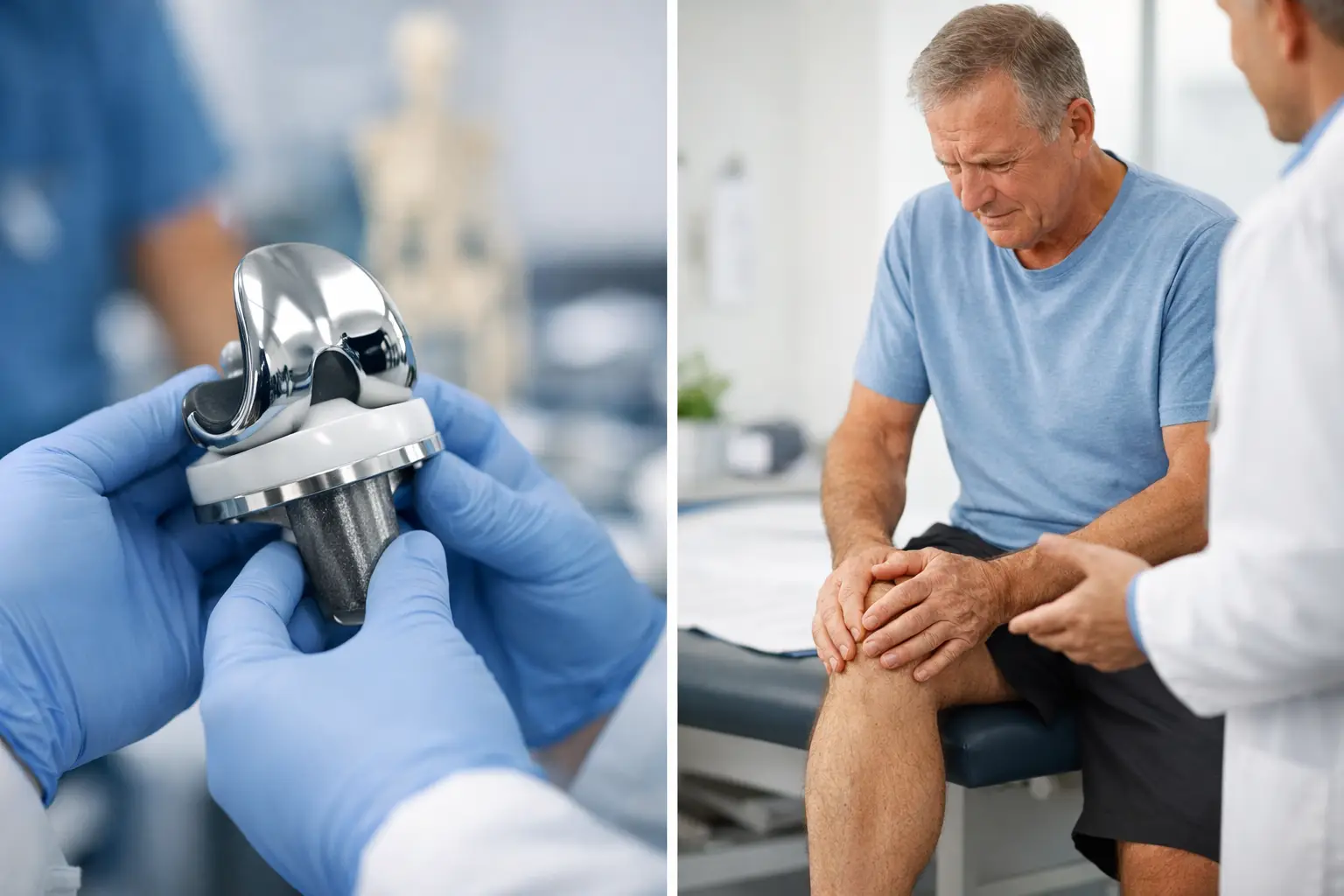
A knee replacement is designed to provide durable pain relief and improved movement for many years. When pain, instability or loss of function returns after a previous operation, it can feel particularly disheartening. Revision knee replacement is a specialist procedure that removes and replaces part or all of an existing knee implant, with the aim of restoring a stable, comfortable and dependable knee.
It is not simply a repeat of the original operation. Revision surgery can be more technically demanding because the surgeon must understand why the first replacement is no longer performing as intended, assess the condition of the bone and soft tissues, and develop a plan tailored to the individual knee. A careful assessment is the foundation of a good decision.
Why might a knee replacement need revision?
Most knee replacements do not require further surgery. However, no artificial joint lasts indefinitely, and problems can occasionally develop years after the initial procedure. In other cases, symptoms may appear earlier and need prompt investigation.
Wear or loosening of the implant is one possible cause. Over time, the bond between the implant and bone can weaken, or the plastic bearing surface within the knee can wear. This may lead to pain during weight-bearing, swelling, a sense that the knee is giving way, or a gradual reduction in confidence when walking.
Instability is another common reason for assessment. A knee may feel unreliable when turning, using stairs or getting up from a chair. The ligaments and muscles around the joint play a major part in stability, so revision planning must consider more than the metal components alone.
Infection around a knee replacement requires particularly careful attention. It may present with persistent pain, warmth, swelling or wound problems, but symptoms can sometimes be subtle. Blood tests, joint fluid analysis and imaging may be needed to clarify the diagnosis. Depending on the nature and timing of the infection, treatment may involve antibiotics and surgery, sometimes in staged operations.
Other causes include fracture around the implant, stiffness that significantly limits daily life, malalignment, or an implant that has not achieved a satisfactory balance of movement and stability. Persistent pain does not always mean that revision surgery is the answer. Pain can originate from the hip, spine, tendons or other medical conditions, which is why an accurate diagnosis matters.
How revision knee replacement is assessed
The most useful consultation starts with your experience. When did symptoms begin? Is the pain present at rest, at night or only with activity? Does the knee feel unstable? How far can you walk, and which everyday activities have become difficult? These details help identify patterns that scans alone cannot show.
Your surgeon will examine the knee’s movement, alignment, stability, swelling and condition of the surrounding tissues. Previous operation notes, implant information and earlier X-rays can also be valuable, particularly when surgery was performed some time ago or elsewhere.
Standing X-rays are commonly used to assess the position and fixation of the components, bone quality and overall alignment of the leg. Further imaging, such as CT scanning, may help define bone loss or component rotation in greater detail. Where infection is a possibility, blood tests and aspiration of fluid from the joint may be recommended.
This process can feel thorough because it is. Revision surgery should not be undertaken simply because an implant is visible on an X-ray or because a knee remains uncomfortable. The benefits, limitations and alternatives need to be weighed against the specific cause of the problem and its effect on your life.
When non-operative treatment may still help
Not every painful knee replacement requires another operation. Physiotherapy may improve strength, confidence and movement where weakness or altered walking mechanics are contributing to symptoms. Pain management, activity modification or treatment for a problem outside the knee may also be appropriate.
If the implant is well fixed and well aligned, and no infection or mechanical problem is found, surgery may offer limited benefit. Honest advice is essential here. The right treatment is the one most likely to improve function safely, not necessarily the most invasive option.
What makes revision surgery more complex?
A primary knee replacement involves replacing worn joint surfaces. In revision surgery, the existing components must first be removed without causing unnecessary damage to the remaining bone. There may be bone loss beneath a loose implant, scar tissue from previous surgery, weakened ligaments or changes in the shape of the joint.
Specialist implants can help address these challenges. Depending on the findings, revision components may use longer stems to gain secure fixation within the bone, augments to rebuild areas of bone loss, or a more constrained design to provide additional stability. In complex cases, planning may involve detailed imaging and careful selection of implants before the day of surgery.
There is no single revision operation that suits every patient. Replacing only one component may be possible in selected circumstances, while other knees need a full revision. Infection can require a different pathway altogether. The appropriate approach depends on the cause of failure, the quality of bone and soft tissue, your general health and your goals for recovery.
Recovery after revision knee replacement
Recovery is individual, but revision knee replacement generally demands more patience than a first knee replacement. The operation may be longer, the tissues may need more time to settle, and early rehabilitation is often carefully adjusted to the stability of the reconstruction.
You will usually begin supported mobilisation soon after surgery with guidance from the physiotherapy team. Pain relief is managed actively so that you can move safely and work on regaining knee movement. Some patients need temporary restrictions on weight-bearing or use of a brace, particularly where bone reconstruction or complex ligament balancing has been required.
Swelling, tiredness and interrupted sleep are common in the early weeks. Progress is rarely completely linear: one week may feel encouraging, while the next feels slower after doing more. Consistent rehabilitation, sensible pacing and regular follow-up matter more than comparing your recovery with someone else’s.
Returning to driving, work and recreational activity depends on the demands involved and your recovery. Desk-based work may be possible earlier than a physically demanding role, while kneeling, impact sports and heavy manual activity may remain difficult even after a successful revision. The aim is not to promise a particular lifestyle outcome, but to create the best possible conditions for less pain, safer movement and renewed independence.
Understanding the risks and likely benefits
All major joint surgery carries risks, including blood clots, bleeding, wound problems, stiffness, nerve or blood vessel injury, and anaesthetic complications. Revision procedures also have a higher risk of infection, fracture and further loosening than primary knee replacement. These risks vary according to the reason for revision, the number of previous operations, bone quality and wider health factors.
That said, a well-planned revision can provide meaningful improvement where there is a clear mechanical problem, infection or instability. Many people seek help because the affected knee has begun to limit walking, work, family life or the activities that keep them independent. A realistic discussion should cover what can be improved, what may remain challenging, and the steps taken to reduce avoidable risks.
Choosing a surgeon with focused experience in complex hip and knee reconstruction can be reassuring when a previous replacement has failed. At Mr. Kam Cheema’s practice, assessment is centred on identifying the precise cause of symptoms and explaining the available options clearly, so that patients can make an informed decision rather than feel rushed towards surgery.
If a replaced knee is becoming increasingly painful, unstable, swollen or difficult to use, seeking specialist assessment is worthwhile. The most helpful next step is often not an immediate operation, but a clear explanation of what is happening and a plan that gives you confidence in the road ahead.