


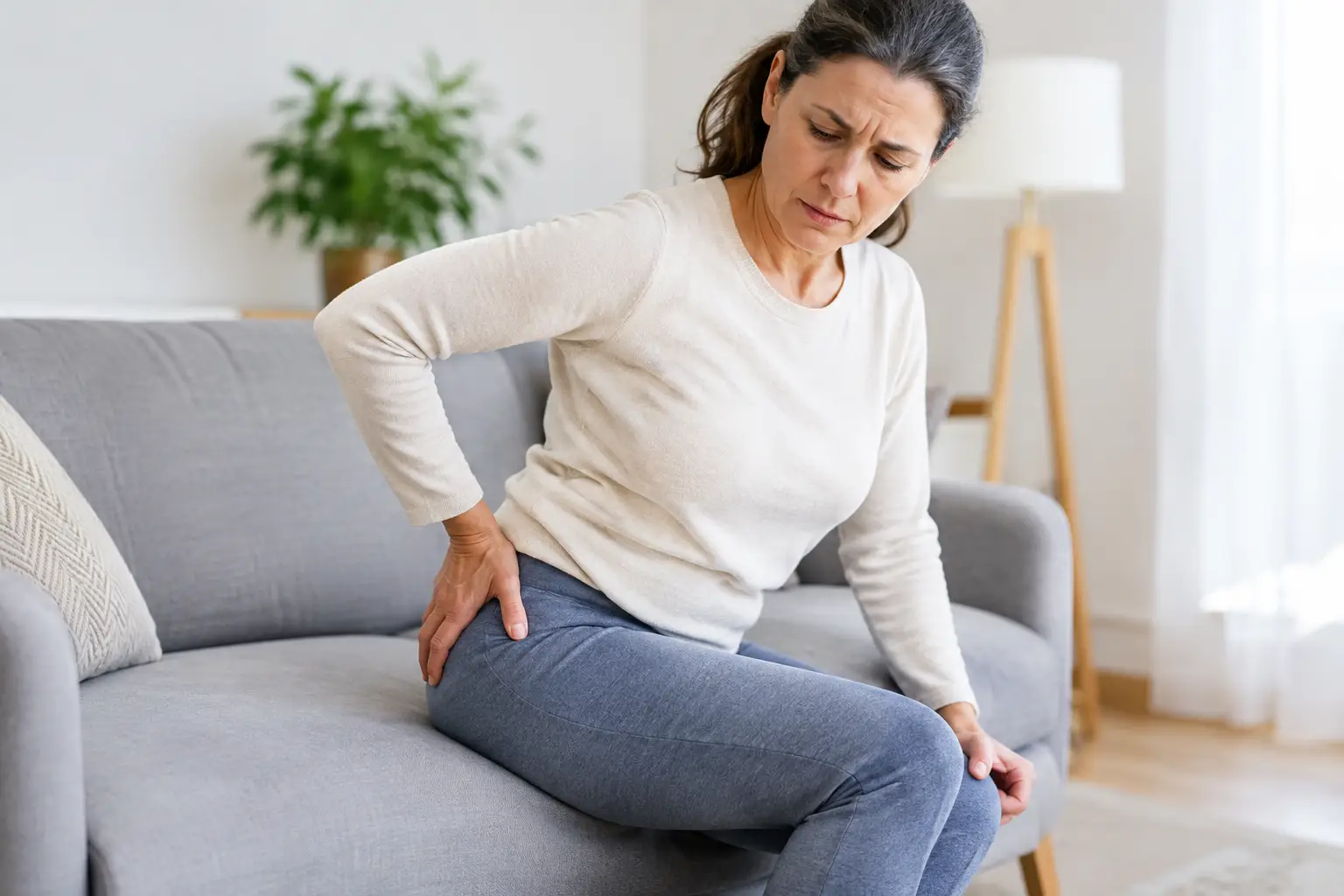
Getting out of a low chair, putting on a sock or taking the first few steps after sitting can reveal hip stiffness long before pain becomes severe. The top causes of hip stiffness range from common age-related joint change to problems affecting the muscles, tendons or lower back. Identifying the likely source matters because the right treatment depends on what is actually limiting movement.
Hip stiffness is not simply an inconvenience to push through. When it persists, changes your walking pattern or stops you doing the activities you value, a careful assessment can help protect mobility and guide appropriate treatment.
Why the hip feels stiff
The hip is a deep ball-and-socket joint, supported by powerful muscles, tendons, ligaments and a smooth cartilage lining. Stiffness can occur when the joint itself is inflamed or worn, when surrounding soft tissues are irritated, or when pain causes the body to guard against movement.
Some people notice stiffness most in the morning, while others feel it after a long car journey, a day at their desk or a demanding walk. The timing, location of discomfort and movements that provoke symptoms all provide useful clues. Groin pain, for example, is more commonly linked to the hip joint itself, whereas pain on the outer side of the hip may arise from the tendons and soft tissues around it.
Top causes of hip stiffness
Hip osteoarthritis
Osteoarthritis is one of the most frequent causes of ongoing hip stiffness in adults. The cartilage that helps the joint move smoothly becomes thinner and the joint may develop bony changes. This can make the hip feel restricted, especially when turning, bending to dress or getting in and out of a car.
Symptoms often develop gradually. Early on, stiffness may ease once you are moving, but it can return after activity or later in the day. As arthritis progresses, pain may be felt in the groin, buttock or thigh, and walking distance, sleep and everyday independence can be affected.
An X-ray can often show arthritic changes, although treatment should be based on your symptoms and function rather than an image alone. Some people manage well with tailored exercise, weight management where appropriate, medication or injections. When pain and restriction remain significant despite non-operative care, hip replacement may offer reliable relief and a return to more comfortable movement.
Inflammatory arthritis
Conditions such as rheumatoid arthritis, psoriatic arthritis and ankylosing spondylitis can cause inflammation within or around the hip joint. Stiffness may be pronounced after waking or following rest and may last longer than the brief stiffness commonly associated with simple overuse.
There may be other signs, including swelling or pain in other joints, fatigue, psoriasis, bowel symptoms or a history of inflammatory disease. Prompt assessment is valuable because medication to control inflammation can help prevent joint damage. Hip surgery may be considered if the joint has been significantly affected, but controlling the underlying condition remains an important part of care.
Tendon and bursa problems around the outer hip
Pain and stiffness on the outside of the hip can be caused by irritation of the gluteal tendons or the bursa, a small fluid-filled cushion that reduces friction. This is often described as greater trochanteric pain syndrome. It can make lying on the affected side uncomfortable and may be aggravated by walking, climbing stairs or standing on one leg.
It is sometimes mistaken for hip arthritis, but the pattern is different. Rotation of the hip may be relatively well preserved, while pressing the outer hip can be tender. A structured physiotherapy programme that improves hip and pelvic control is often central to recovery. In selected cases, an injection may reduce pain sufficiently to allow rehabilitation to progress, but it is not a substitute for addressing tendon strength and loading.
Hip impingement and labral injury
Hip impingement occurs when the shape of the ball, socket or both leads to abnormal contact during certain movements. It is more common in younger and active adults, although symptoms can appear at any age. Deep groin discomfort, catching, clicking or stiffness during squatting, cycling and twisting movements are typical features.
The labrum, a ring of cartilage around the socket, may also be irritated or torn. Not every scan finding requires treatment, as some people have shape changes or labral tears without symptoms. The key question is whether the findings match the pain, restriction and impact on day-to-day life. Physiotherapy and activity modification may help, while persistent mechanical symptoms sometimes require specialist investigation and discussion of surgical options.
Muscle tightness, reduced strength and prolonged inactivity
The hip can feel stiff even when the joint surfaces are healthy. Long periods of sitting, a reduction in activity after illness or injury, and weak gluteal muscles can all alter how the hip moves. Tight hip flexors at the front of the hip may make it difficult to stand fully upright after sitting, while reduced strength can make stairs and longer walks feel hard work.
This type of stiffness usually responds well to gradual, consistent movement rather than forceful stretching. A physiotherapist can help identify whether mobility, strength, balance or walking mechanics are contributing. The aim is to build confidence and capacity without repeatedly aggravating symptoms.
Previous injury or surgery
A fracture, dislocation, childhood hip condition or previous operation can affect the shape and mechanics of the hip over time. Scar tissue, muscle weakness and post-traumatic arthritis may all contribute to stiffness. In some cases, symptoms emerge years after the original injury.
Anyone with worsening pain or restriction after previous hip surgery should be assessed carefully. The issue may be straightforward, but complex cases require a clear understanding of the original procedure, implant position, bone quality and any signs of infection or loosening. Revision surgery is not always needed, yet it should be considered by a surgeon experienced in evaluating and treating complex hip problems when appropriate.
Pain referred from the lower back
Not all stiffness felt around the hip originates in the hip. Arthritis in the spine, disc-related problems or nerve irritation can cause pain in the buttock, thigh or groin and make movement feel restricted. Tingling, numbness, weakness or pain travelling below the knee may point more towards a spinal cause.
It is also possible to have both hip and back problems at the same time. A focused examination helps distinguish the main source of symptoms, avoiding treatment directed at the wrong area.
When hip stiffness needs prompt attention
Most hip stiffness is not an emergency, but certain symptoms need urgent medical assessment. Seek prompt help if you cannot bear weight after a fall, the hip is hot, swollen or red, or you have fever and feel unwell. Severe new pain, especially after injury, may indicate a fracture or dislocation.
Urgent assessment is also sensible if pain is rapidly worsening, wakes you persistently at night without an obvious explanation, or is accompanied by unexplained weight loss. New leg weakness, numbness around the groin or changes in bladder or bowel control require emergency medical attention.
What a specialist assessment involves
A good consultation starts with listening. Your specialist will ask where the stiffness is felt, how long it has been present, which activities are affected and whether symptoms are improving, stable or worsening. Your medical history, previous injuries, current medications and treatment goals are all relevant.
Examination assesses walking, leg length, hip movement, muscle strength and tenderness around the joint. X-rays are commonly used to assess arthritis and joint shape. Depending on the clinical picture, further imaging such as MRI or CT scanning, blood tests or a diagnostic injection may be useful.
The purpose is not simply to name a condition. It is to establish what is causing your limitation, explain the realistic treatment options and agree a plan that fits your life. For some patients, this means a carefully directed non-operative programme. For others with advanced joint disease and substantial loss of quality of life, surgery may provide the most dependable route back to walking, work, travel and valued activities.
Do not let stiffness set the limits of your life
Keeping a brief note of when stiffness occurs, where pain is felt and what you can no longer do comfortably can make a consultation more productive. If symptoms are persistent or changing how you move, an expert hip assessment can replace uncertainty with a clear, individual plan – focused on reducing pain, restoring mobility and helping you return to the life you want to lead.