


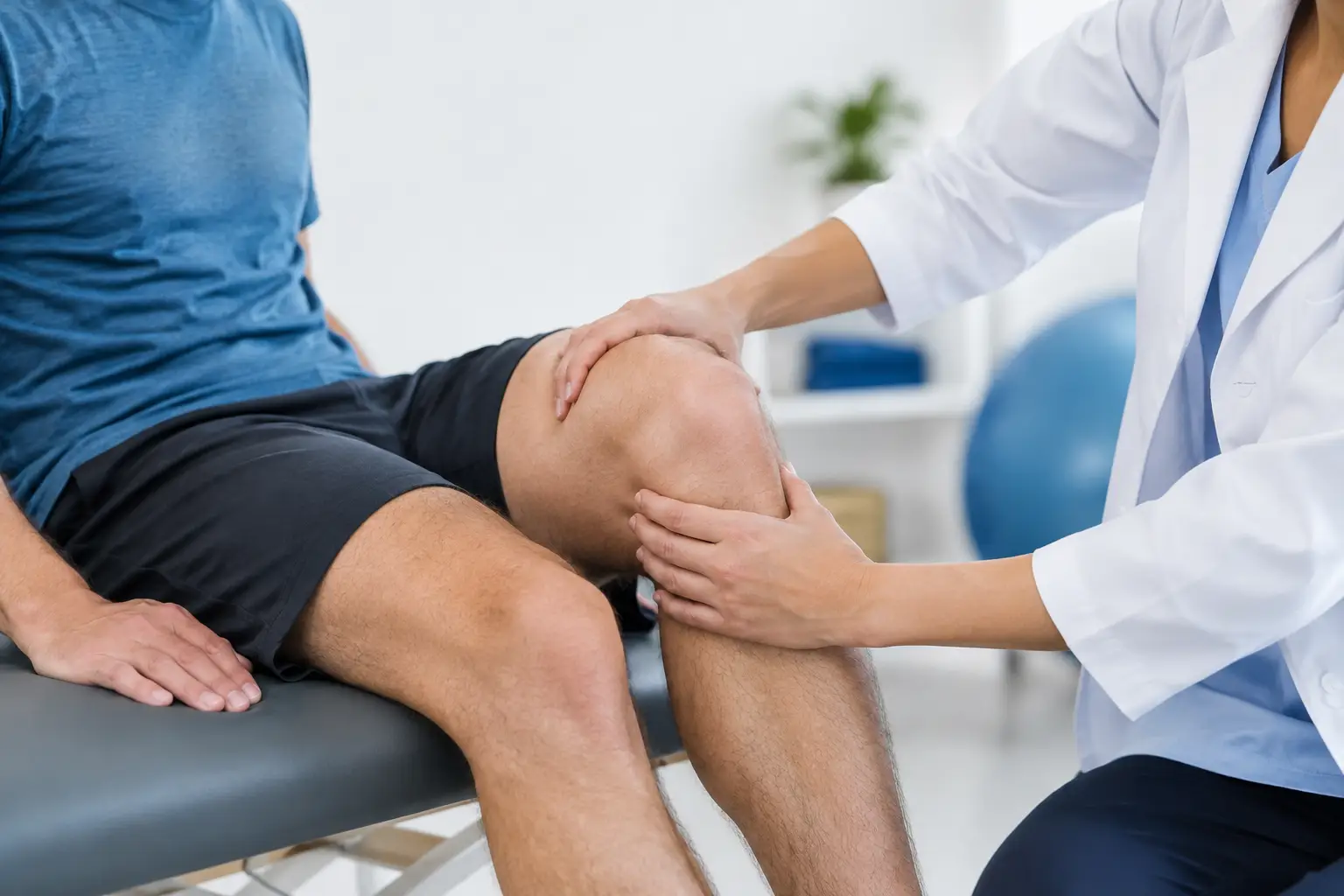
A swollen knee can make a short walk, a flight of stairs or getting up from a chair unexpectedly difficult. The swelling may have appeared after a twist or fall, or it may have built gradually alongside stiffness and pain. Understanding how to treat knee effusion starts with recognising that fluid in the knee is a sign, not a diagnosis. Lasting relief depends on identifying why the joint has produced excess fluid.
What is knee effusion?
Knee effusion is the medical term for an abnormal collection of fluid in or around the knee joint. It is sometimes called water on the knee. A small amount of joint fluid is normal and helps the knee move smoothly. When the joint lining becomes irritated or damaged, it can produce more fluid, causing visible swelling, pressure and reduced movement.
The knee may feel tight, warm or heavy. Bending it fully can be difficult, and some people notice that the swelling worsens after standing, walking or exercise. Effusion can affect one knee or, less commonly, both knees.
There is no single treatment that suits every swollen knee. The correct approach differs significantly between a knee that has swollen after a sporting injury, one affected by osteoarthritis, and one that is hot and painful because of infection or inflammatory arthritis.
When a swollen knee needs urgent assessment
Most knee swelling is not an emergency, but certain symptoms should never be managed by waiting to see whether they settle. Seek urgent medical help if the knee is very hot, red or severely painful, particularly if you feel unwell, feverish or shivery. These can be signs of a joint infection, which requires prompt treatment to protect the joint.
Urgent assessment is also appropriate if swelling follows a significant injury, you cannot bear weight, the knee looks deformed, or it locks and cannot be straightened. A large, rapid swelling after a twist or impact can sometimes indicate bleeding into the joint or a significant ligament, cartilage or bone injury.
Calf swelling, chest pain or shortness of breath require urgent assessment too, as these symptoms can indicate a blood clot rather than a problem confined to the knee.
Early measures for mild knee effusion
If the swelling is mild, there has been no major injury and there are no warning symptoms, a short period of sensible self-care may help settle the irritation. Relative rest is usually better than complete inactivity. Avoid the activity that has aggravated the knee, such as running, deep squats, kneeling or long walks, while maintaining gentle movement within comfort.
Applying a cold pack wrapped in a towel for short periods can reduce discomfort. Elevating the leg when resting may also help, particularly later in the day. A compression bandage or knee support can feel reassuring, but it should be comfortable rather than tight. Remove it if your foot becomes numb, cold, discoloured or increasingly painful.
Simple pain relief or anti-inflammatory medication may be appropriate for some people, but it is not suitable for everyone. Anti-inflammatory medicines can interact with other treatments and may be unsuitable for people with stomach ulcers, kidney disease, certain heart conditions or those taking blood-thinning medication. A pharmacist, GP or orthopaedic specialist can advise on what is safe for you.
These measures can ease symptoms, but they do not repair a torn meniscus, reverse arthritis or treat inflammatory disease. If the effusion returns repeatedly, lasts beyond a few days, or continues to restrict daily life, it is worth arranging a clinical assessment.
How to treat knee effusion by finding the cause
A specialist assessment begins with the story behind the swelling. The timing matters: swelling within hours of an injury can suggest a different problem from swelling that develops the following day. Previous knee surgery, episodes of locking or giving way, inflammatory conditions, medication and changes in activity are all relevant.
Examination helps establish where the tenderness lies, whether the joint is stable and how much movement is available. Depending on the findings, investigations may include X-rays to assess arthritis or bony injury, ultrasound to look at fluid and surrounding soft tissues, or an MRI scan where there is concern about meniscal, cartilage or ligament damage.
Sometimes the fluid itself needs to be tested. Aspirating the knee involves drawing fluid from the joint with a sterile needle. This can relieve uncomfortable pressure and, crucially, allows the sample to be analysed for infection, crystals associated with gout or pseudogout, blood, and inflammatory changes. Aspiration is particularly valuable when the cause is uncertain or infection must be excluded.
Effusion caused by osteoarthritis
Osteoarthritis is a common reason for recurrent knee swelling in adults. As the joint surfaces and supporting structures become worn, the knee can flare after increased activity or sometimes without an obvious trigger. Treatment aims to reduce pain, maintain strength and improve function rather than simply chase the fluid.
A tailored physiotherapy programme can improve the strength of the quadriceps, hip and core muscles, helping to reduce load through the knee. Weight management, where relevant, can also reduce symptoms. A brace, walking aid or adjustment to work and exercise may be useful in selected cases.
For persistent pain, an injection may be considered after an examination and discussion of the likely benefit. A steroid injection can provide short-term relief during an inflammatory flare, although its effect varies and repeated injections are not routinely the best long-term answer. Hyaluronic acid, platelet-rich plasma (PRP) and Arthrosamid may be suitable for some patients, depending on the pattern and stage of arthritis. They should be considered as part of a wider plan, not as a guaranteed alternative to surgery.
Where arthritis is advanced and pain, swelling and loss of mobility continue despite appropriate non-operative care, partial or total knee replacement may offer a more durable solution. The decision should be based on symptoms, examination, imaging and the impact on your life, rather than an X-ray alone.
Effusion after a meniscal or ligament injury
A torn meniscus, ligament injury or cartilage damage can lead to recurrent fluid after twisting, pivoting or impact. Physiotherapy is often the starting point where the knee is stable and symptoms are improving. It can restore movement, build strength and support a safe return to activity.
However, persistent locking, repeated giving way, inability to regain movement or swelling that repeatedly returns may warrant further investigation. Knee arthroscopy can be helpful for selected mechanical problems, but it is not automatically the right treatment for every degenerative meniscal tear. The expected benefit should be clear before proceeding.
Inflammatory and crystal-related causes
Gout, pseudogout and inflammatory arthritis can all cause sudden, painful knee effusion. These conditions require medical treatment directed at the underlying inflammation or crystal disease. An orthopaedic assessment may help clarify the knee problem, but care may also involve a GP, rheumatologist or other specialist.
What to avoid while the knee is swollen
Trying to push through substantial swelling can prolong the flare and alter how you walk, sometimes creating pain in the hip, back or opposite knee. Avoid high-impact exercise, deep loaded bending and twisting movements until the cause is clearer and the knee is settling.
Equally, do not rely on rest indefinitely. Once serious injury and infection have been excluded, progressive movement and strengthening are usually central to recovery. The right level of activity depends on the diagnosis, current pain and your goals, whether that is walking comfortably, returning to work or getting back to golf, tennis or the gym.
A precise plan gives the knee its best chance
A swollen knee deserves more than repeated cycles of rest and pain relief if it keeps coming back. Careful diagnosis can distinguish an arthritis flare from a repairable mechanical problem, inflammatory condition or more urgent cause. For patients in London and Kent with persistent swelling, pain or restricted movement, a hip and knee specialist can provide a clear explanation of the options and a treatment plan centred on restoring confident, comfortable movement.
The most useful next step is not to guess what the fluid means, but to have the knee assessed while the symptoms and their effect on your daily life can be properly understood.