


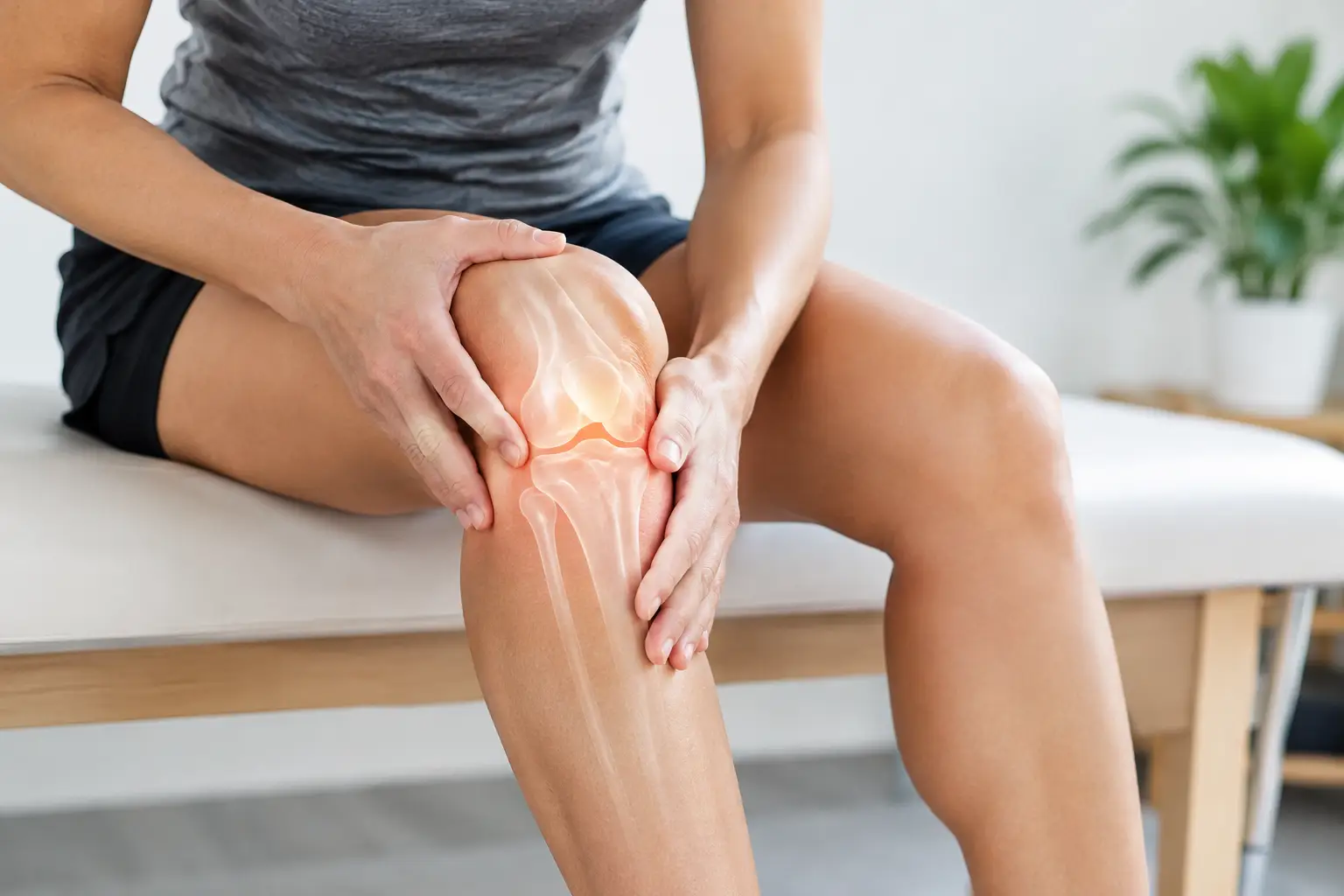
A knee may click as you rise from a chair, climb stairs or squat at the gym. If there is no pain, swelling or loss of movement, the sound is often harmless. Yet when patients ask what causes knee clicking, they are usually also asking whether something inside the joint is wearing out, torn or likely to worsen.
The answer depends on the type of sound, when it occurs and, most importantly, the symptoms that accompany it. A painless occasional click is very different from a painful catch that stops you walking normally or a knee that repeatedly gives way.
What causes knee clicking?
The medical term for crackling, popping or clicking from a joint is crepitus. It is common at every age and does not automatically mean that you have arthritis or need treatment. The knee is a complex joint in which bone, cartilage, tendons, ligaments and the kneecap all move closely together. Several normal processes can create noise.
Small gas bubbles can form in the synovial fluid that lubricates the joint. When they shift or collapse during movement, you may hear a pop. Soft tissues can also move over a bony prominence and create a brief click. Some people notice this only after sitting still, while others hear it during particular exercises such as lunges or stair climbing.
A click becomes more relevant when it is new, persistent or paired with pain. The pattern often gives useful clues, although a proper examination is needed to identify the cause with confidence.
Kneecap movement and patellofemoral irritation
The kneecap, or patella, glides in a groove at the front of the thigh bone as the knee bends and straightens. If it does not track smoothly, there may be grinding, rubbing or clicking behind the kneecap. This can occur with muscle weakness or imbalance around the hip and thigh, a change in training load, previous injury or the natural shape of the joint.
Patellofemoral problems commonly cause discomfort at the front of the knee, particularly on stairs, hills, squatting or after prolonged sitting. The sound itself is less concerning than pain, recurrent swelling or a clear decline in function.
Meniscal injury
The menisci are two firm cartilage cushions between the thigh bone and shin bone. They help distribute load and improve joint stability. A meniscal tear may follow a twisting injury, but it can also develop gradually as tissue becomes less resilient with age.
Some tears cause no symptoms. Others produce a distinct painful click, catching sensation or the feeling that something is briefly trapped in the joint. If the knee locks so that it cannot fully straighten, or if it swells after twisting, timely assessment is sensible. Not every meniscal tear requires surgery. The right approach depends on the tear, the condition of the rest of the knee and the activities you wish to return to.
Cartilage wear and osteoarthritis
Cartilage is the smooth covering on the ends of bones. When it becomes thinner or rougher, movement may feel or sound gritty. Osteoarthritis can therefore cause crepitus, especially alongside stiffness after rest, aching with walking and reduced tolerance for stairs or longer distances.
However, noisy knees are not a reliable measure of arthritis severity. Some people with clear osteoarthritis on an X-ray have little noise or pain, while others have frequent clicking with only early changes. Treatment should be guided by your symptoms, examination and goals, rather than the sound alone.
Tendons, ligaments and soft tissue movement
A tendon can flick over a bony edge during bending or straightening. This may be felt at the inner or outer side of the knee and is often painless. Tightness in surrounding muscles, altered movement patterns and sudden changes in activity can make it more noticeable.
After a ligament injury, clicking combined with instability deserves attention. A knee that buckles, shifts or feels unreliable during turns may need a careful assessment of the ligaments, menisci and cartilage, even if swelling has settled.
After knee injury or surgery
Following an injury or an operation, it is common to be more aware of sensations within the knee. Scar tissue, swelling, altered muscle control and a gradual return to activity can all contribute to clicking. In many cases, this improves as strength and movement recover.
Persistent pain, warmth, increasing swelling or a sudden change in function after surgery should not simply be put down to normal recovery. Your treating team should assess those symptoms, particularly if they are worsening rather than steadily improving.
When knee clicking needs medical assessment
Painless clicking that comes and goes is rarely an emergency. It is reasonable to monitor it while maintaining sensible activity, strength and mobility. The threshold for seeking advice should be lower if the sound is associated with a clear injury or limits your confidence in the knee.
Arrange an assessment if clicking occurs with persistent pain, recurrent swelling, stiffness that affects daily life, catching or locking, a sense of giving way, or difficulty fully bending or straightening the knee. These features can point to a mechanical problem within the joint or to arthritis that would benefit from a structured management plan.
Seek urgent medical attention after a significant injury if you cannot bear weight, the knee is visibly deformed, rapidly swells, becomes hot and red with fever, or you develop calf swelling or breathlessness. These symptoms need prompt assessment for causes beyond a simple click.
How a specialist identifies the cause
A useful consultation begins with the story behind the noise. When did it start? Was there a twist, fall or change in exercise? Is the click painful, and can you point to where it happens? Do stairs, walking, kneeling or sport bring it on? Answers to these questions often narrow the possibilities considerably.
The knee is then examined for swelling, tenderness, alignment, range of movement, stability and the way the kneecap moves. Your hip, gait and muscle strength may also be assessed, as these can influence how the knee is loaded.
An X-ray can show arthritis, alignment and bony changes. MRI scanning is sometimes helpful for assessing meniscal tears, cartilage injuries or ligament damage, but it is not required for every clicking knee. Scans can reveal age-related changes that are not necessarily the source of pain, so the findings must always be interpreted alongside your symptoms and examination.
Treatment is directed at symptoms, not the sound
If clicking is painless and the knee functions well, reassurance may be all that is needed. There is no benefit in avoiding all movement simply because a joint makes noise. Regular low-impact activity, gradual strengthening of the thigh and hip muscles, and attention to technique can improve comfort and confidence for many people.
Where pain is present, physiotherapy may help restore control around the knee and address reduced strength or flexibility. Adjusting a training programme temporarily can be more effective than stopping activity altogether. Weight management, where relevant, can also reduce load through an arthritic knee without making unrealistic promises about a quick fix.
Medication and injections may be considered for selected patients, particularly when inflammation or osteoarthritis is contributing to symptoms. Options such as steroid injections, hyaluronic acid, platelet-rich plasma and Arthrosamid have different purposes and evidence bases. Their suitability depends on the diagnosis, the degree of joint change and your wider health, so they should be discussed as part of an individual plan rather than viewed as interchangeable treatments.
Arthroscopy may be appropriate for certain mechanical problems, including some symptomatic meniscal tears or loose bodies. It is not usually a solution for general arthritic crepitus alone. For advanced arthritis causing substantial pain and restriction despite non-operative treatment, partial or total knee replacement may offer a more durable route back to comfortable movement. The decision should rest on the impact on your life, not on an X-ray or clicking sound in isolation.
A specialist hip and knee assessment can clarify whether your symptoms are likely to settle with targeted non-operative care or whether further investigation is worthwhile. For patients in London and Kent, Mr. Kam Cheema’s practice provides this focused approach, with treatment planned around pain reduction, mobility and the activities that matter to you.
A clicking knee is often simply a noisy knee. But if it is painful, swollen, unstable or stopping you from walking, working or exercising as you would like, getting a clear diagnosis can replace uncertainty with a practical plan for moving forward.