


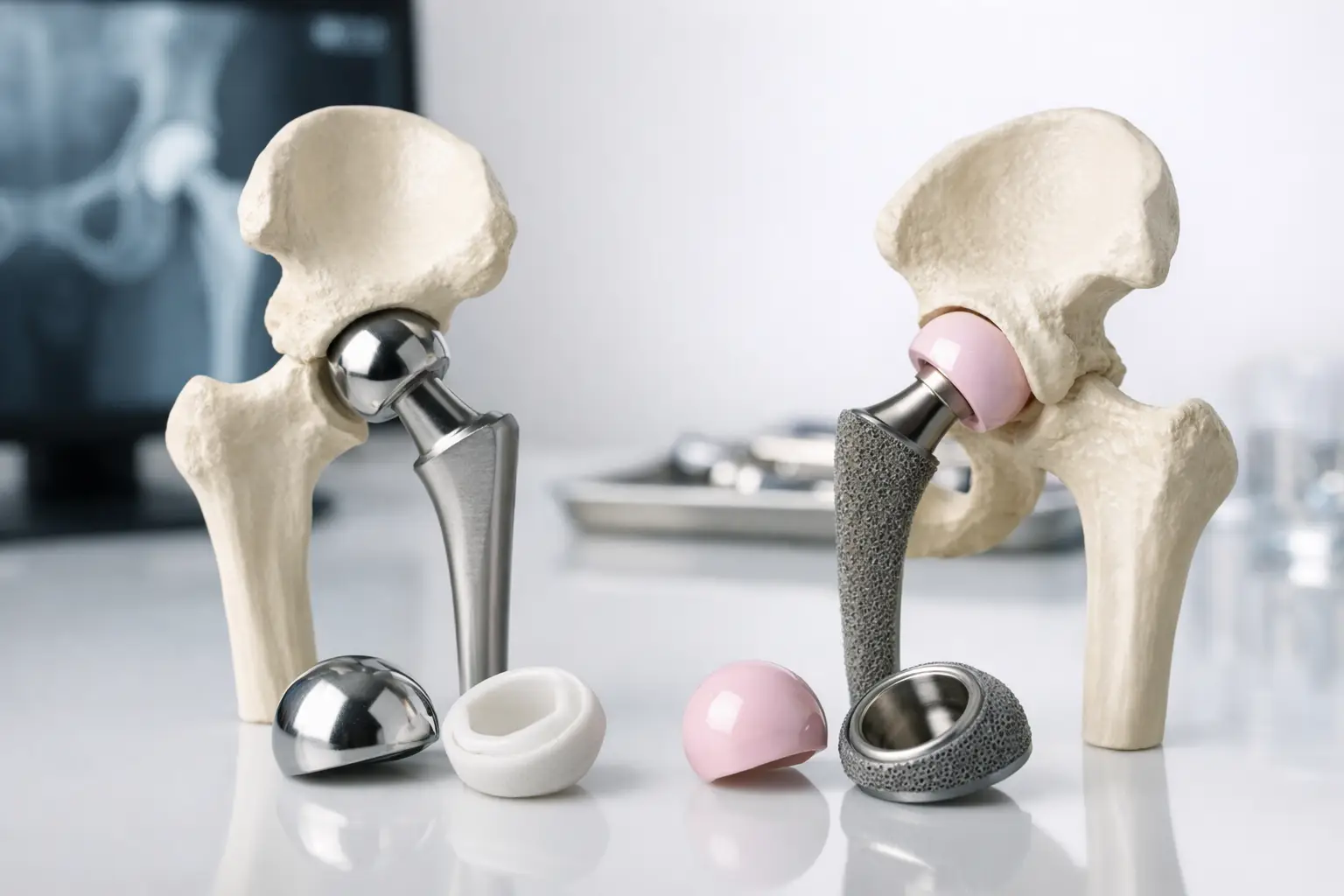
A hip implant comparison can quickly become confusing. Terms such as ceramic, titanium, cemented, uncemented and dual mobility describe genuine differences, but they do not create a simple league table of ‘best’ implants. The right choice is the one that fits your anatomy, bone quality, diagnosis, activity goals and the technical requirements of your operation.
For many people considering total hip replacement, the most useful question is not “Which implant is best?” but “Why is this implant appropriate for me?” A specialist surgeon should be able to explain that decision clearly, including the expected benefits, the trade-offs and the alternatives.
What a total hip implant replaces
A total hip replacement substitutes the damaged ball-and-socket joint with carefully engineered components. The femoral component, or stem, sits inside the thigh bone and supports a new ball. The acetabular component, or cup, is fitted into the pelvic socket. A liner sits within the cup, creating a smooth bearing surface for the new ball to move against.
Implants come in different shapes, sizes and materials because hips and patients are different. The aim is to restore stable movement, leg length and hip mechanics while reducing pain from arthritis or other joint damage. Implant selection is therefore part of a wider surgical plan, not a choice made in isolation.
Hip implant comparison: the key decisions
The main areas compared are fixation, bearing surfaces, component design and the level of constraint or stability built into the joint. Each has a role, and each depends on the individual patient.
Cemented and uncemented fixation
A cemented stem is secured using specialist bone cement. This provides immediate fixation and can be particularly useful when bone is softer or less dense. It is a well-established option with a long clinical history, especially for some older patients or those with osteoporosis.
An uncemented implant has a textured or porous surface designed to allow bone to grow onto it over time. It relies on a precise initial fit and good bone quality. Uncemented cups are commonly used, while the choice of a cemented or uncemented stem is more individual. Neither approach is automatically superior. The surgeon considers the shape of the femur, bone strength, age, health, mobility and the reason for surgery.
Some operations use a hybrid approach, combining a cemented component with an uncemented one. This is not a compromise in quality. It can be a deliberate choice to achieve secure fixation in both parts of the joint.
Bearing surfaces: what moves against what
The bearing is the combination of materials used for the new ball and liner. In modern practice, a ceramic head with a highly cross-linked polyethylene liner is a common and dependable combination. Polyethylene is a sophisticated medical-grade plastic, not the ordinary plastic many people picture. Highly cross-linked versions are designed to reduce wear significantly.
Ceramic heads are very hard and smooth, which may help minimise wear of the liner. Metal heads with modern polyethylene liners also remain an established option in appropriate cases. Ceramic-on-ceramic bearings have very low wear characteristics but may carry specific considerations, including the small possibility of noise from the joint and the fact that they are not suitable for every anatomy or surgical situation.
The practical objective is a durable, low-wear bearing that supports comfortable movement over the long term. For most patients, the difference between two suitable modern bearings is less significant than accurate implant positioning, careful soft-tissue handling and a well-managed recovery.
Head size and stability
The diameter of the femoral head can influence stability. A larger head may make dislocation less likely by increasing the range of movement available before the joint comes out of position. However, larger is not always better. The surgeon must balance stability against the thickness of the liner, the size of the patient’s natural socket and the implant system being used.
Stability also depends on restoring the right hip offset, leg length and tension in the surrounding muscles. This is why detailed pre-operative planning matters. It is not simply a matter of selecting a larger component in theatre.
Standard and dual-mobility cups
Most primary hip replacements use a standard cup and liner. In patients with a higher risk of instability, a dual-mobility cup may be considered. This design allows movement at two interfaces and can provide added stability.
Dual-mobility implants may be helpful in selected situations, such as certain complex reconstructions, revision hip replacement or patients with particular risk factors for dislocation. They are not routinely necessary for every first hip replacement. Using additional technology when it is not needed is not automatically safer; the decision should reflect the individual risks and expected benefits.
Why implant brand is only part of the picture
Patients understandably ask about implant manufacturers and may find strongly held opinions online. Established implant systems are supported by clinical evidence, quality control and long-term outcome data. A surgeon will usually work with systems they know well and can use precisely across a range of anatomical and clinical situations.
However, choosing a hip replacement is not like comparing consumer products. A well-performing implant can give poor results if it is incorrectly positioned, while an appropriate implant placed with meticulous planning and technique can provide excellent function for many years.
In the UK, national joint replacement data and published evidence help surgeons assess implant performance over time. This information is valuable, but it must be interpreted in context. An implant with excellent results in one patient group may not be the right choice for another person with different bone quality, anatomy or previous surgery.
The factors that should shape your implant choice
Your diagnosis matters. Straightforward osteoarthritis in an otherwise healthy hip is different from hip dysplasia, previous fracture surgery, avascular necrosis, inflammatory arthritis or a failed earlier replacement. Complex anatomy can require different component options, augments or custom planning.
Age and activity are relevant, although they should not be treated as a shortcut. A younger, active patient may need an implant strategy designed with long-term wear and the possibility of future revision in mind. An older person who remains very active may have equally demanding functional goals. The important conversation is about the activities that matter to you – walking the dog, getting back to work, gardening, travelling, caring for family or returning to sport.
Bone quality is another major factor. A patient with reduced bone density may benefit from a different fixation strategy from someone with strong, healthy bone. Body shape, spinal stiffness, previous surgery and muscle function can also affect the plan, particularly where stability is a concern.
Custom and complex hip replacement planning
In complex cases, standard implant sizes may not provide the best fit or restore the hip centre accurately. CT-based planning, three-dimensional assessment and, in selected circumstances, custom implants can help address substantial bone loss or unusual anatomy.
This is most often relevant in revision surgery, where a previous hip replacement has loosened, worn or become unstable, or after major trauma and reconstructive surgery. Revision hip replacement requires a different level of planning because the surgeon must manage existing components, altered bone and scar tissue while rebuilding a stable, functional joint.
Custom solutions are valuable when they solve a specific problem. They are not inherently better than standard implants for a routine primary replacement. The aim is always to use the least complex solution that can safely achieve a durable result.
Questions worth asking at your consultation
A good consultation should leave you with a clear understanding of the operation being recommended. You may wish to ask why a particular fixation method suits your bone, which bearing surface is proposed, whether your anatomy creates any stability concerns and what recovery is likely to involve.
It is also reasonable to ask about the surgeon’s experience with the proposed procedure, how leg length and implant position are planned, and what happens if an unexpected issue is found during surgery. Clear answers support informed consent and help set realistic expectations.
Hip replacement is designed to relieve pain and restore useful movement, not to make a joint biologically new. Many patients return to active, independent lives, but recovery takes commitment to rehabilitation, pacing and the guidance of the clinical team.
The most reassuring hip implant comparison is one made with your own scans, examination findings and goals in view. When the implant choice is explained as part of a precise, personalised plan, you can approach surgery with greater confidence in both the decision and the recovery ahead.