


When knee arthritis makes stairs, walking, exercise or even getting up from a chair increasingly difficult, the question is rarely simply whether treatment is available. It is which treatment offers a sensible chance of reducing pain while preserving the activities that matter to you. PRP injections for knee arthritis are one non-surgical option that may help selected patients, particularly where symptoms are persistent but joint replacement is not yet the right step.
PRP is not a cure for arthritis, and it cannot restore severely worn joint surfaces. However, for the right person, it may reduce pain and improve day-to-day function for a period of time. A careful assessment is essential so that treatment is based on the condition of your knee, your symptoms and your goals, rather than a one-size-fits-all approach.
What is PRP treatment?
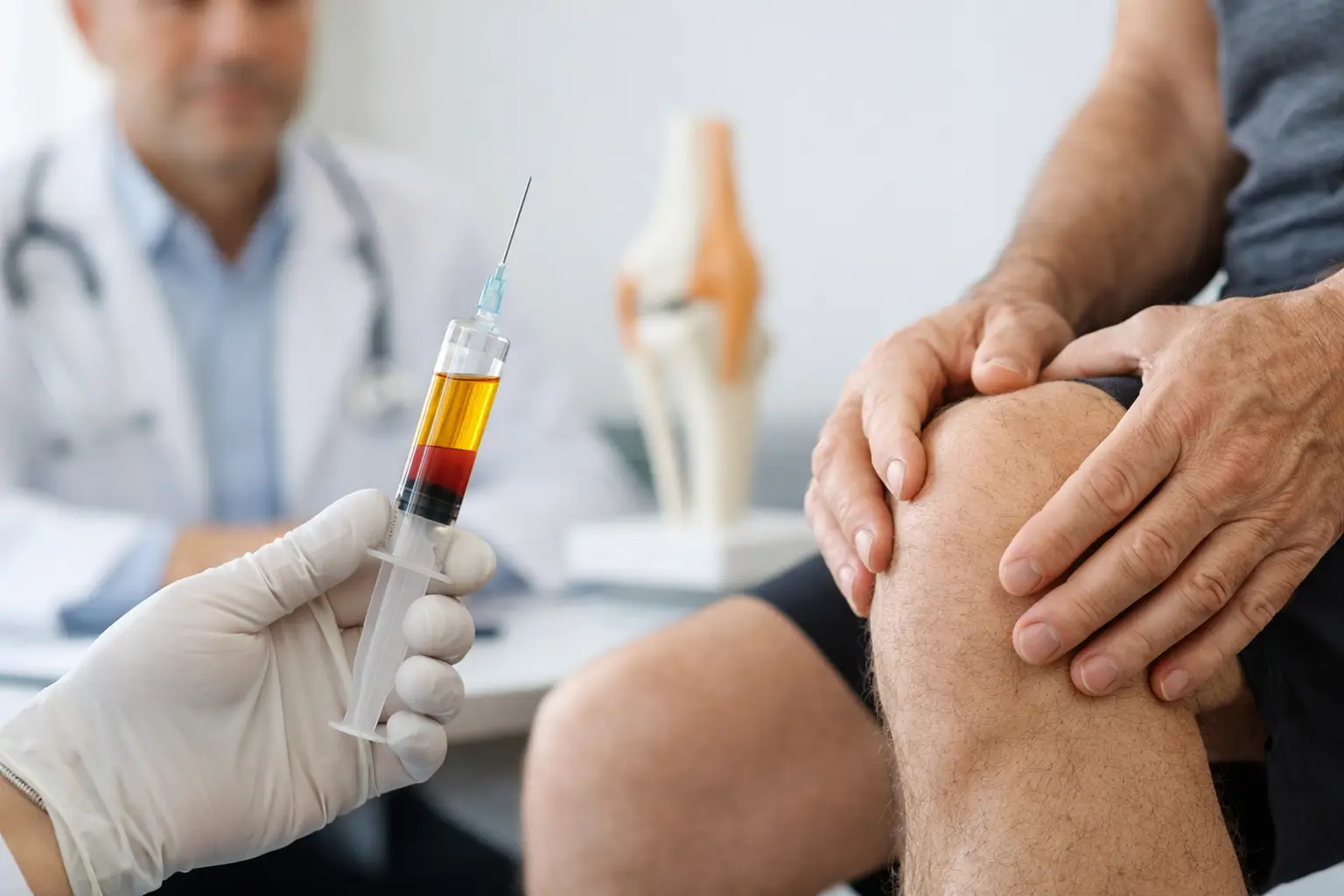
PRP stands for platelet-rich plasma. Platelets are components of your blood involved in healing and tissue repair. During treatment, a small sample of your blood is taken and placed in a centrifuge, which separates and concentrates the platelet-rich portion. This is then injected into the affected knee.
The aim is to use the signalling proteins and growth factors within your own blood to influence inflammation and support the joint environment. PRP is an autologous treatment, meaning the injection is prepared from your own blood. This reduces the risk of an allergic reaction to the injected material.
It is often considered as part of a broader plan for managing knee osteoarthritis. That plan may also include strengthening work, activity modification, weight management where appropriate, pain relief, bracing or other injection treatments. The best approach depends on what is driving your pain and how advanced the arthritis has become.
Who may benefit from PRP injections for knee arthritis?
PRP tends to be considered for people with mild to moderate knee osteoarthritis who have ongoing pain, stiffness or reduced confidence in the knee despite sensible non-operative measures. You may be finding that a previously enjoyable walk is becoming shorter, that golf or cycling is less comfortable, or that work and family life are affected by pain after activity.
Results can be less predictable in advanced arthritis, particularly where there is marked loss of joint space, significant deformity, instability or bone-on-bone change. In these circumstances, an injection may still occasionally have a role, but it should not be presented as a substitute for a treatment that more directly addresses the structural problem. For some patients, partial or total knee replacement provides the more reliable route to lasting pain relief and restored mobility.
Your suitability also depends on your general health and medical history. Blood-thinning medication, certain blood disorders, active infection, uncontrolled diabetes and inflammatory joint disease may affect whether PRP is appropriate or how it should be planned. A specialist consultation should include an examination of the knee and, where needed, up-to-date X-rays or other imaging.
The importance of an accurate diagnosis
Not all knee pain in someone with arthritis comes from arthritis alone. A meniscal tear, ligament problem, kneecap arthritis, referred pain from the hip, or an alignment issue can all alter the right treatment pathway. This is why a precise diagnosis matters before proceeding with an injection.
An experienced hip and knee specialist will assess where your pain is located, when it occurs, whether the knee swells or gives way, and how it affects your movement. The aim is not simply to offer an injection, but to identify the treatment most likely to improve your function.
What happens during the procedure?
PRP treatment is usually carried out as an outpatient procedure. After blood is taken from your arm, the sample is processed to prepare the platelet-rich plasma. The skin around the knee is cleaned carefully before the injection is given. In some cases, ultrasound guidance may be used to improve the accuracy of placement.
The appointment itself is generally straightforward, although the knee can feel sore or full for a few days afterwards. This short-term flare is usually managed with relative rest, ice if advised, and simple pain relief. Your clinician will provide individual guidance about medication, particularly anti-inflammatory medicines, as recommendations can vary according to your circumstances and treatment protocol.
Most people can walk after the injection, but it is sensible to avoid strenuous exercise, impact activity and heavy lifting for a short period. A gradual return to strengthening and low-impact activity is often encouraged once the initial soreness settles. Building strength around the knee remains an important part of protecting the joint and improving confidence in movement.
When might you notice a difference?
PRP does not usually provide the immediate effect sometimes associated with a local anaesthetic or steroid injection. Improvement, when it occurs, is more often gradual over several weeks. Some people report less pain and easier movement within a month, while for others the benefit takes longer to become clear.
The degree and duration of response vary considerably. Research suggests PRP may improve pain and function for some people with knee osteoarthritis, especially in earlier-stage disease, but preparation methods, injection schedules and study quality differ. It is therefore not possible to guarantee a particular outcome or duration of benefit.
Some protocols use a single injection, while others recommend a course. The appropriate approach should be discussed openly, including the expected costs, the evidence for the proposed regimen and what the next step would be if symptoms do not improve.
How does PRP compare with other knee injections?
Steroid injections can be useful when inflammation and swelling are prominent, and they may provide quicker short-term relief. Their effect can wear off, however, and repeated use is not suitable for every knee. Hyaluronic acid injections aim to improve lubrication and cushioning within the joint, with variable results between patients.
Arthrosamid is another non-operative option that may be considered in selected cases of knee osteoarthritis. Unlike PRP, which is prepared from your blood, it is a hydrogel injection designed to integrate into the joint lining. Each treatment has different potential benefits, limitations and evidence, so the choice should be guided by your symptoms, imaging and priorities.
PRP may be appealing if you prefer an injection based on your own blood and wish to explore a regenerative option before considering surgery. Yet it is not automatically the best choice simply because it is marketed as regenerative. Honest advice means recognising when a knee is unlikely to respond sufficiently to injections and discussing more definitive options when appropriate.
Risks and realistic expectations
PRP is generally well tolerated, but no injection is entirely without risk. Temporary pain, swelling, stiffness or bruising can occur after treatment. Infection is uncommon but serious, and should be discussed as part of informed consent. There may also be no meaningful improvement, even where the procedure is technically successful.
The most useful measure of success is often practical: can you walk further, sleep more comfortably, manage stairs with less difficulty, return to a preferred activity or rely less on pain medication? Setting these goals before treatment makes it easier to judge whether PRP has delivered a worthwhile benefit for you.
PRP should also be viewed as a way of managing symptoms, not as a means of delaying necessary surgery indefinitely. If pain is severe, mobility is steadily declining and everyday life is becoming restricted, a discussion about knee replacement may be more constructive than repeating treatments that offer diminishing returns.
A specialist assessment can clarify whether PRP is a reasonable option for your knee or whether another treatment is more likely to give you dependable relief. The right decision is the one that supports safer movement, less pain and a return to the life you want to lead.