


Choosing the Right Knee Operation for Long-Term Comfort
Being told you need a knee replacement can feel worrying. Many people are not sure if a partial knee replacement is enough or if a full, total knee replacement is safer in the long run. The choice is not just about age or how active you are; it is mainly about where the arthritis is and how badly each part of the knee is worn.
Modern imaging, clear examination, and an honest discussion about your goals all help guide this decision. With Mr Kam Cheema, we focus on the true pattern of arthritis, rather than a one-size-fits-all plan, and we also avoid operations such as arthroscopy that are unlikely to help when arthritis is already advanced. Some people also find that planning surgery for warmer months makes early walking and outdoor rehabilitation feel that bit easier, though the right timing is always personal.
Understanding Knee Arthritis Patterns and Symptoms
The knee is not just one joint. It has three main compartments that can age at different speeds:
- Medial compartment, the inner side of the knee
- Lateral compartment, the outer side of the knee
- Patellofemoral compartment, behind the kneecap where it glides in a groove
Osteoarthritis is the most common problem. The smooth cartilage that cushions the bone wears down, which can lead to stiffness, swelling, and pain. The exact pattern of symptoms often reflects which part of the knee is affected.
You might notice:
- Inner (medial) pain, especially when walking or standing for longer periods
- Outer (lateral) pain that worsens with side-to-side movements or uneven ground
- Pain behind or around the kneecap when using stairs, hills, squatting or getting out of a chair
People with mainly medial arthritis often walk with a bow-legged look, while lateral wear can create a more knock-kneed appearance. When one compartment is clearly the main source of trouble and the others are still healthy, a partial knee replacement may be an option. If pain is all around the knee, there is marked deformity or the knee feels unstable or very stiff, this usually points towards a total knee replacement instead.
How X-Rays and MRI Guide the Surgical Plan
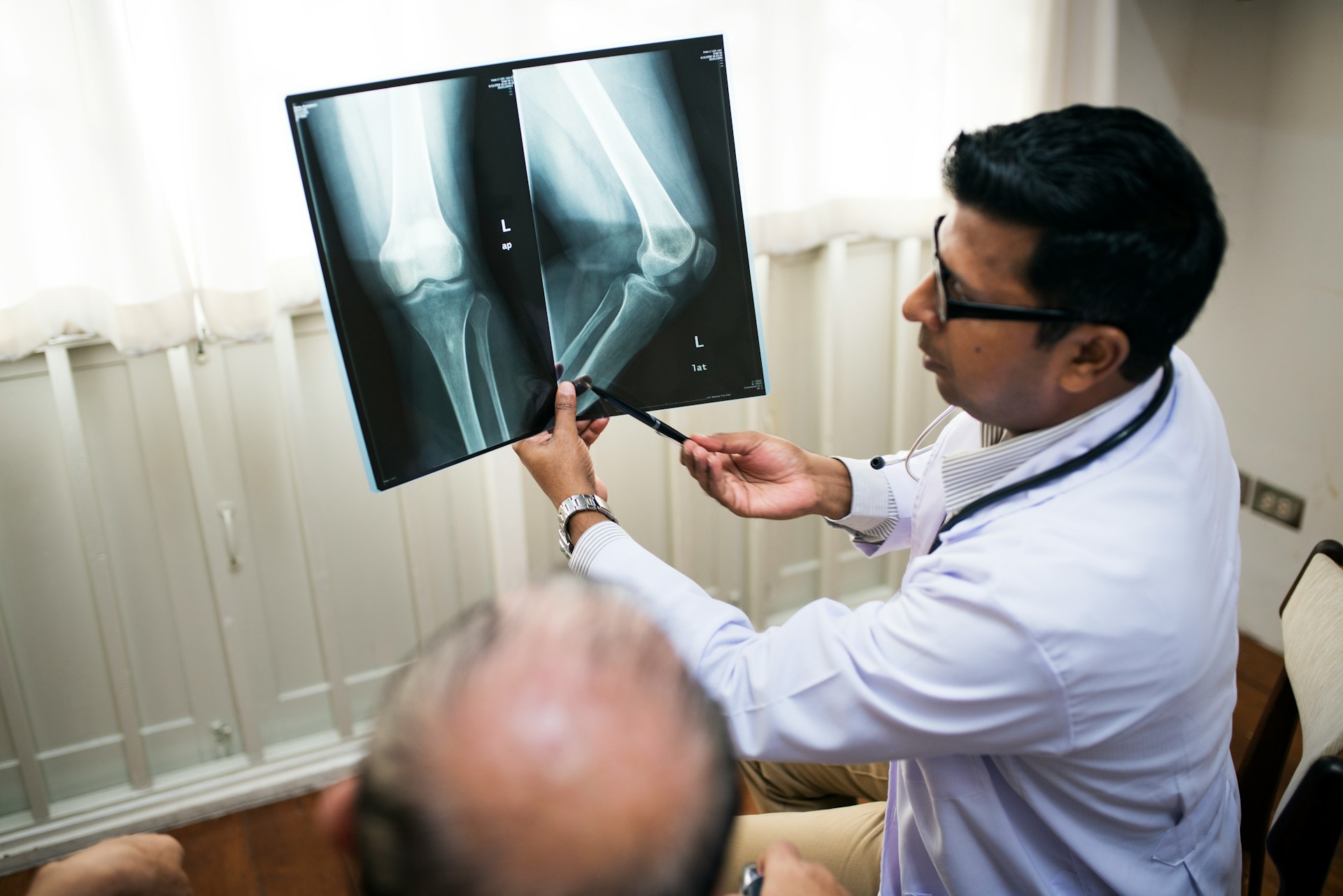
Imaging is a key part of choosing the right operation. Standard weight-bearing X-rays, taken with you standing, show how the joint behaves when it carries your body weight. They help us see:
- How much joint space is lost in each compartment
- Whether the bones are rubbing directly on each other
- Bone spurs around the joint edges
- Overall alignment of the leg from hip to ankle
If the X-ray suggests arthritis is mainly in one compartment, an MRI scan can be helpful to confirm the picture. MRI shows the soft tissues as well as the bone, so we can assess:
- Remaining cartilage thickness
- Meniscal tears and how old or new they look
- Ligament health, especially the cruciate ligaments
- Early wear in other compartments that might not yet show on X-ray
We then bring together:
- What you tell us about your pain and daily limits
- What we find on examination of your knee, gait and leg alignment
- What the X-rays and, if needed, the MRI show
This joined-up view helps us decide whether a partial knee replacement is realistic, or if a total replacement will better match your current arthritis and future plans. Sometimes, it also leads to the conclusion that surgery would not improve function enough right now, in which case non-operative care may be more suitable.
Partial Knee Replacement Benefits and Limitations
A partial knee replacement, often called a unicompartmental replacement, targets one worn area of the knee while leaving the rest of the joint alone. There are several patterns:
- Medial partial knee replacement
- Lateral partial knee replacement
- Patellofemoral replacement, focused on the kneecap compartment
- In some cases, more than one compartment can be treated while still preserving some native joint
People most likely to benefit are those with:
- Arthritis clearly limited to one compartment
- Good ligament support
- Reasonable knee movement with no major deformity
- Stable alignment that does not swing too far into bow-leg or knock-knee
Advantages can include a smaller incision, quicker early recovery and a knee that often feels more natural because the healthy parts and ligaments are preserved. Many patients find the joint feels more like their own, especially for bending and straightening.
There are also limits. The rest of the knee has to be in reasonably good condition. If arthritis is already widespread, a partial procedure may not give lasting relief. There is also the chance that arthritis may progress in the untreated compartments over time, which might later require conversion to a total knee replacement. For some people, going straight to a total knee replacement is safer and more reliable.
When a Total Knee Replacement Is the Better Choice
A total knee replacement becomes the clearer option when more than one compartment is significantly worn. Signs include:
• Pain in several parts of the knee, not just one spot
• Obvious deformity that does not correct when you lie down
• Feeling that the knee wants to give way
• Marked loss of movement or a stiff, locked feeling
In a total knee replacement, the damaged surfaces in all three compartments are resurfaced with implants, and the alignment of the whole leg can be corrected. This helps rebalance the joint, address widespread wear and support more predictable long-term comfort in the right patient.
Recovery after a total knee replacement is usually a bit longer than after a partial procedure, with more healing time and structured physiotherapy. However, for many people, the trade-off is worth it, as the entire joint is addressed in one operation. Activity levels often return to comfortable walking, stairs, travel and light sport, as long as expectations are realistic and we agree a shared plan before surgery.
Why Arthroscopy Often Fails in Advanced Knee Arthritis
Knee arthroscopy is keyhole surgery where a camera and small instruments are passed into the joint. It can be very helpful in younger knees with injuries such as simple meniscal tears, loose bodies or early cartilage damage. In these situations, trimming a torn meniscus or smoothing a rough area can settle symptoms.
In established osteoarthritis, the picture is different. Once the cartilage has worn away across a joint surface, washing the knee out or trimming small fragments often does not change the underlying problem. Pain may return quickly because the bones are still rubbing and the joint lining is still inflamed.
Many people are offered arthroscopy in the hope it will “buy time”, but for advanced arthritis this can mean:
- Extra recovery without clear benefit
- Ongoing pain and swelling
- Delay in planning a more definitive treatment that could actually change function
With Mr Kam Cheema, the goal is to match the procedure to the true stage of arthritis. If imaging shows advanced wear, we are usually honest that arthroscopy is unlikely to help and focus instead on options such as partial knee replacement, total knee replacement or non-operative care tailored to you.
Planning Your Best Summer of Mobility with Mr Kam Cheema
Planning ahead for knee treatment can make a big difference to how confident you feel about walking, holidays and family activities. Some people like to arrange surgery when the days are longer and pavements are drier, as it can make early walks and outdoor exercises feel more comfortable. Others prefer a quieter time of year when support at home is easier. There is no single right answer, only what fits your life best.
It can help to keep a simple symptom diary for a few weeks. Note:
- Where the pain is: inner, outer, or behind the kneecap
- What activities trigger it: stairs, hills, standing, or sport
- How stiff the knee feels first thing in the morning
- Any giving-way or locking sensations
Bringing this, along with any previous scans or X-rays, to a consultation with Mr Kam Cheema can make the discussion clearer and more focused. Together, you can review whether a partial knee replacement, a total knee replacement or careful non-surgical management is most suitable, and plan a pathway that aims to return you to steadier, more confident movement.
Take The Next Step Towards Confident, Comfortable Movement
If knee pain is limiting your day-to-day life, we can help you understand whether a partial knee replacement is the right option for you. At Mr Kam Cheema Hip & Knee Surgeon, we take time to explain your choices clearly so you can make an informed decision with confidence. To arrange a tailored assessment or ask specific questions about your situation, please contact us and we will be in touch promptly.