

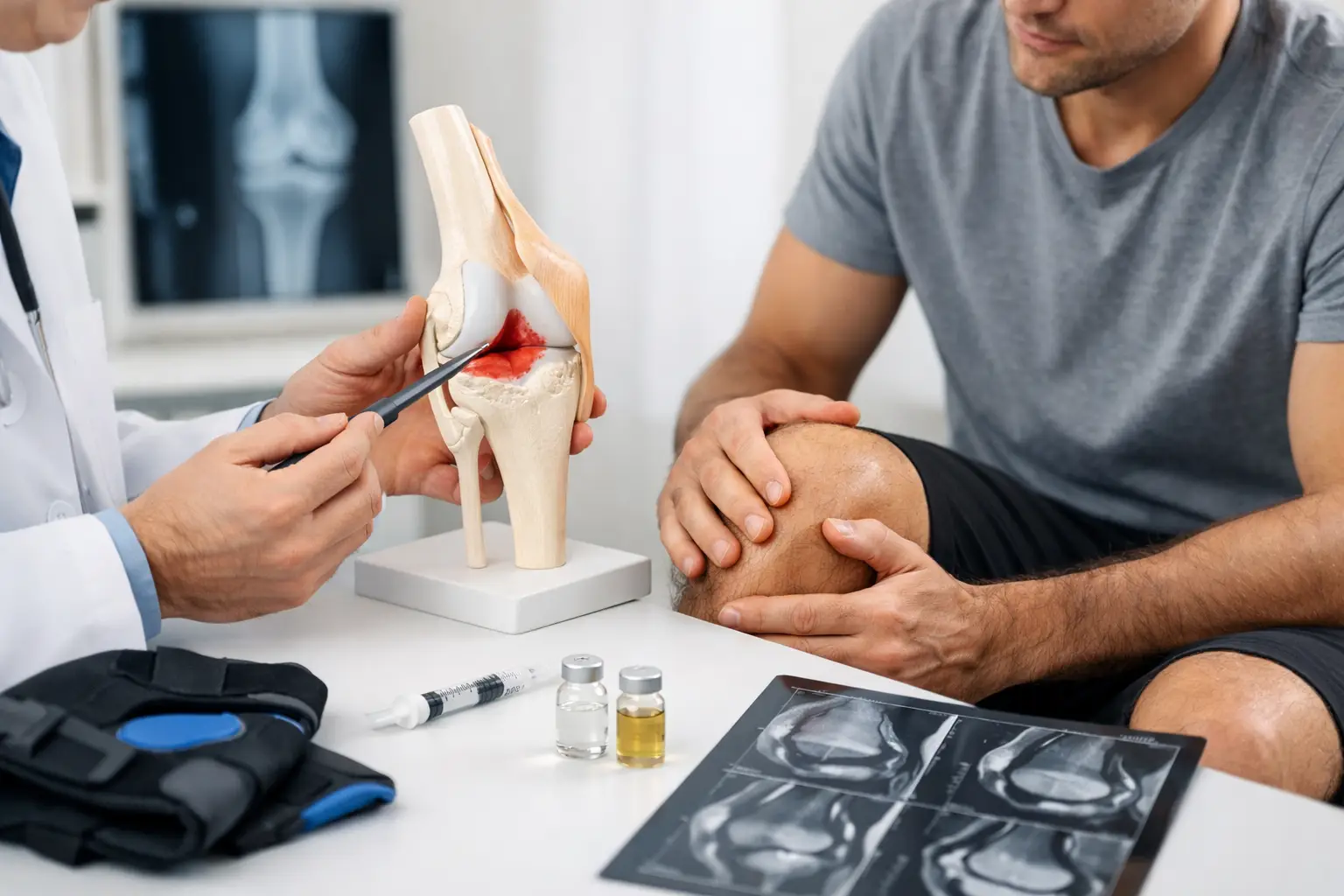
A meniscus tear can make ordinary movements unexpectedly difficult: turning in the kitchen, getting out of a car, climbing stairs or returning to a favourite sport. The right meniscus tear treatment options depend not only on what the scan shows, but also on how your knee feels, how the injury happened, the type and position of the tear, and what you need to get back to doing.
For some people, a carefully planned non-operative programme provides excellent relief and restores confidence in the knee. For others, persistent catching, locking or pain may point towards arthroscopic surgery. A specialist assessment helps distinguish between these situations, so treatment is based on your individual knee rather than an image alone.
Understanding the role of the meniscus
The menisci are two tough, crescent-shaped pads of cartilage that sit between the thigh bone and shin bone in each knee. They help distribute load, absorb shock and contribute to stability. The inner meniscus is called the medial meniscus; the outer one is the lateral meniscus.
A tear may occur suddenly after a twist, pivot or sporting injury. It can also develop gradually as the tissue becomes less resilient with age, often alongside early arthritis. These are different clinical situations. A tear following a football injury in an otherwise healthy knee may be managed differently from a degenerative tear identified on an MRI scan in someone with established osteoarthritis.
Pain along the joint line, swelling, stiffness, clicking and a sense that the knee may give way are common symptoms. Some people can fully straighten and bend the knee but find longer walks painful. Others experience true mechanical locking, where a displaced portion of meniscus prevents normal movement. This distinction matters when deciding how urgently to investigate and treat the problem.
Meniscus tear treatment options: choosing a sensible starting point
Treatment should protect as much healthy meniscal tissue as possible while addressing the symptoms that limit your life. There is no benefit in rushing into an operation simply because a scan identifies a tear. Equally, ongoing locking or disabling pain should not be dismissed when it is affecting work, sleep, mobility or exercise.
Activity modification and symptom control
In the early stages, reducing the movements that aggravate the knee can settle pain and swelling. This does not necessarily mean complete rest. Gentle movement is usually helpful, but repeated twisting, deep squatting, running or impact activity may need to be paused temporarily.
Simple measures such as ice after activity, appropriate pain relief and, in selected cases, a short period using a support or crutches can help you move more comfortably. The aim is to calm the knee enough to allow a progressive return to normal movement, rather than becoming overly protective of it.
Targeted physiotherapy and rehabilitation
A structured physiotherapy programme is often the foundation of non-operative care. It focuses on restoring full range of movement, improving quadriceps and hip strength, and rebuilding balance and control around the knee. Better muscle function can reduce the load passing through an irritated area of meniscus and improve confidence during walking, stairs and everyday activities.
Rehabilitation needs to reflect the person in front of you. Someone preparing to return to tennis may require a different progression from someone whose priority is walking the dog comfortably or managing a physically demanding job. Improvement is usually measured over weeks rather than days, with exercises advanced as swelling, pain and control improve.
For many degenerative meniscal tears, especially where there is no true locking, high-quality rehabilitation can offer results comparable to surgery. It also helps clarify whether the meniscus is the main source of symptoms or whether arthritis, tendon irritation or another knee condition is contributing.
Injections when inflammation or arthritis contributes
An injection does not repair a torn meniscus. However, it can be useful in particular circumstances, especially where inflammation or arthritis is amplifying knee pain and preventing effective rehabilitation.
A steroid injection may reduce inflammation for a period of time, while hyaluronic acid, platelet-rich plasma (PRP) or Arthrosamid may be considered for suitable patients with knee osteoarthritis. The most appropriate choice depends on the condition of the joint, your medical history and treatment goals. These options should be discussed honestly: they can reduce symptoms for some people, but they are not a substitute for treating a mechanically displaced tear or advanced joint damage where another intervention is more appropriate.
When arthroscopic surgery may be recommended
Knee arthroscopy is a keyhole procedure that allows the surgeon to inspect and treat structures inside the joint using a small camera and fine instruments. It may be considered when symptoms continue despite an appropriate period of non-operative treatment, or when the tear is causing mechanical problems such as locking.
The two principal surgical approaches are meniscal repair and partial meniscectomy. The preferred option is determined by the pattern of the tear, its location, tissue quality and the overall condition of the knee.
Meniscal repair
Where possible, repairing the meniscus is preferable because it preserves its cushioning and load-sharing function. A surgeon may use sutures or specialised fixation devices to stabilise the tear while it heals. Repairs are more likely to be feasible in tears near the outer edge of the meniscus, where blood supply is better, and in certain traumatic tears.
The trade-off is a more protective rehabilitation period. You may need to limit weight-bearing, bending or twisting for a time while the repair heals, depending on the technique used. Recovery requires patience, but preserving meniscal tissue can be particularly valuable for younger, active patients and for long-term knee health.
Partial meniscectomy
If a portion of meniscus is unstable, badly damaged or unlikely to heal, partial meniscectomy may be advised. This means carefully trimming only the torn, unstable section while retaining as much normal meniscus as possible. It can relieve catching and pain caused by a flap or displaced fragment.
Recovery after partial meniscectomy is often quicker than after repair, but removing meniscal tissue has a long-term trade-off: less meniscus means less cushioning in that part of the knee. For this reason, the decision is not simply about the fastest route back to activity. Precise surgical judgement is needed to balance current symptoms with protecting the joint for the future.
The importance of arthritis and tear type
An MRI scan can be helpful, but it is only one part of the assessment. Meniscal tears are common in middle age and later life, including in people who have no knee pain. If the knee also has significant arthritis, the visible tear may not be the main driver of symptoms.
Arthroscopy is not routinely the best answer for pain caused mainly by osteoarthritis. In that setting, a plan focused on activity modification, physiotherapy, weight management where appropriate, injections and arthritis-specific treatment may offer more meaningful benefit. If arthritis becomes advanced and pain has a major effect on daily life, partial or total knee replacement may be a more durable solution than treating the meniscus alone.
Conversely, a locked knee after a twisting injury, a repairable tear in an active person, or persisting mechanical symptoms despite well-directed rehabilitation may make arthroscopy a sensible option. The value lies in identifying the problem that is actually limiting your knee.
What recovery should look like
Recovery is not defined only by the date you can return to work or sport. A good outcome means decreasing swelling, restoring a normal walking pattern, regaining strength and returning to activities without repeatedly provoking symptoms.
After arthroscopy, early movement and physiotherapy are usually central to recovery. The pace varies considerably. A partial meniscectomy may allow a relatively prompt return to routine activities, whereas a meniscal repair demands a more gradual approach to protect healing tissue. Driving, work and sport should be resumed according to your pain, movement, strength, the demands of the activity and specific clinical advice.
Persistent swelling, calf pain, worsening redness, fever, or a knee that becomes increasingly painful should be reviewed promptly. These symptoms are uncommon, but safe recovery depends on recognising when further assessment is needed.
Making a decision with confidence
The best treatment is the one that fits the cause of your symptoms and your priorities, not the one that sounds most dramatic. A thorough consultation should examine knee stability, movement, swelling, tenderness and function, alongside X-rays or MRI findings where needed. It should also make space to discuss your work, exercise, previous treatment and expectations for recovery.
Mr Kam Cheema provides specialist assessment of knee conditions with a focus on clear advice, careful treatment planning and restoring the mobility that matters to you. Whether your knee needs rehabilitation, injection treatment or arthroscopic surgery, the objective is the same: less pain, greater confidence and a reliable return to everyday life.
If your knee is repeatedly catching, locking or stopping you from doing the things you value, a specialist review can turn uncertainty into a practical plan for moving forward.