


A painful, catching or swollen knee can make everyday decisions feel unexpectedly difficult. You may be avoiding stairs, stopping a sport you enjoy, or wondering why the knee still does not feel right after an injury. Knee arthroscopy can be a valuable treatment for carefully selected problems, but it is not automatically the best answer for every knee pain.
The right decision depends on what is causing your symptoms, how the knee is functioning, the results of your examination and scans, and what you need to get back to. A specialist assessment should provide clarity, not simply lead to an operation.
What is knee arthroscopy?
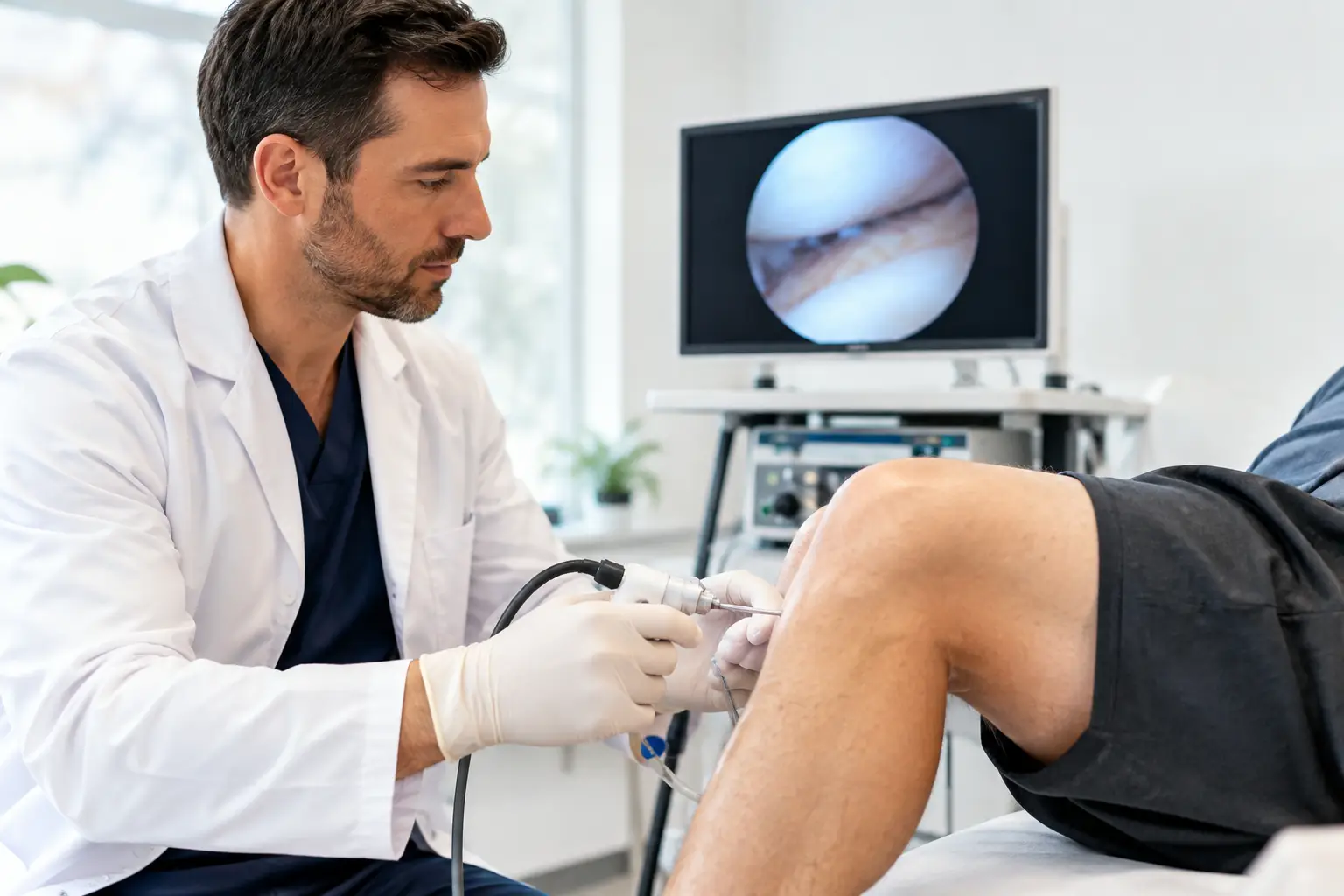
Knee arthroscopy is a keyhole procedure used to look inside the knee joint and, where appropriate, treat a specific problem at the same time. A small camera, called an arthroscope, is passed through a tiny incision. This gives the surgeon a detailed view of structures including the cartilage, meniscus, ligaments and joint lining.
Further small incisions may be used to introduce fine instruments. Depending on the diagnosis, treatment may involve trimming or repairing a torn meniscus, removing a loose fragment of cartilage or bone, treating selected cartilage damage, or assessing a problem that has remained unclear despite scans.
It is usually performed as a day-case procedure under general or spinal anaesthetic. Most patients go home on the day of surgery, provided they are comfortable, mobile enough to manage safely and have someone available to support them initially.
When can arthroscopy help?
Arthroscopy tends to be most useful when symptoms and imaging point towards a mechanical problem within the knee. Mechanical symptoms may include a true locking episode, where the knee physically becomes stuck and cannot fully bend or straighten, rather than a brief sensation of stiffness or pain.
A meniscal tear is one of the commonest reasons to consider arthroscopy. The meniscus is a tough, shock-absorbing piece of cartilage between the thigh bone and shin bone. A sudden twisting injury can cause a tear, particularly in active adults. Some tears settle with time, physiotherapy and activity modification. Others continue to cause catching, recurrent swelling, pain along the joint line or locking.
Where possible, preserving the meniscus is the priority. A repair may be considered for tears with a good chance of healing, particularly in a healthier part of the meniscus with a better blood supply. In other situations, carefully removing only the unstable torn section may offer more reliable symptom relief. The best approach depends on the tear pattern, its location, tissue quality and the condition of the rest of the knee.
Arthroscopy can also help when there is a loose body within the joint, often after an injury or due to cartilage wear. These fragments can cause unpredictable catching, locking and swelling. Selected cartilage lesions may also be addressed arthroscopically, although the appropriate treatment varies considerably according to the size and site of the defect, age, activity level and wider knee alignment.
When arthroscopy may not be the answer
Many people understandably assume that keyhole surgery is a simple solution for knee pain caused by wear and tear. The reality is more nuanced. For established knee osteoarthritis, arthroscopy does not reliably improve the underlying arthritis or provide lasting benefit for general aching, stiffness and pain on walking.
An MRI scan may show a meniscal tear in a knee that also has arthritis. This does not necessarily mean that the tear is the main source of symptoms or that surgery will help. Degenerative meniscal changes are common with age, including in people without knee pain. Treating the scan rather than the person can lead to an operation that does not deliver the improvement hoped for.
In these circumstances, non-operative treatment may be more appropriate. This can include targeted physiotherapy, weight management where relevant, sensible adjustment of aggravating activities, pain relief and injections for selected patients. If arthritis has become advanced and is significantly affecting quality of life, partial or total knee replacement may be a more durable solution than arthroscopy.
This is why a careful consultation matters. A specialist should explain not only what can be done, but whether it is likely to make a meaningful difference to your pain, mobility and daily life.
Your assessment before surgery
A high-quality decision starts with your story. How did the symptoms begin? Was there a twist, fall or sporting injury? Does the knee lock, give way, swell after activity, or hurt at night? Just as importantly, which activities are currently limited – walking the dog, getting up from a chair, working, playing golf or keeping up with grandchildren?
The knee is then examined for swelling, tenderness, range of movement, stability and signs that may indicate meniscal, ligament or kneecap-related problems. X-rays are often useful to assess arthritis, alignment and bone changes. MRI can provide greater detail about the menisci, ligaments and cartilage, but it is interpreted alongside your symptoms and examination rather than in isolation.
Sometimes the most appropriate recommendation is to continue non-operative care. That is not a delay or a lesser form of treatment. It is a decision based on giving you the best prospect of a worthwhile outcome while avoiding unnecessary surgery.
What happens during and after the procedure?
During arthroscopy, fluid is used to expand the joint slightly so the surgeon can see clearly. The camera images are viewed on a screen, allowing the joint to be inspected systematically. If a treatable problem is found, the planned procedure is carried out through the additional small openings.
After surgery, the knee is covered with small dressings and may feel swollen or sore for several days. You will normally be encouraged to begin gentle movement early. Crutches are often used initially, particularly if you have discomfort or if the procedure requires a period of protected weight-bearing.
Recovery is not identical for every patient. Following a straightforward partial meniscal trim, many people are walking more comfortably within days and can return to desk-based work in around one to two weeks, depending on symptoms and travel arrangements. Jobs involving prolonged standing, lifting, kneeling or manual work usually require longer.
Meniscal repair has a more protective recovery because the repaired tissue needs time to heal. There may be restrictions on bending, weight-bearing, driving and return to sport for several weeks. Your rehabilitation plan should be tailored to the procedure performed and the demands of your work and activities.
Physiotherapy is often a central part of recovery. Early goals include reducing swelling, regaining full movement and restoring quadriceps control. Later rehabilitation focuses on strength, balance and a safe progression back to the activities that matter to you. Returning to running, pivoting sports or heavy physical work should be based on function and confidence, not simply the date of surgery.
Understanding the risks
Knee arthroscopy is commonly performed and generally safe, but no operation is risk-free. Potential complications include infection, bleeding, blood clots, persistent swelling, stiffness, nerve or blood vessel injury, anaesthetic-related problems and ongoing pain. There is also a possibility that surgery will not relieve symptoms as much as expected, particularly if there is unrecognised or coexisting arthritis.
These risks are uncommon, but they deserve an honest discussion. Your individual risk may be affected by factors such as smoking, diabetes, previous surgery, medication, body weight and medical history. Measures such as early mobilisation, exercises and, where appropriate, clot-prevention treatment are used to support a safe recovery.
You should seek urgent advice after surgery if you develop increasing calf pain or swelling, chest pain, breathlessness, a high temperature, worsening redness around the wounds, or pain that is escalating rather than gradually settling.
Questions worth asking at your consultation
Before choosing knee arthroscopy, it is reasonable to ask what is believed to be causing your symptoms and how certain that diagnosis is. Ask whether the aim is to repair, remove or assess tissue, and why that approach is recommended in your case. You should also understand the alternatives, the likely recovery timetable, what improvement is realistic and what would happen if symptoms persist.
For patients in London and Kent, access to specialist care should mean more than a quick route to surgery. It should mean clear explanations, careful surgical planning and follow-up that remains focused on restoring comfortable, confident movement.
The most useful outcome of a consultation is often certainty about the next step. Whether that is arthroscopy, rehabilitation, an injection or a different form of surgery, the decision should be guided by your knee, your goals and a realistic plan for getting you back to the life you value.