


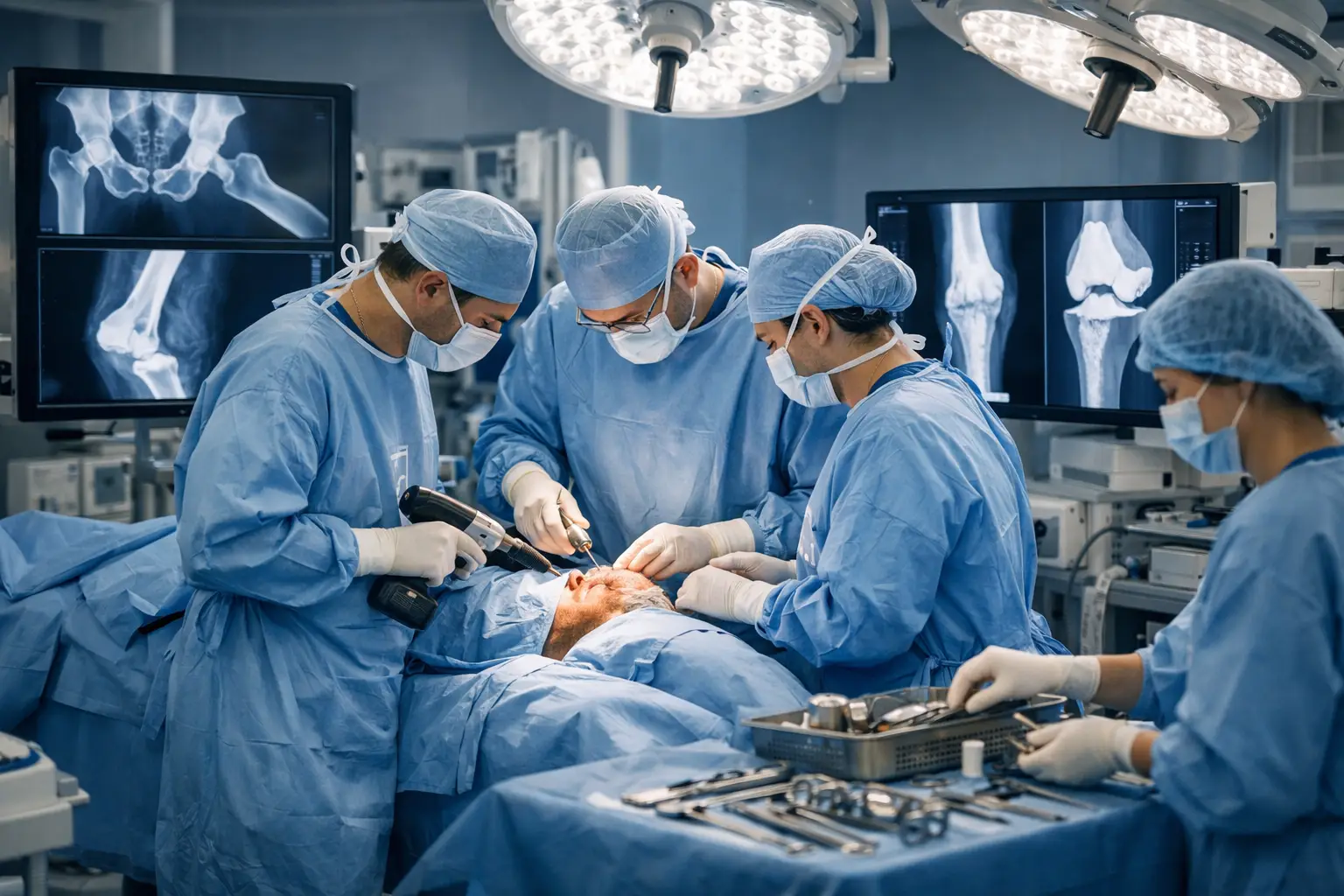
A serious injury can change daily life in seconds. Complex trauma surgery is used when damage to the hip, knee or surrounding bone and soft tissues cannot be treated reliably with a simple cast, brace or routine operation. The priority is not simply to repair an X-ray finding. It is to restore stability, reduce pain, protect the joint where possible and give you the best chance of returning to safe, confident movement.
For patients, the language around trauma can feel alarming. A clear explanation of the injury, the available options and the expected recovery is therefore as important as the operation itself. The right treatment depends on the pattern of injury, your general health, your mobility before the accident and what you need to get back to in everyday life.
What makes an injury complex?
Orthopaedic trauma becomes complex when there is more than one problem to solve. This may include a fracture that extends into the joint surface, broken bone in several pieces, a dislocation, previous metalwork, poor bone quality or damage to ligaments, tendons, muscles or skin. Injuries around an existing hip or knee replacement can also require particularly careful assessment.
A fracture near the hip or knee is not automatically a complex injury. Some can heal well with non-operative care or a straightforward fixation procedure. Complexity arises when alignment, joint stability or blood supply is at risk, or when an injury is likely to cause long-term stiffness, arthritis or loss of function if it heals in the wrong position.
The aim is often to preserve the natural joint. However, this is not always the best or safest route. Where the joint surface has been badly damaged, or where a previous replacement has been affected, reconstruction or joint replacement may offer a more predictable path to pain relief and mobility. Honest advice means discussing both the benefits and the limitations of each approach.
Complex trauma surgery: the decisions behind the operation
In the immediate aftermath of a major injury, emergency teams first address urgent concerns such as circulation, nerve function, open wounds and associated injuries. Once you are stable, a specialist orthopaedic assessment helps establish the detailed plan. This may involve X-rays, CT scans and, in selected cases, further imaging to understand the bone, joint and soft-tissue damage.
Surgical planning is highly individual. A surgeon considers whether the fragments can be restored accurately, whether the bone is strong enough to hold fixation, and how early you need to be able to put weight through the limb. For an active person with a reconstructable joint, preserving bone and cartilage may be the priority. For someone with severe arthritis, fragile bone or extensive joint damage, a replacement-based solution may provide a more reliable outcome.
Timing also matters. Some injuries need urgent treatment to protect the skin, nerves, blood vessels or joint. Others benefit from a short period of swelling control and further planning before definitive reconstruction. A delay is not necessarily a setback. In the right circumstances, it can make surgery safer and improve the precision of the final repair.
Fixation, reconstruction or joint replacement?
Fixation uses plates, screws, rods or other implants to hold broken bone in the correct position while it heals. The exact method depends on the fracture and the quality of the bone. Accurate restoration is especially important where the break involves the knee or hip joint, because even a small step in the joint surface can affect how the joint loads over time.
Reconstructive surgery may involve repairing damaged ligaments or tendons, rebuilding bone loss, correcting deformity or managing the consequences of an earlier injury that has healed poorly. These operations require careful planning because they must address both the visible structural problem and the way the limb functions as a whole.
In some circumstances, total or partial joint replacement is considered after trauma. This may be appropriate when the joint is too damaged to reconstruct reliably, when a fracture occurs around a worn or loose replacement, or when post-traumatic arthritis has become the main source of pain and disability. Replacement is a significant decision, particularly in younger and more active patients, but it can be transformative when other options are unlikely to give a durable result.
Why specialist planning matters for hip and knee injuries
The hip and knee are weight-bearing joints. Their success is measured not only by whether the bone heals, but by whether you can stand, walk, climb stairs, sleep comfortably and return to the activities that matter to you. A technically successful operation still needs a rehabilitation plan that reflects your strength, balance, work demands and home circumstances.
Complex cases can require detailed pre-operative planning, specialised implants or techniques designed to manage bone loss and altered anatomy. Previous operations add another layer of difficulty, as scar tissue, old implants and changes in bone shape can affect the available options. Fellowship-trained hip and knee expertise is particularly valuable when decisions involve reconstruction, revision surgery or joint replacement following injury.
Good planning also includes preparing for what surgery cannot guarantee. Even with excellent treatment, a severe injury may leave some stiffness, weakness or a higher risk of arthritis in the future. Discussing this openly allows you to set realistic goals while still working towards meaningful improvement.
Recovery is part of the treatment, not an afterthought
Recovery after complex trauma surgery is rarely identical for two people. The procedure performed, the stability of the repair, the condition of the soft tissues and your pre-injury fitness all influence the pace of rehabilitation. Some patients can begin putting weight through the leg early, while others need crutches, a brace or restricted weight-bearing to protect the repair.
Pain control is carefully managed so that you can move safely and participate in physiotherapy. Early exercises may focus on circulation, swelling reduction and maintaining movement in nearby joints. As healing progresses, the focus shifts to restoring range of motion, muscle control, balance and walking confidence.
It is natural to measure recovery by milestones, but progress is not always linear. Swelling can increase after activity, muscles may take time to regain strength, and confidence can lag behind physical healing. Regular follow-up allows the treatment plan to be adjusted if pain, stiffness, wound healing or mobility are not progressing as expected.
Practical preparation at home
Before leaving hospital or preparing for planned surgery, it helps to arrange practical support. A clear route through the home, a chair with arms, help with meals and transport to appointments can make the first few weeks more manageable. If stairs are unavoidable, a physiotherapist can advise on the safest way to use them with crutches.
Ask when you can shower, drive, return to work and resume particular activities such as cycling, gardening or caring for grandchildren. The answer depends on your operation and recovery, rather than a fixed calendar date. Returning too quickly can compromise healing; avoiding movement for too long can lead to stiffness and loss of strength.
When to seek urgent advice
Following surgery or a serious injury, increasing pain alone is not always an emergency, but it should not be ignored if it is sudden or severe. Seek urgent medical advice for chest pain, shortness of breath, calf swelling, a cold or numb foot, uncontrolled bleeding, a wound that becomes increasingly red or leaks fluid, fever or a sudden loss of movement.
If you have sustained a fresh significant injury, particularly after a fall, road traffic collision or sporting accident, urgent assessment is essential. Do not attempt to walk on a limb that appears deformed, unstable or unable to bear weight.
Questions worth asking at your consultation
A consultation should leave you clearer, not overwhelmed. It is reasonable to ask what the scans show, why one treatment is preferred over another, whether there are non-operative alternatives and what could happen if you wait. You should also understand the likely restrictions after surgery, the risks that are most relevant in your case and the milestones used to judge recovery.
For patients in London and Kent seeking specialist assessment of a complex hip or knee injury, a focused opinion can help make a difficult decision more manageable. Mr. Kam Cheema’s approach is centred on precise planning, clear communication and treatment choices that support durable function wherever possible.
The most helpful next step is often a careful assessment rather than rushing towards a particular operation. When you understand the injury and the reason for the recommended plan, you can approach treatment with clearer expectations and greater confidence in the road back to movement.