


A knee that aches on stairs, stiffens after sitting or limits a much-loved walk can make every treatment option sound promising. So, can PRP help knee arthritis? For some people, it may reduce pain and improve day-to-day function for a period of time. It is not, however, a cure for arthritis or a substitute for joint replacement when the joint is severely worn and symptoms are having a major impact on life.
The right answer depends on the stage of arthritis, the pattern of pain, the knee’s alignment and stability, previous treatments, and what you need to get back to doing. A careful assessment is more useful than choosing an injection on the basis of advertising or a friend’s experience.
What PRP treatment involves
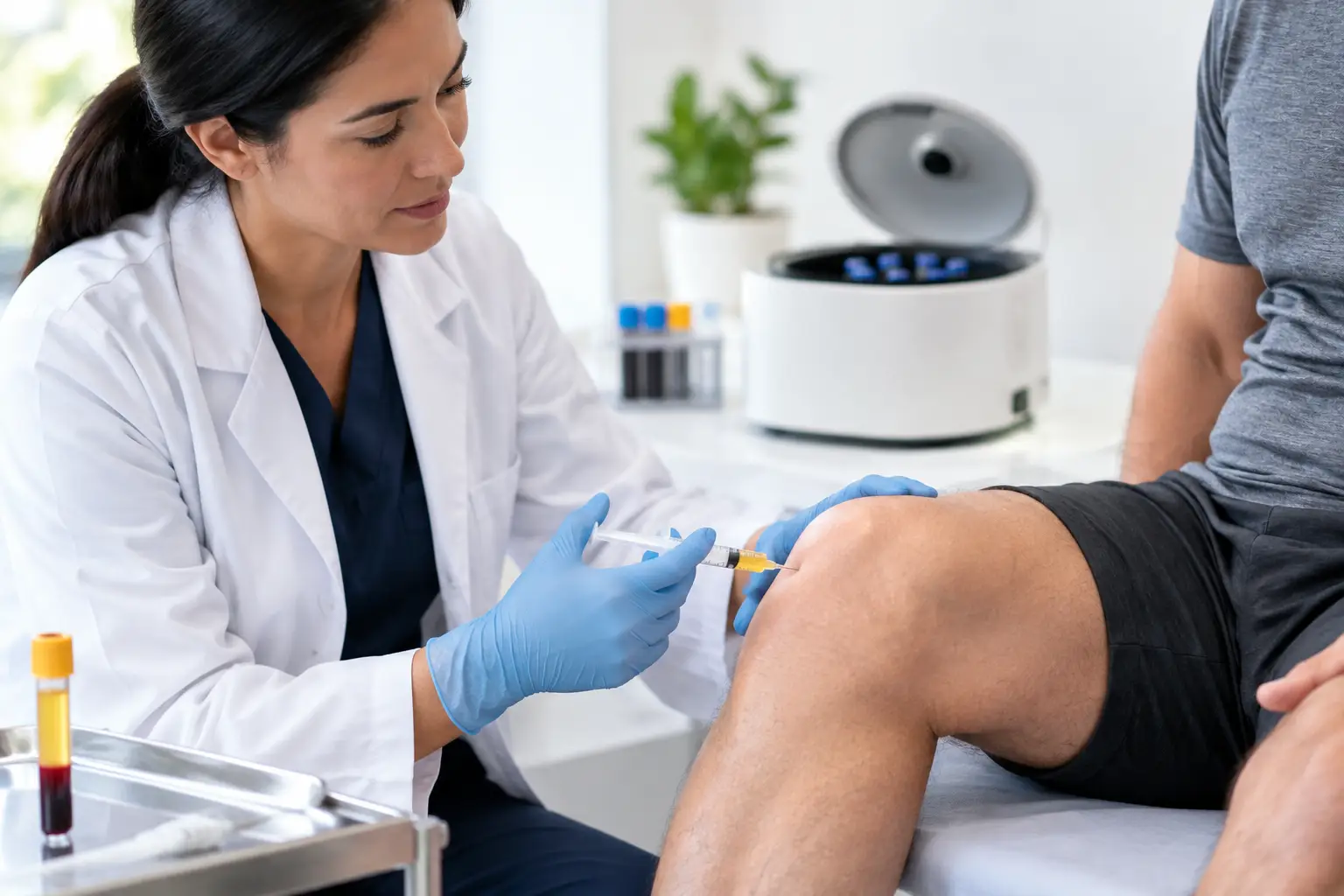
PRP stands for platelet-rich plasma. Platelets are small components of your blood involved in healing and tissue signalling. In a PRP treatment, a small blood sample is taken from your arm and placed in a centrifuge. This separates the blood components so that a concentrated platelet-containing plasma can be prepared and injected into the knee.
The intention is not to replace lost cartilage. Arthritis changes are complex: cartilage wears, the bone beneath it can become irritated, the joint lining may become inflamed, and muscles around the knee may weaken as pain alters how you move. PRP is thought to influence the inflammatory environment within the joint and support the body’s repair signalling. This may help some patients experience less pain and better function.
The injection is usually performed in a clinic appointment, often using ultrasound guidance where appropriate to improve placement accuracy. Most people can go home on the same day. The knee may feel more sore or swollen for a few days afterwards, so activity is normally adjusted briefly before a gradual return to normal movement and exercise.
Can PRP help knee arthritis at every stage?
PRP tends to be considered most often for mild to moderate knee osteoarthritis, particularly when symptoms persist despite sensible non-operative care. It can be a reasonable option for someone who wants to remain active, is not ready for surgery, or is seeking symptom relief while working on strength, weight management or a specific activity goal.
Evidence suggests PRP can provide pain and functional improvement for selected people with knee osteoarthritis, sometimes for longer than a standard steroid injection. Results vary considerably. Some patients notice a meaningful improvement; others have little response. The benefit, when it occurs, is usually measured in months rather than viewed as a permanent solution.
In advanced arthritis, where X-rays show marked joint-space loss, deformity or bone-on-bone wear, PRP is less likely to deliver the level of relief patients hope for. An injection may still be discussed in particular circumstances, but expectations must be realistic. If pain disrupts sleep, walking, work or independence despite appropriate treatment, knee replacement may offer a more predictable route to durable pain reduction and restored function.
Age alone does not determine whether PRP is suitable. A fit 70-year-old with relatively early arthritis may be a better candidate than a younger person with severe joint damage, significant malalignment or mechanical instability.
What a specialist assessment should establish
Knee pain is not always caused by arthritis alone. Meniscal problems, ligament instability, kneecap pain, referred pain from the hip, inflammatory conditions and stress injuries can all produce overlapping symptoms. Treating the wrong diagnosis with an injection is unlikely to produce a good result.
A thorough consultation should include your symptom history, examination of the knee and review of appropriate imaging. The aim is to understand not only what the scan shows, but how the condition affects your life. For one person, the priority may be managing a busy working day without limping. For another, it may be returning to golf, gardening, travelling or keeping up with grandchildren.
Your specialist should also assess factors that influence injection outcomes. These include joint alignment, range of movement, ligament stability, muscle strength, body weight and the extent of arthritis. If the knee is significantly bowed or knock-kneed, for example, the uneven loading may limit the benefit of any injection. In that setting, addressing the underlying mechanical issue may be more important.
PRP compared with steroid and hyaluronic acid injections
There is no single best injection for every arthritic knee. Each option has a different role.
A steroid injection can settle inflammation and provide relatively rapid short-term relief, especially when the knee is acutely swollen or painful. Its effect is often temporary, and repeated steroid injections are not generally a long-term strategy for managing arthritis.
Hyaluronic acid aims to improve the lubricating properties of the joint fluid. Some people find it helpful, while others do not. Its results can be variable, particularly in more established arthritis.
PRP is an autologous treatment, meaning it is prepared from your own blood. It may offer longer-lasting symptom improvement for certain patients than steroid treatment, but it also involves a blood sample, preparation process and a higher cost. Protocols vary between clinics, including the concentration and composition of the PRP and the number of injections offered. This is one reason studies can be difficult to compare directly.
Rather than assuming that the newest or most expensive injection is automatically best, it is sensible to ask what outcome is realistic in your particular knee and what the next step would be if it does not help.
What results can you realistically expect?
The most useful way to think about PRP is as one part of a wider plan, not a stand-alone fix. A successful result may mean walking further with less discomfort, needing fewer painkillers, sleeping better, or being able to return to low-impact exercise. It does not necessarily mean the arthritis has stopped progressing or that high-impact activity will become comfortable again.
Results are often gradual rather than immediate. Some people experience a flare in the first few days after injection before settling. Improvement may develop over several weeks. Your clinician will advise on the appropriate recovery plan, but protecting the knee from unnecessary overload while maintaining gentle movement is usually important.
Strengthening the quadriceps, hamstrings, gluteal muscles and core remains valuable before and after PRP. Stronger muscles can reduce the load passing through a painful knee and improve confidence in movement. Physiotherapy, pacing activities and choosing lower-impact exercise such as cycling, swimming or an exercise bike can make a meaningful difference alongside injection treatment.
Safety and when PRP may not be appropriate
PRP is generally well tolerated because the injected material comes from your own blood. Temporary pain, swelling and stiffness at the injection site are the most common side effects. Infection and bleeding are uncommon but important risks with any joint injection.
PRP may not be suitable if you have an active infection, certain blood or platelet disorders, a significant bleeding problem, or are taking medication that requires particular consideration. Your medical history, allergies and medicines should be reviewed carefully. Advice about anti-inflammatory medication around the procedure can vary, so follow the specific guidance given by your treating clinician rather than stopping prescribed medicines independently.
It is also worth considering the cost-benefit question honestly. If the knee is severely arthritic and replacement is already clearly indicated, repeated injections that offer only modest or short-lived relief can delay a treatment that may better restore mobility and quality of life. Conversely, when arthritis is early or moderate, a well-chosen injection may help preserve activity and defer surgery appropriately.
When surgery becomes the more reliable option
Knee replacement is not a failure of non-operative care. It is an effective treatment for people whose arthritis pain and loss of function have reached the point where daily life is consistently restricted. Modern partial and total knee replacement are planned around the pattern of arthritis, knee anatomy, stability and functional needs.
The decision should not be based on an X-ray alone. Some patients have substantial changes on imaging but cope well, while others have less dramatic imaging and disabling symptoms. The key question is whether the pain, stiffness and reduced mobility continue to take too much from your life despite appropriate measures.
PRP can be a useful option when it is recommended for the right knee, at the right stage, with a clear understanding of its limits. If you are weighing up injections, rehabilitation or surgery, a specialist hip and knee assessment can provide the clarity to choose a plan that supports the activities and independence that matter to you.