


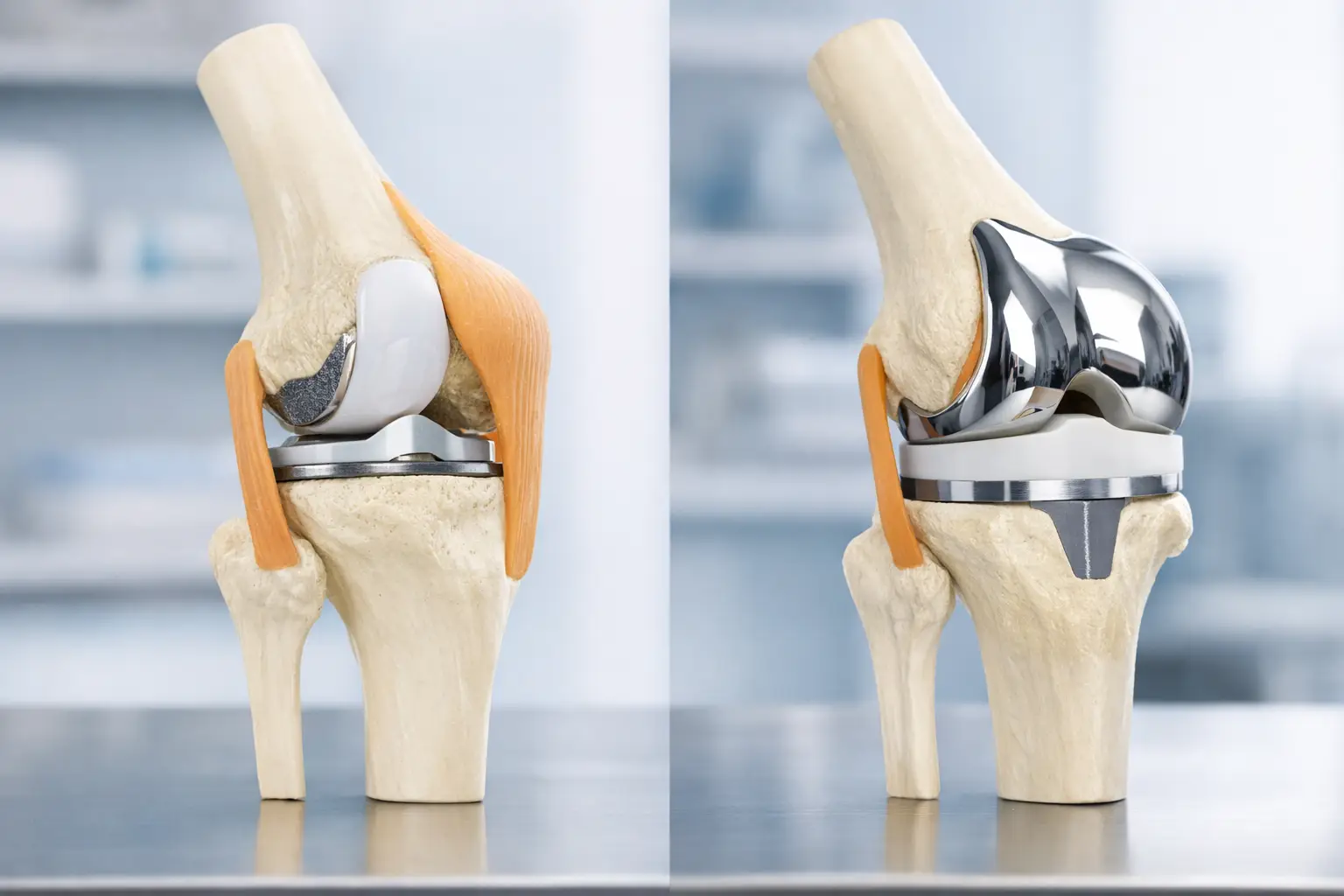
A decision about partial versus total knee replacement is rarely as simple as choosing the smaller operation. The best procedure depends on where arthritis has damaged the joint, how stable the knee remains, your symptoms, and the activities you hope to return to. For some people, preserving as much of the natural knee as possible is a major advantage. For others, a total knee replacement offers the more reliable solution for widespread arthritis and persistent pain.
The aim is the same in both cases: to reduce pain, improve movement and help you return to the everyday activities that matter to you. A careful specialist assessment helps ensure that the operation matches the knee in front of you, rather than a one-size-fits-all treatment plan.
Understanding partial versus total knee replacement
The knee has three main compartments: the inner side, called the medial compartment; the outer side, called the lateral compartment; and the area behind the kneecap, known as the patellofemoral compartment. Arthritis does not always affect all three equally.
A partial knee replacement, also called unicompartmental knee replacement, replaces only the damaged part of the knee. It may involve the inner, outer or kneecap compartment, although medial partial replacement is the most common. The healthy bone, cartilage and ligaments in the rest of the knee are retained.
A total knee replacement resurfaces the ends of the thigh bone and shin bone, and may also resurface the back of the kneecap. It is designed for arthritis affecting more than one compartment, or where deformity, instability or joint damage means a partial replacement is unlikely to provide a durable result.
Neither procedure is automatically better. The right choice is the one most likely to give you lasting pain relief, stability and function.
When might a partial knee replacement be suitable?
Partial knee replacement can be an excellent option when arthritis is clearly limited to one part of the knee. Patients often describe pain predominantly on the inner side of the joint, with the remainder of the knee feeling relatively comfortable. X-rays may show bone-on-bone arthritis in one compartment while the other compartments are well preserved.
The knee’s supporting ligaments also need to be functioning well, particularly the anterior cruciate ligament in many cases. Significant stiffness, marked bow-legged or knock-kneed deformity, inflammatory arthritis, or extensive damage in other parts of the knee can make total replacement the safer recommendation.
Where it is appropriate, a partial replacement has meaningful benefits. It involves less disruption to the knee, retains more natural bone and ligaments, and can feel more natural in movement for some patients. Early recovery can also be quicker, although it still requires commitment to physiotherapy, walking exercises and a structured rehabilitation plan.
There is a trade-off. Because the untreated parts of the knee remain, arthritis can progress elsewhere over time. A partial replacement can then require revision to a total knee replacement. This does not mean partial replacement is a poor choice. It means patient selection and precise surgical planning are central to achieving a good long-term outcome.
When is total knee replacement the better option?
Total knee replacement is usually recommended when arthritis is advanced across two or three compartments of the knee. Common signs include pain on both sides of the joint, pain behind the kneecap, substantial stiffness, altered leg alignment, night pain and a growing limitation in walking, stairs and daily activities.
It may also be the preferred operation when previous surgery, ligament problems or significant deformity have changed the structure of the knee. In these situations, treating only one compartment may leave pain or instability behind. A total replacement allows the surgeon to address the whole arthritic joint and restore alignment in a more comprehensive way.
Recovery is not necessarily dramatically harder than after a partial replacement, but it can take longer for the knee to feel settled and for strength to return. Most people improve steadily over months rather than weeks. The goal is not merely a satisfactory X-ray but a knee that supports independent movement, work, family life and the activities you value.
The assessment matters more than the label
An operation should never be selected from symptoms alone. Knee pain can arise from arthritis, meniscal injury, kneecap problems, tendon conditions, referred pain from the hip or spine, and more than one issue at the same time.
A thorough consultation usually includes a discussion of your pain pattern, medical history, previous treatments and goals. Your knee will be examined for movement, alignment, swelling, tenderness and ligament stability. Weight-bearing X-rays are essential because they show how the joint behaves under load. In selected cases, further imaging may help clarify whether cartilage and ligaments are suitable for a partial replacement.
Your lifestyle is part of the decision too. Someone hoping to get back to long walks, golf, gardening or playing with grandchildren may have different priorities from someone whose main goal is moving around the house without pain. Age alone should not determine the operation. The condition of the knee, overall health, expectations and willingness to engage with recovery all matter.
Recovery: what patients should realistically expect
Both partial and total knee replacement involve an operation, anaesthetic, wound healing and rehabilitation. You will be encouraged to stand and walk early with support from the hospital physiotherapy team, using crutches or sticks initially. Swelling, bruising, disrupted sleep and fluctuating discomfort are common in the early weeks.
After partial replacement, some patients regain comfortable movement and confidence more quickly because less of the joint has been replaced. However, a quicker early recovery should not be mistaken for a minor procedure. Returning to driving, work, exercise and unrestricted activity must be based on safe knee control, medication use, wound healing and the demands of your role.
After total knee replacement, progress can feel less linear. One week may bring a noticeable improvement, while the next is dominated by swelling or stiffness. Regular exercises, gradual increases in walking and good pain management are important. Full recovery commonly continues for up to a year, with improvements in strength, endurance and comfort occurring throughout that period.
In either procedure, the best outcomes come from partnership. Surgical precision is vital, but so is preparing well before surgery, following rehabilitation advice and raising concerns promptly during recovery.
Risks and durability
Knee replacement is widely performed and can be highly successful, but no operation is without risk. Potential complications include infection, blood clots, stiffness, wound problems, nerve or blood vessel injury, ongoing pain and dissatisfaction with the result. These risks are discussed in relation to your individual health, medication and surgical history.
A partial replacement carries the additional possibility that arthritis progresses in the remaining knee compartments. A total replacement may be more suitable when that risk is already evident on imaging or examination. Conversely, replacing the whole knee when arthritis is genuinely isolated to one compartment may sacrifice healthy structures unnecessarily.
Both types of implant can last many years, but durability varies with factors such as activity, body weight, bone quality, implant position and the biology of the individual joint. Revision surgery is possible when required, although the aim of initial treatment is always to choose the procedure most likely to remain effective for the long term.
Do you need knee replacement now?
Surgery is generally considered when pain and restricted movement continue despite appropriate non-operative treatment, and when the impact on daily life is substantial. This may include physiotherapy, activity modification, weight management where relevant, pain relief, bracing or targeted injections. Options such as steroid, hyaluronic acid, platelet-rich plasma and Arthrosamid may have a role for selected patients, depending on the diagnosis and stage of arthritis.
These treatments do not reverse advanced bone-on-bone arthritis, but they can sometimes reduce symptoms or help delay surgery. Equally, persisting for too long with severe pain and progressive loss of mobility can affect fitness, sleep, confidence and independence. The right timing is personal and should follow an honest discussion of symptoms, imaging findings and realistic expectations.
Making a confident choice
If you are considering partial or total knee replacement, ask what compartments of your knee are affected, whether your ligaments are stable, and why one operation is being recommended over the other. It is also reasonable to discuss expected recovery, possible complications, implant longevity and what support will be available after surgery.
A specialist hip and knee assessment provides the clarity needed to make this decision with confidence. The most appropriate replacement is not defined by how much of the knee is changed, but by how well the treatment restores comfortable, dependable movement for the life you want to lead.