

What is a Unicompartmental Knee Replacement?
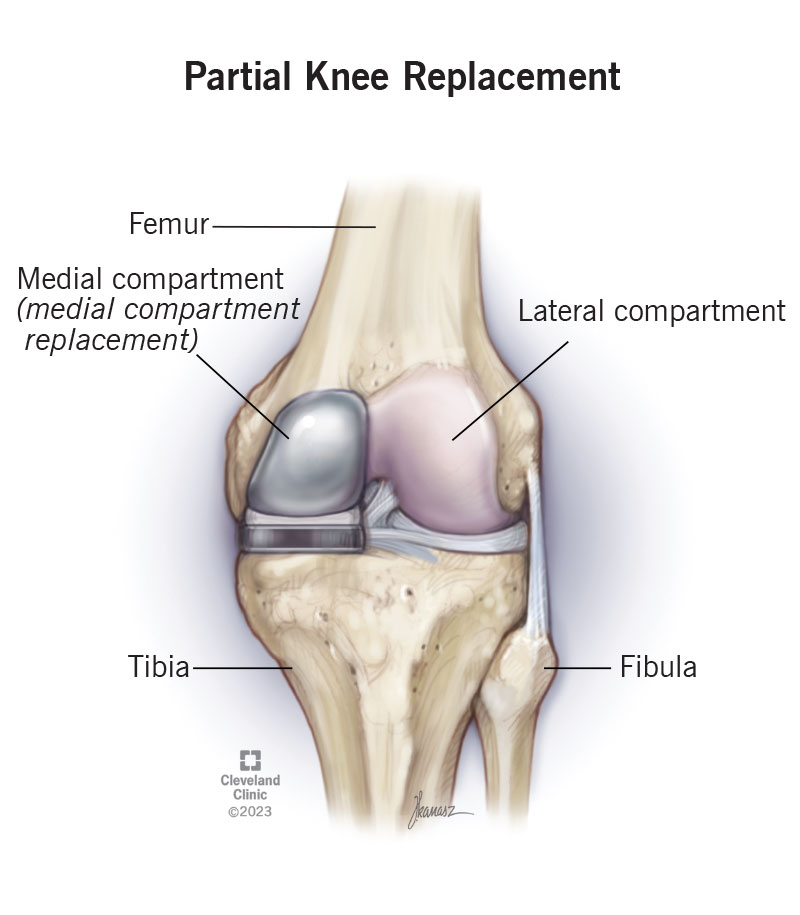
A unicompartmental knee replacement (UKR), also known as a partial knee replacement, is an operation that resurfaces only the worn-out part of the knee—most commonly the medial compartment. Unlike a total knee replacement, the healthy structures in the rest of the knee are preserved, including the cruciate ligaments.
This procedure offers excellent pain relief and a more “natural-feeling” knee for suitable patients.
Treatment for a UKR includes preparation before surgery, the operation itself, and post-operative rehabilitation, all of which are explained here.
Why consider a unicompartmental knee replacement?
A UKR is considered when:
- Arthritis affects only one compartment (usually medial)
- Pain is limiting daily activities
- Non-surgical treatments no longer provide benefit
- The ligaments, particularly the ACL, are intact
- The knee is not severely deformed
- X-rays confirm isolated compartment wear
The goals of treatment are:
Less pain, improved mobility, faster recovery, and a more natural-feeling knee.
Pre-operative Treatments & Preparation
→ Physiotherapy
→ Strengthening exercises
→ Weight optimisation
→ Walking aids if needed
These help maintain strength and mobility prior to the operation.
→ Review medical history and medications
→ Complete blood tests, ECG and other assessments
→ Discuss options for anaesthesia (usually spinal or general)
→ Ensure you are medically optimised
Exercises may include:
→ Quadriceps and hamstring strengthening
→ Straight leg raises
→ Gluteal and core conditioning
Treatment During Surgery: What Happens in a Unicompartmental Knee Replacement?
A UKR usually takes 45–60 minutes and requires a smaller incision than a full knee replacement.
→ Cruciate ligaments (ACL/PCL)
→ Lateral compartment
→ Patellofemoral joint
are left untouched, helping the knee feel more natural.
→ Femoral component – a curved metal cap resurfacing the end of the thigh bone
→ Tibial component – a metal baseplate on the shin bone
→ Plastic insert (polyethylene) – provides a smooth, low-friction bearing
Most UKRs are cemented, but uncemented options exist.
→ Smooth motion
→ Balanced ligaments
→ Correct alignment
Post-operative Treatments & Recovery
Because less bone and soft tissue are disturbed, many patients recover faster than after a total knee replacement.
Pain Management
- Pain control may include:
- Spinal anaesthetic with light sedation
- Local anaesthetic injections
- Oral pain medications
- Ice therapy
- Most patients need only mild painkillers after the first week.
Early Mobilisation
-
You will get up to walk on the same day or the morning after surgery.
A physiotherapist will guide you to: - Walk safely with aids
- Start knee bending
- Begin strengthening exercises
Rehabilitation and Return to Activity
- Rehabilitation focuses on:
- Restoring knee bend and straightening
- Strengthening the quadriceps and hamstrings
- Improving balance and gait
- Typical recovery milestones:
- Walking independently: 2–4 weeks
- Driving: ~3 weeks
- Work (desk-based): 2–3 weeks
- Golf/cycling: 4–6 weeks
- Full activity: 6–12 weeks
Long-term Treatment After Knee Replacement
Continuing Strength & Mobility
- Low-impact activities are encouraged:
- Walking
- Swimming
- Cycling
- Pilates or yoga
Protecting Your New Knee
- Avoid high-impact activities early such as:
- High-impact running
- Frequent jumping sports
- Repetitive heavy lifting
- Gradually build up with physio guidance
Ongoing Review
- Follow-up appointments monitor:
- Wound healing
- Knee range of movement and strength
- X-rays to assess the implant
- Modern partial knee replacements often last 10–15+ years, depending on activity level and anatomy. Many last longer.
Risks and Complications
UKR is a safe and widely performed procedure, but risks include:
- Infection
- Blood clots
- Stiffness
- Persistent pain
- Progression of arthritis in the other compartments (may require conversion to a TKR)
- Fracture or implant loosening (rare)
- Nerve or vessel injury (very rare)
These risks will be discussed with you in detail before surgery.