


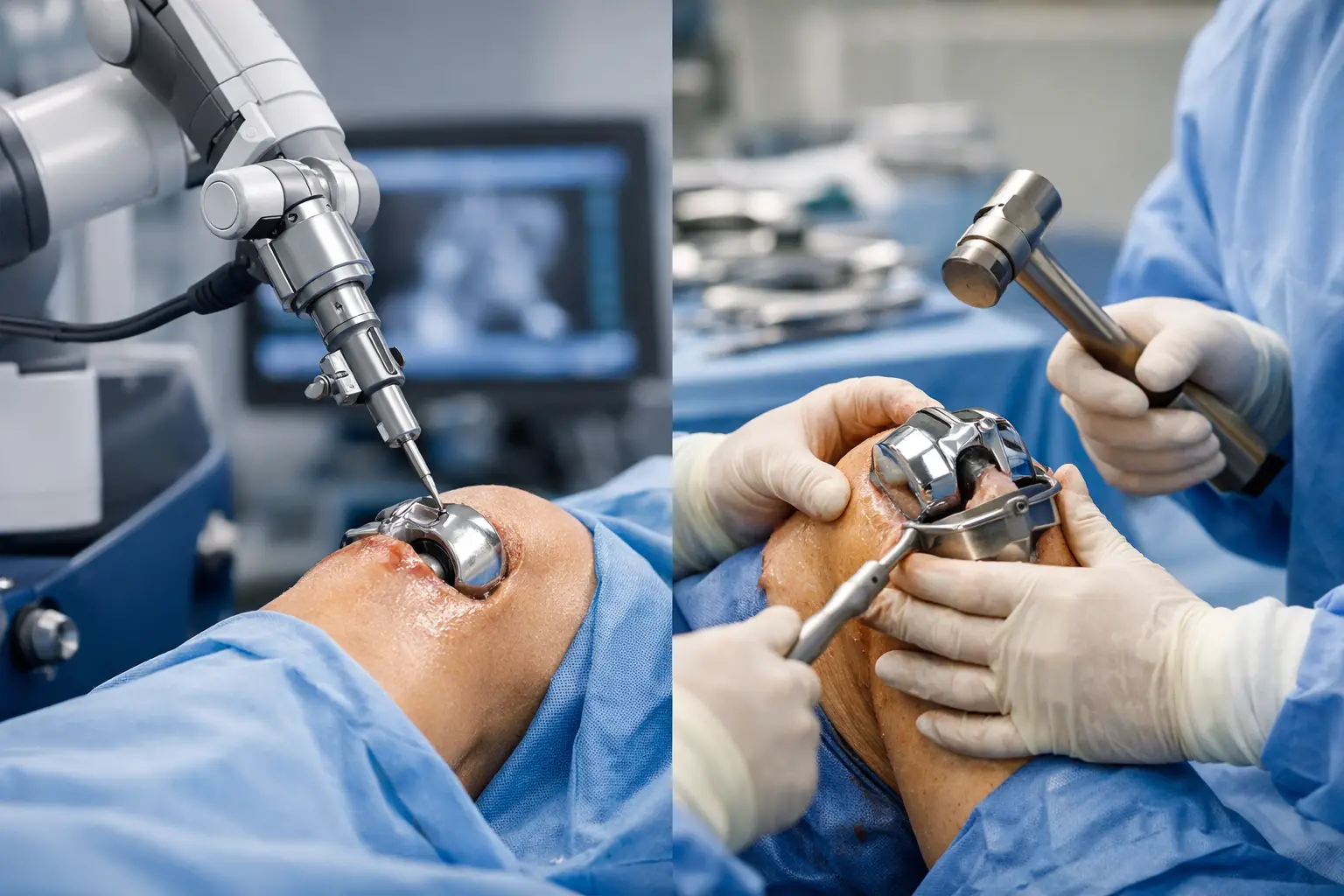
When knee pain begins to dictate how far you walk, whether you can use the stairs or how comfortably you sleep, the question is rarely whether technology sounds impressive. The real question is which operation offers the best chance of reducing pain and restoring the life you value. Robotic versus conventional knee replacement is therefore not simply a choice between new and established technology. It is a decision about planning, precision, your knee anatomy and the experience of the surgical team caring for you.
For many people with advanced knee arthritis, a knee replacement can be life-changing. Both robotic-assisted and conventional techniques are well-established ways of replacing worn joint surfaces with carefully selected implants. The right approach is individual, and should follow a detailed consultation rather than a general assumption that one method is always better.
What is conventional knee replacement?
In a conventional total knee replacement, the surgeon uses pre-operative X-rays, clinical examination and specialised instruments to remove damaged bone and cartilage, prepare the joint and position the replacement components. Guides are used during surgery to help make planned bone cuts and establish the intended alignment.
This is not an imprecise or outdated operation. Conventional knee replacement has a long and successful record, with excellent pain relief and durable outcomes for many patients. A fellowship-trained knee surgeon plans the procedure carefully, assesses the stability of the ligaments and makes important decisions during surgery based on the individual knee.
The term ‘conventional’ can make it sound less sophisticated than it is. In reality, it remains an effective option, particularly where the patient’s anatomy and pattern of arthritis are straightforward and the surgical plan is clear.
How robotic-assisted knee replacement works
Robotic-assisted knee replacement adds a digital planning and guidance system to the operation. Depending on the system used, a three-dimensional model of the knee may be created from a CT scan or built during surgery. This enables the surgeon to plan component size, position and alignment in detail before making the bone cuts.
During the procedure, the robotic system tracks the position of the knee and surgical instruments. It provides real-time information and can help the surgeon carry out the plan within closely defined boundaries. The surgeon remains in complete control throughout. The robot does not perform the operation independently, make clinical decisions or replace surgical judgement.
This distinction matters. Robotic technology is a tool that can support accuracy and consistency. Its value depends on thoughtful planning, correct use and a surgeon who understands when the technology will genuinely benefit the patient in front of them.
Robotic versus conventional knee replacement: where are the differences?
The most meaningful difference is in the level of intra-operative data and guidance available to the surgeon. Robotic systems can measure aspects of knee movement, alignment and soft-tissue balance during the operation. This may help refine the plan and achieve very precise component positioning.
In some studies, robotic-assisted surgery has been associated with improved accuracy in achieving planned alignment and fewer outliers from the intended position. It may also allow more personalised positioning in selected cases, rather than applying one standard alignment target to every knee. For patients, this can be reassuring, particularly when precision is a priority.
However, accuracy on an X-ray or computer screen is only one part of a successful knee replacement. Pain relief, movement, stability, wound healing, rehabilitation, expectations and the health of the surrounding muscles all influence how a knee feels in daily life. Current evidence has not established that robotic assistance guarantees a better long-term result for every patient.
A well-planned conventional replacement performed by an experienced specialist can produce excellent outcomes. Conversely, robotic technology cannot compensate for an unsuitable indication for surgery, an inappropriate implant choice or poor rehabilitation. The best result comes from combining the right treatment, careful surgical technique and committed recovery support.
Implant choice still matters
The implant is not determined simply by whether a robot is used. Your surgeon will consider the extent of arthritis, knee deformity, ligament function, bone quality, previous operations and activity goals. Some patients need a total knee replacement, while others with arthritis confined to one part of the knee may be suitable for a partial knee replacement.
In complex cases, including previous knee surgery, significant deformity or revision knee replacement, detailed planning is particularly important. Technology may be useful in certain situations, but the decision must be based on the specific problem rather than a preference for a particular device.
Will robotic surgery make recovery quicker?
It is understandable to hope that a more precise operation will mean a faster or easier recovery. Some patients report less early pain or a quicker return of movement after robotic-assisted surgery, but recovery experiences vary and the evidence is still developing. It would not be honest to promise a shorter recovery solely because a robotic system is used.
The early weeks after either type of knee replacement usually involve swelling, stiffness and gradual rebuilding of strength. Pain management, safe mobilisation, physiotherapy and regular exercises are central to progress. Most people are walking with support soon after surgery, but it can take several months for the knee to feel more natural and for confidence to return.
Your starting fitness, weight, other medical conditions, home support and willingness to engage with rehabilitation may have as much influence on recovery as the surgical technique. A clear recovery plan should be part of the discussion before you decide to proceed.
Risks and limitations to consider
Both robotic and conventional knee replacement carry the usual risks of major joint surgery. These include infection, blood clots, stiffness, persistent pain, wound problems, instability, nerve or blood vessel injury and the possibility that further surgery may be needed in the future. These complications are uncommon, but they should be discussed openly.
Robotic surgery also has practical limitations. It may require additional imaging, such as a CT scan, depending on the platform. There can be extra cost, and not every implant system or hospital offers robotic assistance. In rare circumstances, a technical issue or an unexpected finding during surgery may mean the surgeon safely continues using conventional instruments.
Neither technique can guarantee that the knee will feel exactly like a natural joint. The aim is dependable pain reduction, improved stability and the ability to return to everyday activities with greater comfort. For most patients, kneeling, high-impact sport and very demanding physical work should be discussed realistically before surgery.
How to decide which approach is right for you
The most useful starting point is not, ‘Which method is best?’ but, ‘What does my knee need?’ A specialist assessment should establish whether your pain is truly arising from arthritis, whether non-operative treatment has been fully considered and whether replacement is likely to improve your function.
Ask how your operation would be planned, what implant is recommended and why, and whether robotic assistance would add a meaningful advantage in your case. It is also reasonable to ask about the surgeon’s experience with both approaches, expected recovery milestones and what support will be available if progress is slower than anticipated.
At Mr Kam Cheema’s practice, the focus is on matching detailed surgical planning to the individual rather than promoting one technique as the answer for every knee. That means discussing both surgical and non-surgical options honestly, including when waiting, physiotherapy, injections or other treatments may still be appropriate.
The technology used in theatre matters, but it should never distract from the wider care around it. The most reassuring choice is one made with a specialist who listens carefully, explains the trade-offs clearly and builds a plan around getting you back to the activities that matter to you.