

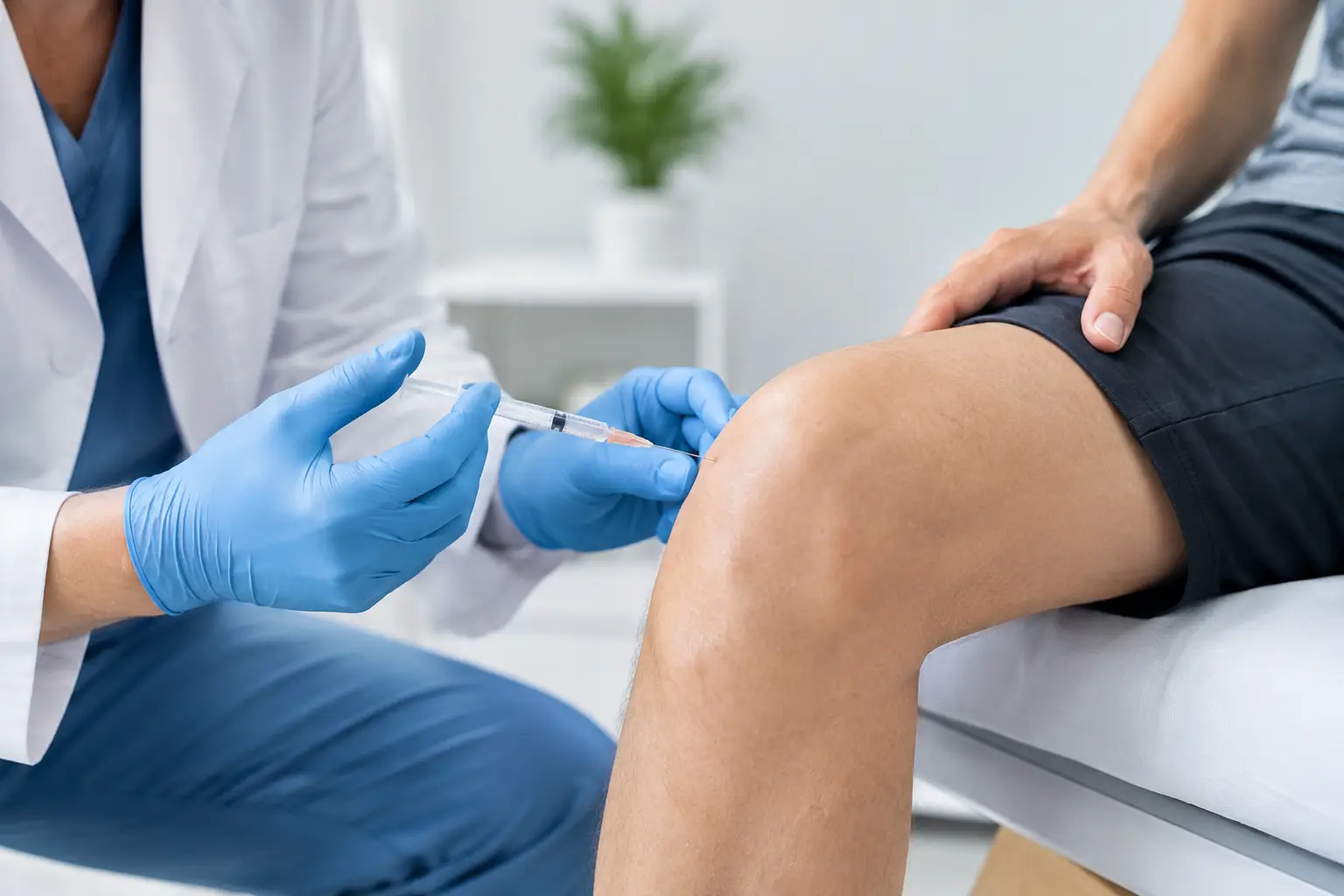
A knee that hurts on the stairs, swells after a walk or interrupts sleep can make even straightforward decisions feel urgent. This guide to knee injection treatments explains where injections may fit into your care, what each option is designed to do, and when an injection is unlikely to be the right answer.
Knee injections are not a single treatment. They range from well-established anti-inflammatory steroid injections to treatments intended to improve lubrication or support the knee’s biological environment. The best choice depends on the cause of your pain, the condition of the joint, your wider health and what you want to return to – whether that is work, walking the dog, golf or simply moving around with greater confidence.
When can a knee injection help?
Injections are commonly considered for osteoarthritis, particularly when pain and stiffness persist despite sensible activity modification, physiotherapy, pain relief and weight management where appropriate. They may also help to settle inflammation following a flare-up, or provide a window in which rehabilitation becomes more manageable.
They are not a substitute for a careful diagnosis. Knee pain may arise from arthritis, a meniscal tear, tendon problems, instability, referred pain or, less commonly, infection or an inflammatory condition. The history of your symptoms, examination and imaging where needed help establish whether an injection is likely to help and, importantly, what it cannot fix.
For example, an injection may reduce pain from arthritic inflammation but cannot repair advanced loss of cartilage, correct marked deformity or restore a mechanically locked knee. In these circumstances, it may still have a role in managing symptoms or helping clarify the source of pain, but it should not delay treatment that offers a more durable solution.
Guide to knee injection treatments: the main options
Steroid injections
A corticosteroid injection is intended to reduce inflammation inside the joint. It is often the most appropriate option when a knee is noticeably swollen, painful at rest or experiencing an acute arthritis flare. Local anaesthetic may be used alongside the steroid, which can offer short-term relief soon after the procedure.
The effect is variable. Some people gain useful relief for weeks or months; others experience little change. Steroid injections can be valuable when pain is preventing sleep, travel or physiotherapy, but repeated injections are not usually a long-term strategy. The frequency and timing need individual consideration, particularly if knee replacement surgery may be needed, because an injection too close to surgery can increase infection risk.
A brief increase in pain for a day or two can occur after the injection. People with diabetes should also know that steroid can temporarily raise blood glucose levels, so a plan for monitoring is sensible.
Hyaluronic acid injections
Hyaluronic acid is a naturally occurring component of joint fluid. Injecting it into an arthritic knee is sometimes described as viscosupplementation: the aim is to improve the fluid’s cushioning and lubricating properties.
This may suit some people with mild to moderate osteoarthritis who cannot take certain anti-inflammatory medicines, have not had sufficient benefit from other measures or would prefer an option that does not contain steroid. Relief usually develops gradually rather than immediately, and benefits can last several months for selected patients.
Results are less predictable in severe, bone-on-bone arthritis. It is therefore worth having an honest discussion about the likely value in your particular knee rather than viewing hyaluronic acid as a way to avoid a necessary joint replacement indefinitely.
Platelet-rich plasma, or PRP
PRP uses a sample of your own blood. The blood is processed to concentrate platelets, then the platelet-rich portion is injected into the knee. Platelets contain growth factors involved in the body’s healing response, and PRP is used with the intention of reducing symptoms and supporting the joint environment.
Some patients with early to moderate osteoarthritis report reduced pain and improved function after PRP. However, preparation methods, injection protocols and the evidence base vary, which means results are not uniform. PRP does not regrow a severely worn joint, and it is not right for everyone.
Because the injection is prepared from your own blood, serious reactions are uncommon, though temporary soreness and swelling can occur. The quality of the assessment and the technique matter as much as the treatment label. PRP should be offered as part of a coherent treatment plan, not as a promise of cartilage regeneration.
Arthrosamid treatment
Arthrosamid is a non-biodegradable polyacrylamide hydrogel injected into the knee to cushion the synovial lining, the tissue around the joint that contributes to pain and inflammation in osteoarthritis. It is a single-injection treatment and is intended to remain in place, unlike steroid or hyaluronic acid, which are gradually broken down.
It may be an option for people with knee osteoarthritis who are seeking longer-lasting symptom relief without immediate surgery. Clinical experience and research are developing, and some patients gain worthwhile improvement in pain and function. As with every injection, the degree and duration of benefit cannot be guaranteed, and suitability depends on the pattern and severity of arthritis.
What happens at the appointment?
A specialist consultation should begin with your symptoms and priorities, not with a predetermined injection. You may be asked when the pain began, whether the knee swells or gives way, how far you can walk, what treatments you have already tried and how the problem affects daily life.
The knee is examined and any relevant X-rays or scans reviewed. If an injection is suitable, the clinician will explain the expected benefit, alternatives and recognised risks before you decide whether to proceed. Image guidance may be used in some cases to support accurate placement, especially where anatomy is less straightforward.
The procedure itself is usually quick. The skin is cleaned carefully, the injection is administered using a fine needle and a small dressing is applied. Most people return home the same day. It is generally sensible to avoid strenuous exercise for a short period afterwards, while gentle movement is often encouraged according to the advice you receive.
Risks, safety and realistic expectations
All injections carry a small risk of bleeding, bruising, skin reaction and post-injection discomfort. Infection within a joint is rare but serious. Increasing redness, heat, swelling, fever or severe pain after an injection needs urgent medical assessment.
An injection should be postponed if there is an active skin infection near the knee or a significant illness that raises safety concerns. Blood-thinning medication, diabetes, immune suppression, allergies and previous joint replacement surgery should all be discussed in advance. These factors do not automatically rule treatment out, but they may change the plan.
The central question is not simply, “Which injection is best?” It is, “Which treatment best matches this knee, this stage of disease and this person’s goals?” A steroid injection may be the sensible choice for a painful inflammatory flare. PRP, hyaluronic acid or Arthrosamid may be considered in selected cases where symptom control and function are the priority. When arthritis is advanced and daily life remains restricted, partial or total knee replacement may provide the more reliable long-term route to mobility.
Making the decision with confidence
Before agreeing to treatment, ask what diagnosis the injection is intended to address, how long benefit might reasonably last, what you should do afterwards and what the next step will be if it does not help. A clear plan prevents an injection from becoming a cycle of temporary relief without progress.
The most useful treatment is the one that helps you move towards the life you want to lead, with a realistic understanding of both its limits and its potential. A thorough specialist assessment can give you the clarity to make that decision without feeling rushed. I have gathered the injection treatments I offer, including PRP, on my PRP and knee injections page.