


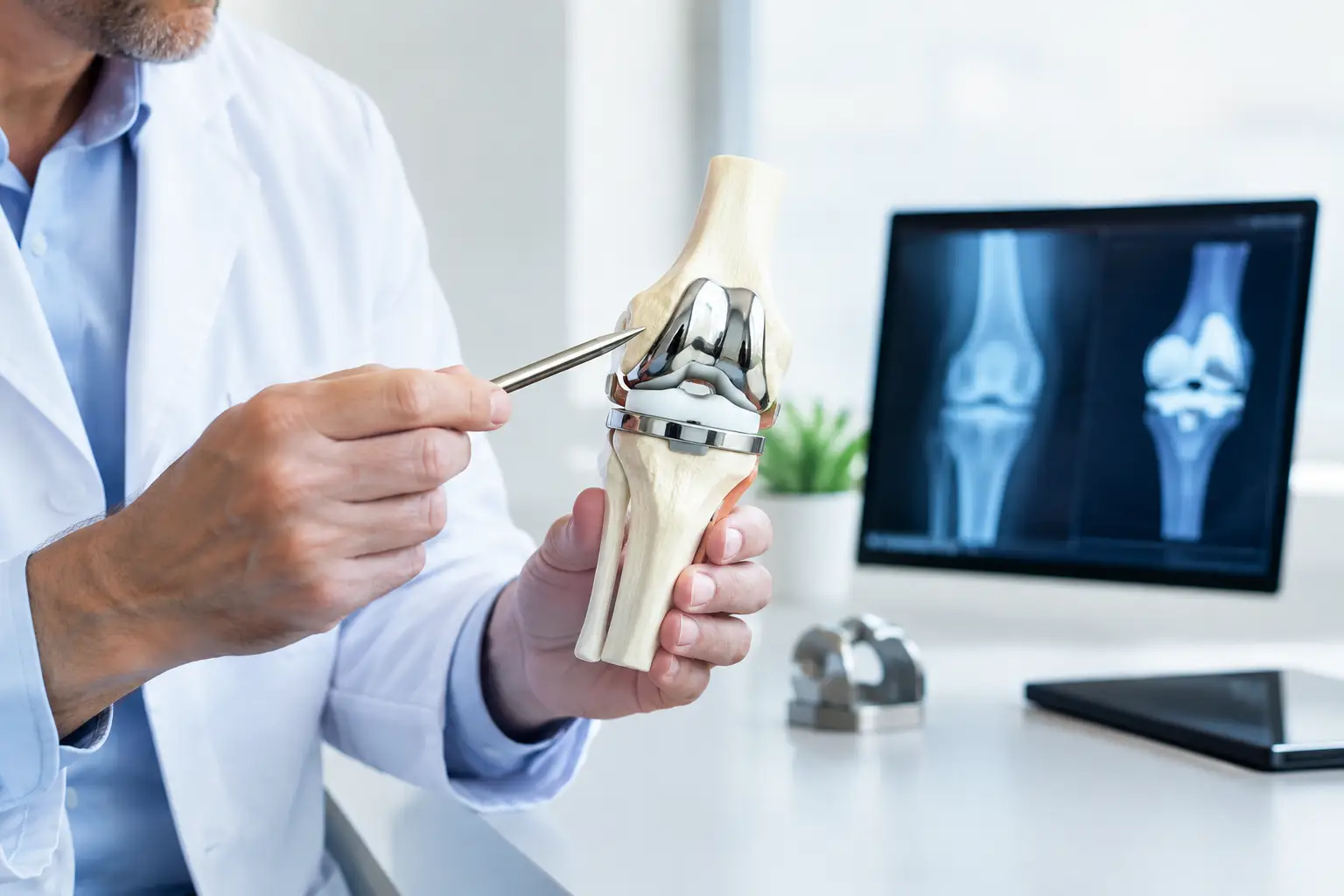
For someone who has started planning their day around painful stairs, avoiding a favourite walk or struggling to get comfortable at night, the future of knee replacement surgery is not an abstract idea. It is about a more precise answer to a personal question: can treatment reduce pain reliably and help me return to the life I want to lead?
Knee replacement has already transformed the lives of many people with severe arthritis and joint damage. The next advances are unlikely to be one dramatic change. More often, they involve better planning, more accurate surgical execution, improved understanding of recovery and closer attention to what matters to each individual patient. Technology can support these aims, but it does not replace careful diagnosis, surgical judgement or a well-managed rehabilitation plan.
The future of knee replacement surgery is more personal
A knee replacement is not simply a matter of fitting an implant. Every patient has a different pattern of arthritis, leg alignment, bone shape, ligament stability, activity level and expectation of recovery. A retired walker, a parent who needs to manage a busy household and someone hoping to remain comfortable at work may all define a good outcome differently.
Future care is increasingly centred on matching the treatment to these differences. For some patients, a partial knee replacement may be appropriate when arthritis is confined to one part of the joint and the remaining structures are healthy. Others will need a total knee replacement because disease affects more than one compartment of the knee. In complex cases, including a previously replaced knee that has become painful or unstable, revision surgery requires particularly detailed planning.
The important point is that personalisation should begin before the operation. It includes confirming the true source of pain, reviewing previous treatment, considering non-operative options where appropriate and deciding whether surgery is likely to offer a meaningful improvement. A sophisticated surgical plan is of little value if knee replacement is not the right intervention in the first place.
Better imaging and planning before surgery
Modern pre-operative planning is becoming more detailed. Standard X-rays remain essential for showing arthritis, joint space loss and alignment. In selected cases, CT scans and other imaging can add useful information about bone anatomy, previous implants or deformity.
Digital planning software allows the surgeon to assess limb alignment, estimate implant size and anticipate technical challenges before entering theatre. This can be especially valuable for patients with substantial deformity, retained metalwork, previous fractures or a failed earlier knee replacement.
Patient-specific instrumentation and custom planning may also be considered in certain circumstances. These approaches use imaging data to help tailor guides or plans to the individual knee. They are not necessary for every patient, and they do not guarantee a better result by themselves. Their value depends on the clinical problem, the quality of the plan and the experience of the surgical team using them.
There are trade-offs to discuss openly. Additional scans can involve cost and, in the case of CT, radiation exposure. More data is only helpful when it changes decision-making or improves precision in a meaningful way.
Robotics and navigation: useful tools, not automatic answers
Robotic-assisted and computer-navigated knee replacement are likely to become more widely available. These systems can help a surgeon measure bone cuts, assess soft-tissue balance and execute a pre-operative plan with a high degree of accuracy.
That precision is promising because small differences in component position, alignment and ligament balance can affect how a knee feels and functions. However, accuracy on a computer screen is not the same as a guaranteed pain-free knee. Recovery is influenced by many factors, including muscle strength, stiffness, wound healing, medical health, expectations and the way the brain processes pain.
The strongest approach is to see technology as an adjunct to specialist care. It can provide useful measurements and consistency, while the surgeon remains responsible for interpreting the findings, adapting safely to what is seen during surgery and making decisions that suit the patient rather than the machine.
Implants designed for longevity and function
Knee implants have evolved considerably, with durable metal components and highly wear-resistant plastic bearings forming the basis of modern replacements. Ongoing research focuses on materials, surface coatings and implant designs that may reduce wear, improve fixation to bone and preserve function over a longer period.
This matters because people are having knee replacement at a wider range of ages and often expect to remain active afterwards. While no implant lasts forever, well-performed knee replacement can provide durable relief for many years. The aim is not merely an implant that looks good on an X-ray. It is a stable, comfortable knee that supports everyday activities safely.
New implant designs must be judged carefully. A promising feature is not necessarily a proven long-term advantage. The best choice is usually one supported by reliable clinical evidence, appropriate for the patient’s anatomy and used by a surgeon familiar with its strengths and limitations.
Recovery will become more proactive
The operation is only one part of knee replacement treatment. The future of care also lies in helping patients arrive at surgery in the best possible condition and making recovery more predictable afterwards.
Prehabilitation can include strengthening the thigh and hip muscles, improving knee movement where possible, addressing nutrition, stopping smoking and optimising medical conditions such as diabetes. These steps cannot remove severe arthritis, but they can improve readiness for surgery and support rehabilitation.
After surgery, enhanced recovery pathways are designed to control pain effectively, encourage safe early movement and reduce unnecessary time in hospital. Anaesthetic techniques, local pain relief around the joint and carefully selected medicines can reduce reliance on strong opioids for many patients. This is particularly valuable because opioid medication can cause nausea, constipation, drowsiness and dependence.
Digital follow-up tools may make it easier to monitor progress between appointments. Patients can record pain levels, movement, walking tolerance and wound concerns from home, allowing the clinical team to identify those who need earlier review. This can be helpful for patients in London, Kent and the wider South East, but remote monitoring should complement rather than replace direct access to clinical advice when something does not feel right.
Rehabilitation needs to fit real life
There is no single timetable that suits everyone. Some people make rapid gains in the first weeks; others need longer to overcome swelling, regain bend or rebuild confidence. The best rehabilitation plans have clear goals but remain flexible enough to respond to the individual.
Physiotherapy is not about forcing the knee through pain at any cost. It is about gradually restoring extension, bend, strength, balance and walking ability while protecting healing tissues. A patient who understands what is expected at each stage is more likely to recognise normal post-operative discomfort, stay engaged with rehabilitation and seek help promptly if recovery is not progressing as it should.
Earlier intervention may prevent unnecessary surgery
An encouraging part of the future is better care before knee replacement is needed. Weight management, targeted physiotherapy, activity modification, bracing and appropriate injections may help some people manage symptoms and delay surgery. Treatments such as steroid injections, hyaluronic acid, platelet-rich plasma and Arthrosamid can have a role for selected patients, depending on their diagnosis and the severity of joint disease.
These options should not be presented as cures for advanced bone-on-bone arthritis. Equally, knee replacement should not be treated as the only answer to every painful knee. A thorough assessment helps distinguish arthritis from meniscal problems, tendon conditions, referred pain and other causes that require a different approach.
When surgery is needed, timing matters. Waiting until mobility has declined severely can make strength and confidence harder to restore. Having surgery too early, before symptoms are genuinely limiting daily life and non-operative options have been considered, may also be unwise. The right time is when the balance of likely benefit, risk and personal impact supports the decision.
What will not change
Even as techniques develop, the foundations of successful knee replacement will remain the same: an accurate diagnosis, an honest discussion of likely outcomes and risks, meticulous surgery, prevention of infection and blood clots, and committed rehabilitation.
Patients should feel able to ask what technology is being recommended, why it is suitable for their knee and what evidence supports it. They should also receive a realistic explanation of recovery. Most people experience major pain relief and improved mobility after knee replacement, but an artificial knee does not feel exactly like the natural joint, and full recovery takes time.
The most valuable advances will be those that make treatment safer, more tailored and more dependable without losing sight of the person behind the X-ray. A careful consultation with a specialist knee surgeon can turn the idea of future progress into a clear, practical plan for moving forward with confidence.