

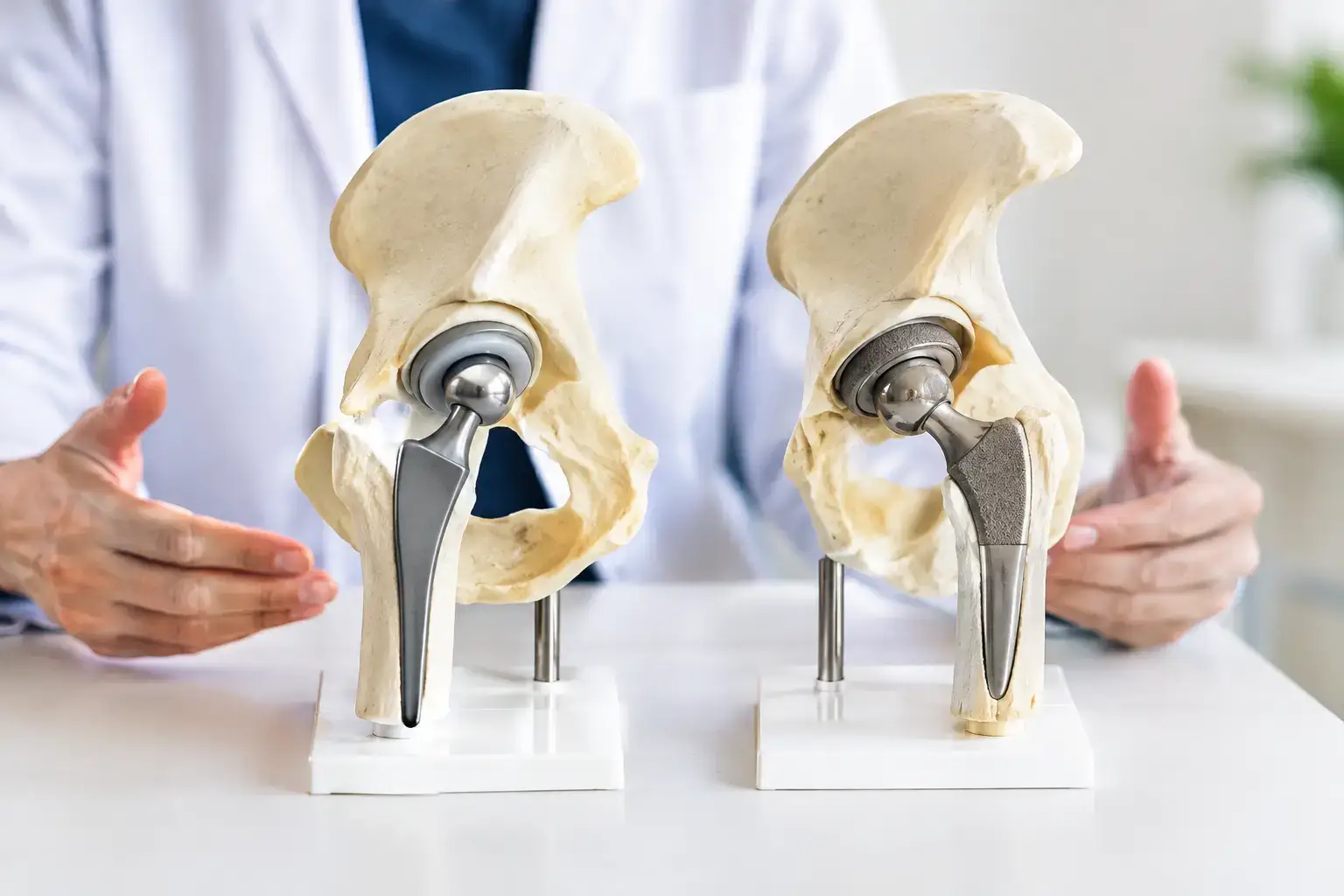
For someone living with persistent hip pain, the question of anterior versus posterior hip replacement can feel like the deciding factor in a major life-changing operation. It is a worthwhile question, but the best approach is not simply the one that promises the quickest recovery or has the most attention online. It is the approach that suits your hip anatomy, overall health, diagnosis and surgeon’s experience, with a clear plan for a safe, durable result.
A total hip replacement replaces the damaged ball-and-socket joint with implants designed to relieve pain and restore movement. Both anterior and posterior approaches can achieve excellent long-term outcomes. The difference lies in the route used to reach the joint, the soft tissues encountered during surgery and, in some cases, the early stages of recovery.
Anterior versus posterior hip replacement: the essential difference
The anterior approach reaches the hip from the front. It uses a plane between muscles rather than routinely splitting the major muscles around the hip. The posterior approach reaches the hip from the back, passing through the tissues at the rear of the joint. It is the most established and widely used approach for total hip replacement.
Neither approach changes the fundamental purpose of surgery: removing worn joint surfaces, positioning the replacement accurately and helping you return to daily life with less pain and better mobility. The quality of planning, implant positioning, infection prevention, soft-tissue management and rehabilitation matter at least as much as the direction of the incision.
It is also worth separating the surgical approach from the size of the scar. A smaller incision is not automatically a less invasive operation, nor does it guarantee an easier recovery. A well-executed procedure that provides the surgeon with appropriate visibility and control is the priority.
The anterior approach
During an anterior hip replacement, the patient is usually positioned on their back. This can allow the surgeon to compare leg lengths and assess the position of the components during the operation. X-ray imaging may also be used where appropriate to support accurate implant placement.
Because the route is between particular muscle groups, some patients experience less early discomfort around the back of the hip and may find certain movements easier in the first weeks after surgery. Early mobility is often encouraged after either approach, sometimes on the day of surgery, provided it is safe to do so.
There are, however, specific considerations. The anterior approach can be technically demanding, particularly in patients with more complex anatomy, significant stiffness, previous surgery, severe deformity or a higher body weight. There is a small risk of irritation or altered sensation in the skin over the outer thigh, caused by stretching of a sensory nerve near the incision. This usually improves, but can occasionally persist.
The approach may also involve different risks to the thigh bone and surrounding soft tissues during component insertion. These risks are not reasons to avoid the operation when it is appropriate. They are reasons to ensure the approach is selected and performed by a surgeon with relevant experience.
The posterior approach
The posterior approach gives the surgeon excellent access to the hip joint and is highly versatile. It has a long record of reliable results across routine, complex and revision hip replacement surgery. It can be particularly useful where exposure is more challenging, such as in a very stiff hip, after previous operations or when reconstructive work is required.
To reach the joint, the surgeon works through tissues at the back of the hip, including the short external rotator muscles. At the end of surgery, these tissues and the joint capsule are carefully repaired. Modern posterior techniques, combined with accurate component positioning and larger or more stable bearing options where suitable, have substantially improved stability.
Historically, posterior hip replacement was associated with a higher concern about dislocation, when the ball comes out of the socket. Dislocation remains an uncommon but recognised complication after any total hip replacement. Individual risk depends on many factors, including implant position, muscle strength, spinal stiffness, neurological conditions, previous surgery and whether the operation is a first replacement or a revision.
Some patients are asked to avoid particular positions for a period after a posterior approach, such as deep bending combined with twisting. Restrictions vary between surgeons and patients. They should be specific to your operation and risk profile rather than treated as a one-size-fits-all rule.
Is recovery faster after an anterior hip replacement?
For some people, the anterior approach may offer an advantage in the first few weeks. They may be more comfortable getting in and out of bed, walking or resuming everyday movements sooner. However, this early difference often narrows over the following months.
By three to 12 months, studies generally show that both approaches can deliver similarly strong improvements in pain, walking ability and quality of life when surgery and rehabilitation have gone well. A hip replacement is not judged only by how you feel in the first fortnight. It should support years of confident movement.
Recovery is influenced by much more than the incision. Your fitness before surgery, the severity of arthritis, muscle strength, other medical conditions, pain control, sleep, home support and commitment to physiotherapy all play a part. A patient who has become very limited by pain may need more time to rebuild strength regardless of the approach used.
Most people use walking aids initially and progress steadily with guidance from their clinical team. Returning to driving, work, golf, cycling or longer walks depends on the individual and the demands of the activity. Pushing too hard too early can cause unnecessary swelling and fatigue, while doing too little can slow the return of strength and confidence.
How a specialist chooses the right approach
The right question is usually not, “Which approach is best?” It is, “Which approach is best for me, and why?” A thoughtful recommendation begins with an assessment of the whole patient rather than a preference for one technique.
Your surgeon will consider the pattern and severity of hip damage, leg length, hip shape, range of movement, bone quality and scans or X-rays. They will also discuss previous surgery, spinal problems, medical conditions, medications, work and the activities you most want to return to.
For straightforward arthritis in a first-time hip replacement, both anterior and posterior approaches may be suitable. In complex cases, including deformity, previous fracture surgery, infection treatment or failed hip replacement, the approach may be influenced by the need to safely remove old components, address bone loss or reconstruct the joint. In those circumstances, reliable exposure and precise reconstruction take precedence over a fashionable label.
A fellowship-trained hip specialist should be comfortable explaining not only the benefits of their recommended approach, but also its limitations and alternatives. Honest advice includes recognising when non-operative treatments remain appropriate and when hip replacement is likely to offer the most meaningful improvement.
Questions worth asking at your consultation
It is reasonable to ask which approach is being recommended, how often your surgeon performs it and why it suits your circumstances. You may also wish to discuss the expected recovery milestones, whether you will have movement precautions, the plan for pain relief and physiotherapy, and the specific complications relevant to you.
Ask how implant position and leg length will be planned, especially if one leg already feels shorter or if you have a spinal condition. If you have had previous hip surgery or are considering revision surgery, ask how this changes the operative plan and likely recovery.
The aim is not to memorise surgical terminology. It is to leave the consultation understanding the reasoning behind the recommendation, what your rehabilitation will involve and what a successful outcome means for your life.
Focus on the outcome that matters to you
Anterior and posterior hip replacement are both established ways to perform a highly successful operation. The most suitable choice balances surgical access, stability, anatomy, safety and the expertise required for your particular hip. It should never be based on marketing claims alone.
If hip pain is limiting sleep, work, exercise or the independence you value, a specialist assessment can bring clarity. The most reassuring plan is one that is carefully tailored, openly explained and focused on helping you move forward with confidence.
Whichever approach suits your hip, I explain how I plan and carry out the operation itself on my total hip replacement page.