

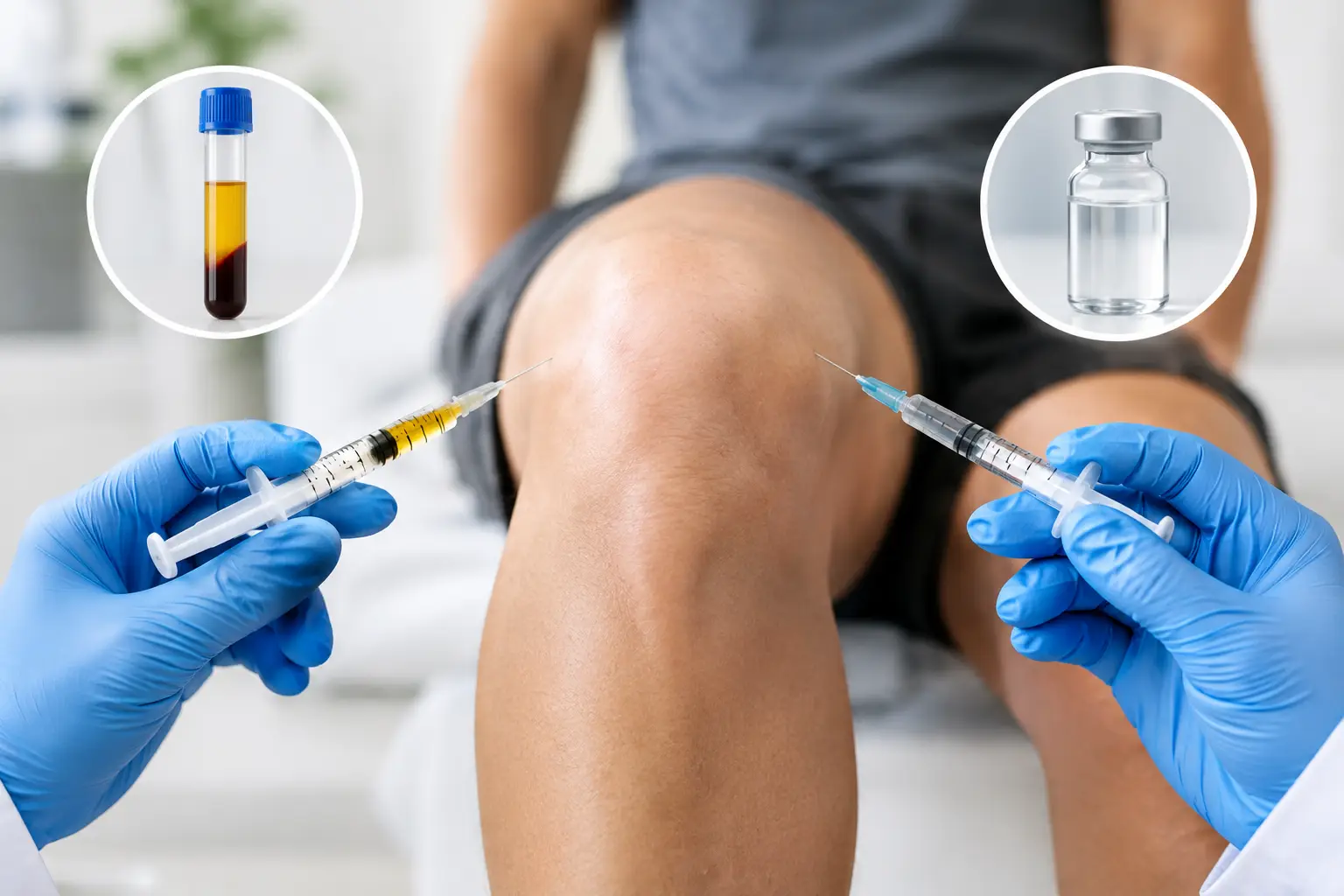
A painful knee can make a short walk, a flight of stairs or time with grandchildren feel disproportionately difficult. When physiotherapy, activity modification and simple pain relief have not provided enough progress, PRP versus hyaluronic acid injections is a question many patients ask. Both treatments may have a role in managing knee symptoms, but they work differently, suit different circumstances and cannot reliably reverse advanced joint damage.
The right choice starts with an accurate diagnosis. Knee pain may arise from osteoarthritis, a meniscal injury, tendon problems, inflammation or a combination of issues. The appearance of an X-ray or MRI matters, but so do your symptoms, movement, activity goals and previous treatment. An injection should be part of a considered plan, not a substitute for understanding why the knee hurts.
PRP versus hyaluronic acid injections: the key difference
Platelet-rich plasma, usually called PRP, is made from a small sample of your own blood. The blood is processed to concentrate platelets, then the resulting plasma is injected into the area being treated. Platelets contain signalling proteins involved in the body’s normal healing response. In the knee, PRP is used with the aim of reducing inflammation and improving symptoms in selected patients.
Hyaluronic acid is a naturally occurring substance found in joint fluid. In a healthy joint, it helps the fluid act as a lubricant and shock absorber. Osteoarthritis can alter both the amount and quality of this fluid. A hyaluronic acid injection, sometimes known as viscosupplementation, aims to improve the joint environment and may reduce pain and stiffness.
Neither treatment is a new cartilage lining. Neither can reliably correct substantial bone-on-bone arthritis, a major mechanical deformity or an unstable meniscal tear. They are symptom-management options that can sometimes create a more comfortable window for rehabilitation and valued everyday activity.
When PRP may be considered
PRP is often discussed for people with early to moderate knee osteoarthritis who remain limited despite an appropriate programme of exercise, strength work and activity adjustment. It may also be considered in certain tendon conditions around the knee, although the indication and injection technique are different from treatment for arthritis.
Some patients report a gradual improvement in pain and function over several weeks after PRP. The response is variable. Research suggests that PRP may offer worthwhile symptom improvement for some people with mild to moderate osteoarthritis, but studies use different preparations, doses and treatment schedules. This makes it difficult to promise a particular result or duration of benefit.
PRP is not suitable for everyone. A specialist will consider factors such as active infection, bleeding disorders, platelet disorders, some medications and significant medical conditions. As the injection is prepared from your own blood, allergic reaction is not generally the concern it can be with some other injected products. However, it still involves a needle procedure and carries risks including temporary pain, swelling, bruising, bleeding and, rarely, infection.
Following PRP, the knee can feel more uncomfortable for several days. This short-term inflammatory response does not necessarily mean the treatment has failed. You will be given individual advice about activity and pain relief, particularly if anti-inflammatory medicines are part of your usual routine.
When hyaluronic acid may be considered
Hyaluronic acid injections are generally considered for symptomatic knee osteoarthritis, particularly where pain and stiffness are affecting walking, work, exercise or sleep. They can be an option for people who wish to delay surgery where appropriate, cannot tolerate certain medicines or have not gained sufficient relief from more conservative measures.
The treatment is usually straightforward and recovery is often quick. Some people notice a benefit within days, while for others improvement is more gradual. When it works, relief may last for several months, although there is no fixed timeframe and some patients gain little benefit.
The evidence for hyaluronic acid is mixed, which is why recommendations vary between clinical guidelines. This does not mean it never helps. It means the likely benefit should be discussed honestly in the context of your knee, rather than presented as a universal answer. It may be less likely to provide meaningful relief in a severely worn joint with substantial deformity or persistent mechanical symptoms.
Temporary soreness or swelling after the injection can occur. Rarely, a more significant inflammatory reaction can develop. Infection is uncommon but serious, and patients should seek prompt medical advice if they develop increasing pain, marked swelling, redness, fever or feel unwell after an injection.
Which injection is better for knee arthritis?
There is no single best injection for every painful knee. PRP may be a reasonable consideration for an active patient with early or moderate osteoarthritis who is looking for a biological treatment and understands that the evidence and response are variable. Hyaluronic acid may suit someone seeking lubrication-based symptom relief, particularly when the main issue is stiffness and aching related to osteoarthritis.
Cost, convenience and treatment goals also matter. PRP requires blood to be taken and processed, and a course may involve more than one injection depending on the agreed protocol. Hyaluronic acid products and schedules vary too. These details should be transparent before treatment, alongside a realistic discussion of what the injection can and cannot achieve.
A useful question is not simply, “Which injection is strongest?” It is, “What problem are we trying to solve?” If the aim is to settle symptoms enough to rebuild quadriceps strength, return to walking or manage an important period at work, an injection may be helpful. If pain is caused by advanced arthritis and daily life remains severely restricted despite well-delivered non-operative care, it may be more valuable to discuss whether joint replacement offers a more durable path back to function.
The assessment matters as much as the injection
Before recommending PRP or hyaluronic acid, a hip and knee specialist should take a careful history, examine the knee and review suitable imaging. Symptoms such as locking, repeated giving way, a sudden swollen knee or pain after significant trauma may point towards a problem that needs a different approach.
The injection itself should be delivered with careful attention to diagnosis, anatomy and safety. In some circumstances, ultrasound guidance can help confirm accurate placement. For a swollen knee, removing excess fluid may be considered before an injection, depending on the clinical situation. If there is concern about infection or an inflammatory arthritis, this must be investigated rather than treated as routine osteoarthritis.
The best results are usually supported by what happens around the procedure. Targeted physiotherapy can improve strength and control around the knee. Weight management, where relevant, can reduce load through the joint. Adjusting high-impact activity temporarily may settle symptoms without forcing you to stop moving altogether. A well-chosen injection can support this work, but it rarely replaces it.
What to expect after treatment
Most patients can return home on the same day. It is sensible to arrange a lift if the knee is painful or if you are uncertain how comfortable you will be afterwards. Avoid strenuous exercise for the period advised by your clinician, but gentle movement is often encouraged.
Keep track of your response in practical terms: walking distance, stair use, sleep, ability to work, exercise tolerance and reliance on pain relief. These measures are more meaningful than judging the knee hour by hour. Improvement, if it occurs, is often gradual rather than immediate.
You should contact your treating team promptly if you develop worsening pain beyond expected post-injection soreness, severe swelling, increasing redness, fever, chills or any other concern that suggests infection or an unexpected reaction.
For patients in London and Kent, a specialist consultation can clarify whether PRP, hyaluronic acid, physiotherapy, another injection treatment or surgery is most likely to help. The aim is not simply to choose an injection, but to choose the course of care that gives you the best prospect of moving with greater comfort and confidence again. I compare these options in the wider context of the injections I offer on my PRP and knee injections page.