


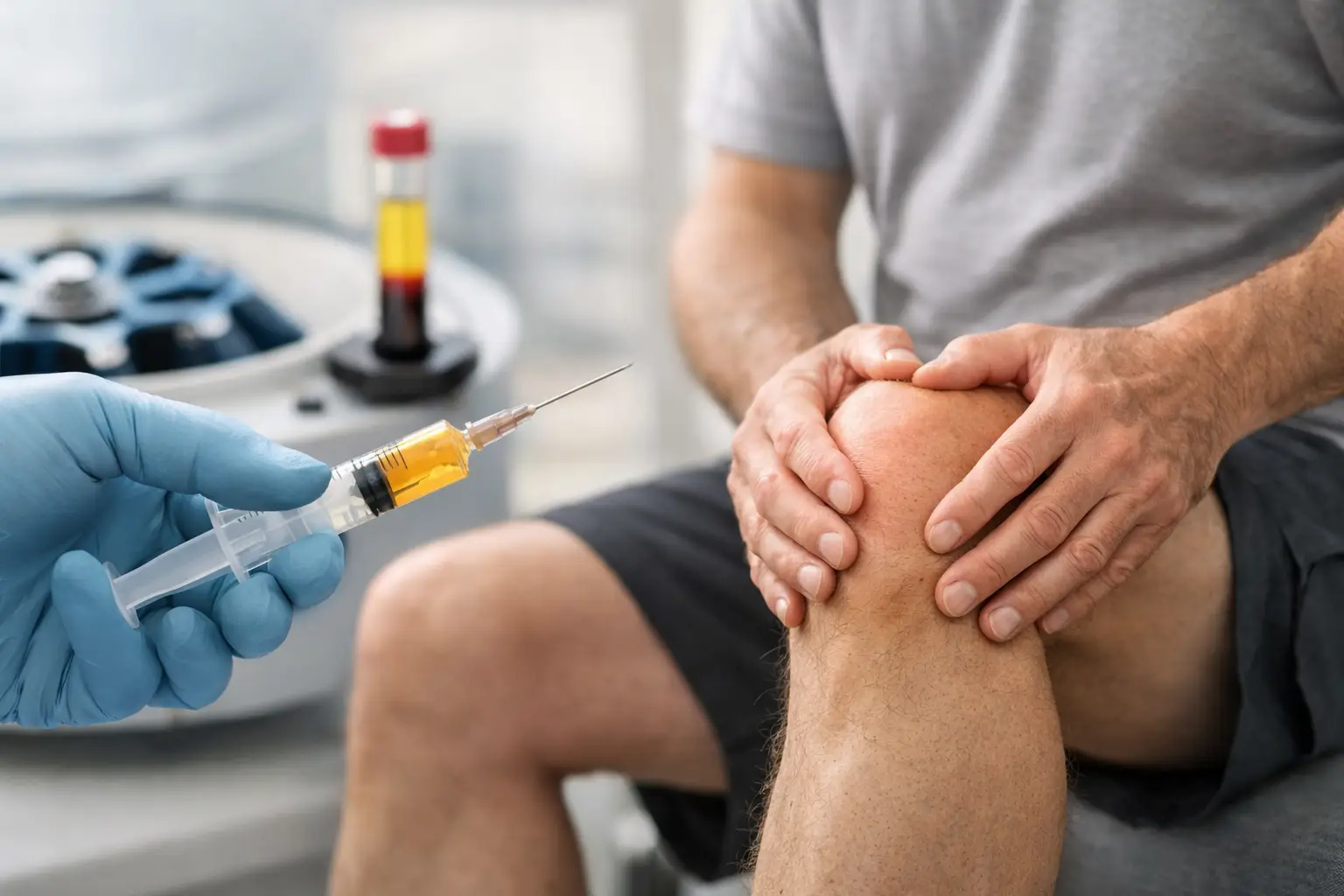
A PRP injection is often presented as a way to use the body’s own healing signals to settle joint pain. But does PRP work when your knee is painful on stairs, stiff after sitting, or limiting the walking, exercise and everyday activities you value? The honest answer is that it can help some patients, particularly those with certain forms of knee arthritis or tendon-related pain, but it is not a cure-all and it is not the right treatment for every painful joint.
The most useful starting point is an accurate diagnosis. Knee pain may come from osteoarthritis, a meniscal tear, tendon irritation, instability, inflammation or a combination of problems. Each requires a different discussion about the most appropriate route back to comfortable movement.
What PRP treatment involves
PRP stands for platelet-rich plasma. Platelets are components of your blood involved in clotting and tissue signalling. During treatment, a small sample of your blood is taken and processed in a centrifuge to separate plasma containing a higher concentration of platelets. This preparation is then injected into the area being treated, commonly the knee joint.
The intention is not simply to place blood into a joint. Platelets release proteins known as growth factors, which may influence inflammation and the biological environment around injured or degenerative tissue. In practical terms, PRP aims to reduce symptoms and support function. It should not be described as regrowing a severely worn joint surface or reversing established arthritis.
Preparation methods differ between clinics. Platelet concentration, the presence of white blood cells and the number and timing of injections can all vary. This is one reason results from research studies – and from person to person – are not identical.
Does PRP work for knee arthritis?
For mild to moderate knee osteoarthritis, research suggests PRP can provide meaningful pain relief and improved function for some patients. In comparative studies, it has often performed as well as or better than hyaluronic acid injections over several months, and some evidence suggests a benefit over placebo injections. However, the quality of studies varies, so treatment should be recommended with appropriate caution rather than promises.
The people most likely to consider PRP are usually those with persistent symptoms despite sensible first-line care, but who do not yet need joint replacement. They may have early or moderate arthritic change, recurrent swelling, aching with activity or difficulty returning to lower-impact exercise. A course may be particularly useful where pain is preventing effective rehabilitation work to strengthen the quadriceps and improve knee control.
Response is less predictable in advanced, bone-on-bone arthritis. If the joint is substantially deformed, very stiff, unstable or painful at rest and at night, an injection may offer limited or short-lived relief. In this situation, continuing to repeat treatments that do not change day-to-day function can delay a more effective solution, such as joint replacement.
PRP may also be used for certain tendon conditions around the knee, although the evidence and injection technique differ from treatment for arthritis. A tendon problem should not be assumed simply because pain is felt near the kneecap or on the inner side of the knee. Examination and, where appropriate, imaging help establish the source of the symptoms.
What PRP cannot reliably do
PRP does not repair a displaced meniscal tear, correct a knee that repeatedly gives way, remove loose fragments from a joint or straighten a significant deformity. It will not make a badly damaged joint structurally normal. If there is true locking, a sudden loss of movement, marked swelling after injury, fever or an inability to bear weight, prompt medical assessment is more appropriate than arranging an injection.
For hip pain, careful diagnosis is equally important. Pain felt in the hip or groin can arise from the hip joint, lower back, tendons or surrounding soft tissues. Evidence for PRP in hip arthritis is less established than many patients expect, so the proposed benefit should be considered against the diagnosis, scan findings and available alternatives.
Who may be a suitable candidate?
A specialist assessment considers more than an X-ray report. Your pattern of pain, walking distance, range of movement, work demands, sporting aims, previous injections and general health all matter. Someone hoping to manage a mild arthritic knee well enough for a walking holiday has different priorities from someone unable to sleep because of constant pain.
PRP is usually considered after a structured discussion about activity modification, weight management where relevant, pain relief and targeted physiotherapy. These measures are not a lesser alternative to an injection. They remain central to improving joint strength, confidence and long-term function, whether or not PRP is used.
It may not be suitable for everyone. Active infection, certain blood or platelet disorders, some medications that affect clotting, and uncontrolled medical conditions may alter the balance of risk. Your clinician should also ask about anticoagulants and anti-inflammatory medicines before treatment. Do not stop prescribed medication without advice from the doctor managing it.
PRP compared with other knee injections
There is no single ‘best’ injection for every knee. Steroid injections can reduce inflammation and may give relatively quick relief, particularly where there is a flare of pain and swelling. Their effect is often temporary, and repeated use needs to be considered carefully.
Hyaluronic acid is designed to improve the lubricating properties of joint fluid. Some people find it helpful, while others do not notice a worthwhile difference. PRP is a biological treatment intended to modify the joint environment rather than provide lubrication alone, but it also has variable results and is usually self-funded.
For selected patients, other non-operative options may be discussed. When arthritis is advanced and has a major effect on independence, sleep and quality of life, a partial or total knee replacement may provide a more durable improvement than repeated injections. The right decision is not about avoiding surgery at all costs. It is about choosing treatment proportionate to the condition and your goals.
What to expect after a PRP injection
The appointment begins with confirmation of the diagnosis and consent. Blood is taken, processed and injected using a sterile technique. Depending on the area being treated and the clinical circumstances, imaging guidance may be used to improve precision.
It is common to experience temporary soreness or a flare in symptoms for a few days afterwards. This does not automatically mean the injection has failed. Relative rest is normally advised initially, followed by a gradual return to normal activity and a rehabilitation plan. High-impact sport or strenuous training should not be resumed immediately simply because the injection itself was quick.
Improvement, when it occurs, is usually gradual rather than immediate. Some patients notice a change within a few weeks; for others it takes longer. Benefit may last months, but there is no guaranteed duration. A clinician may recommend one injection or a planned course, based on the condition, the preparation used and your response.
Safety, limitations and realistic expectations
Because PRP is made from your own blood, allergy is unlikely. Nevertheless, every injection carries small risks, including pain, bruising, bleeding, infection and a temporary inflammatory flare. These risks should be discussed clearly before proceeding.
The larger limitation is uncertainty of outcome. A well-delivered PRP injection cannot overcome an incorrect diagnosis, a mechanical problem requiring reconstruction or arthritis that has reached the point where the joint is no longer functioning satisfactorily. Equally, a scan showing arthritis does not dictate that surgery is the only answer. Symptoms, function and the response to appropriate non-operative care should guide the decision.
A worthwhile consultation should leave you clear about what PRP is intended to achieve, how success will be measured and what the next step would be if it does not help. For some people, reduced pain on stairs and a return to regular walking is a successful outcome. For others, the goal may be to postpone surgery while maintaining an active life. Those are valid aims, provided expectations are realistic.
The best treatment plan is the one that fits the cause of your pain and the life you want to return to. If PRP is being considered, seek advice from a hip and knee specialist who can assess the full range of non-operative and surgical options, rather than treating an injection as the answer before the problem has been properly defined.