


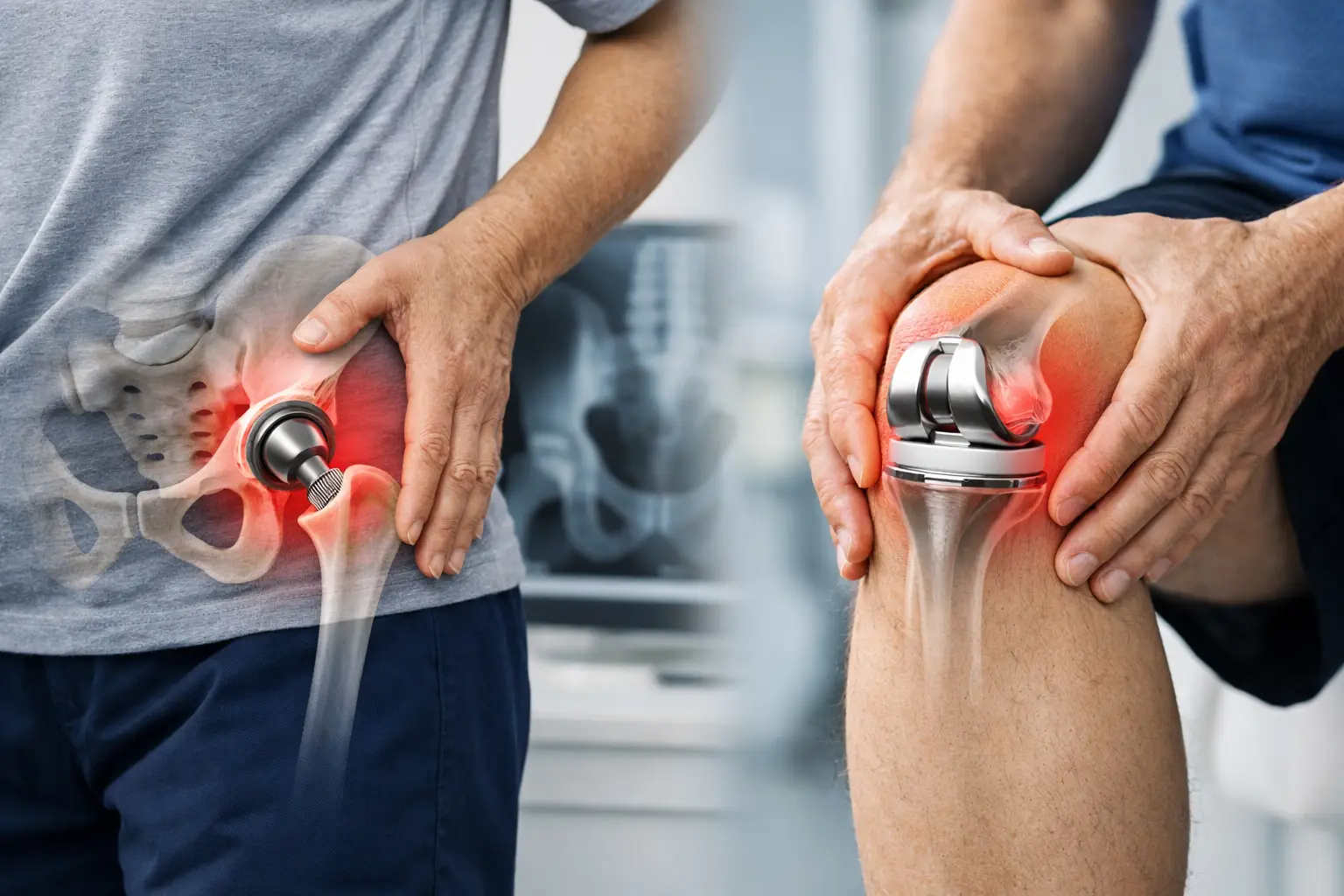
A hip or knee replacement is designed to reduce pain and restore dependable movement for many years. When discomfort returns after an initially successful operation, patients understandably worry about implant loosening. It can be a significant cause of pain after joint replacement, but it is not the only explanation – and a careful specialist assessment is the right place to start.
Loosening does not necessarily mean an implant has suddenly moved or that urgent surgery is always required. The pattern of symptoms, the timing, imaging findings and the condition of the surrounding bone all matter. A clear diagnosis helps determine whether monitoring, non-operative treatment or revision joint replacement offers the best route back to comfortable, confident movement.
What is implant loosening?
Hip and knee replacements rely on secure fixation between the implant and the bone. Depending on the type of replacement, this may be achieved with bone cement or through bone growing on to a specially prepared implant surface. Implant loosening occurs when that secure connection is lost or becomes insufficient.
As the implant moves very slightly against the bone, it may cause inflammation, pain and further loss of bone around the joint. In some people, this develops gradually over many years. In others, it may follow infection, a fracture around the implant, trauma or another problem affecting the replacement.
A loose implant is different from normal early post-operative discomfort. Most people have some pain, swelling and stiffness while recovering from surgery, particularly in the first weeks and months. Symptoms that persist, worsen after initial improvement, or develop years later should be assessed rather than simply accepted as part of ageing.
Signs of implant loosening in the hip or knee
The symptoms can vary according to the joint involved, the type of implant and the underlying cause. Pain is the most common feature. In the hip, this may be felt in the groin, thigh or buttock, often when standing, walking or putting weight through the leg. In the knee, pain may be felt around the joint, with a sense that it cannot be trusted during everyday activities.
Some patients describe increasing stiffness, reduced walking distance, a limp, clicking or a feeling of instability. Activities that were previously manageable – getting up from a chair, climbing stairs, walking the dog or returning to work – may become progressively harder. Occasionally, there may be swelling or pain at rest.
These symptoms do not automatically confirm loosening. Tendon irritation, spinal pain, wear of the bearing surface, instability, scar tissue, infection and pain from elsewhere in the limb can create similar problems. This is why it is vital not to make decisions from symptoms or an X-ray alone.
When to seek urgent advice
A sudden inability to bear weight, a new deformity, severe pain after a fall, wound leakage, fever, increasing redness or rapidly worsening swelling requires prompt medical assessment. These symptoms can indicate a fracture, dislocation or infection and should not wait for a routine appointment.
Why does a joint replacement loosen?
One cause is mechanical wear over time. Tiny particles may be released from some bearing surfaces as a replacement is used. The body can react to these particles, leading to bone loss around the implant, known as osteolysis. As bone support reduces, fixation can weaken.
The quality and quantity of bone also matter. Osteoporosis, previous surgery, significant deformity and complex anatomy can make fixation more challenging. Implant position, joint stability and the forces placed through the joint influence how well a replacement performs over the long term.
Infection must always be considered. A low-grade infection around a joint replacement can present subtly, sometimes as persistent pain or gradual loosening without obvious fever or wound problems. It requires a different treatment plan from aseptic loosening, meaning loosening not caused by infection. Identifying the cause before any revision operation is one of the most important steps in achieving a durable result.
It is understandable to wonder whether normal activity has caused the problem. Most patients should not blame themselves. Walking, exercise and everyday use are encouraged after a successful replacement. While higher-impact activity may not suit every implant or patient, loosening is usually influenced by several factors rather than one movement or decision.
How implant loosening is diagnosed
A specialist consultation begins with listening carefully to the story of your replacement. The date and type of surgery, how long it worked well, the precise location of pain, any change in function and any recent illness or injury can all provide useful clues.
Examination assesses gait, range of movement, leg length, joint stability, muscle strength and areas of tenderness. Standard X-rays are often the first investigation, allowing comparison with previous images where available. They may show changes in implant position, gaps around the implant, bone loss or other signs of loosening.
Further imaging, such as CT scanning or specialised nuclear medicine imaging, may be helpful in selected cases. Blood tests can look for signs of infection or inflammation. If infection is suspected, an aspiration may be recommended, where fluid is taken from the joint for laboratory testing. No single test answers every question, so the findings must be interpreted together.
This detailed approach is particularly valuable for patients who have had previous joint surgery. Revision hip and knee replacement can be more complex than primary replacement, and sound planning before surgery helps protect bone, address the true cause of pain and select the most appropriate implants.
Treatment depends on the cause and its effect on you
If imaging shows minor changes but pain is limited and the implant remains stable, monitoring may be appropriate. This could include regular review, activity guidance, pain relief and targeted physiotherapy to improve strength and control around the joint. The right plan depends on whether symptoms are affecting quality of life and whether there is evidence of progressive bone loss or migration.
When a loose implant is causing substantial pain, instability or damage to the surrounding bone, revision joint replacement is often recommended. During revision surgery, the existing components are removed and the joint is reconstructed with implants designed to achieve stable fixation. Bone graft, augments or more specialised components may be needed where bone has been lost.
Revision surgery is not simply a repeat of the first operation. It demands careful evaluation of the previous implants, bone stock, soft tissues and possible infection. Recovery may take longer than after a primary replacement, particularly when reconstruction has been required. However, for the right patient, it can significantly reduce pain, improve stability and restore the ability to manage valued daily activities.
If infection is present, treatment may involve antibiotics and one or more operations. In some cases, the replacement is revised in a single procedure; in others, it is safer to remove the implant, treat the infection and undertake reconstruction at a later stage. The best approach depends on the organism involved, the condition of the tissues and the individual clinical situation.
Preparing for revision surgery
Good preparation supports a safer operation and smoother recovery. Your surgeon will discuss the expected benefits, limitations and risks in the context of your own health and goals. Optimising conditions such as diabetes, anaemia, nutrition and bone health can make a meaningful difference. Smoking cessation, where relevant, is also strongly encouraged because it supports wound healing and reduces complications.
It is useful to plan practical support at home before surgery. This may include help with meals, shopping, stairs and transport to follow-up appointments. Physiotherapy is central to recovery, but progress is individual. The aim is not to rush milestones; it is to build strength, confidence and safe movement steadily.
Do not ignore a painful replacement
A replacement that becomes painful after a period of good function deserves a considered explanation. Early assessment can identify problems before bone loss becomes more extensive and can also provide reassurance when the implant is stable and another treatable cause is found.
For patients in London and Kent with persistent symptoms after hip or knee replacement, assessment by a fellowship-trained hip and knee specialist can bring clarity to a difficult situation. The next step is simply to have your symptoms heard, your imaging reviewed carefully and your options explained honestly, so you can make a decision with confidence.